Hajj, Arafah, Eid al-Adha, and the Season That Unites the Muslim World
There are days that change the rhythm of the world.
The first ten days of Dhul Hijjah are among them.
They are not simply a spiritual season. They are one of the summits of the Islamic calendar. A sacred convergence where prayer, charity, fasting, pilgrimage, sacrifice, remembrance, discipline, and surrender all meet at once.
And this is why these days are unlike any others.
Because nowhere else in the year do the five pillars of Islam appear together so completely.
The Shahada is renewed through remembrance.
Prayer intensifies.
Charity expands.
Fasting becomes more present.
And millions answer the call of Hajj.
For a brief moment each year, Islam becomes fully visible.
Not as theory.
As movement.
As rhythm.
As civilisation.
The world continues its noise,
but somewhere, the Talbiyah rises.
Feet move toward Makkah.
Hands rise toward Allah ﷻ.
And across the earth,
hearts remember
what they were created for.
Dhul Hijjah: The Twelfth Month of the Islamic Calendar
Its name literally means:
“The Month of Pilgrimage.”
And unlike many sacred moments in Islam that can be lived individually throughout the year, Hajj exists only during this precise season.
Once a year.
During specific days.
In a specific place.
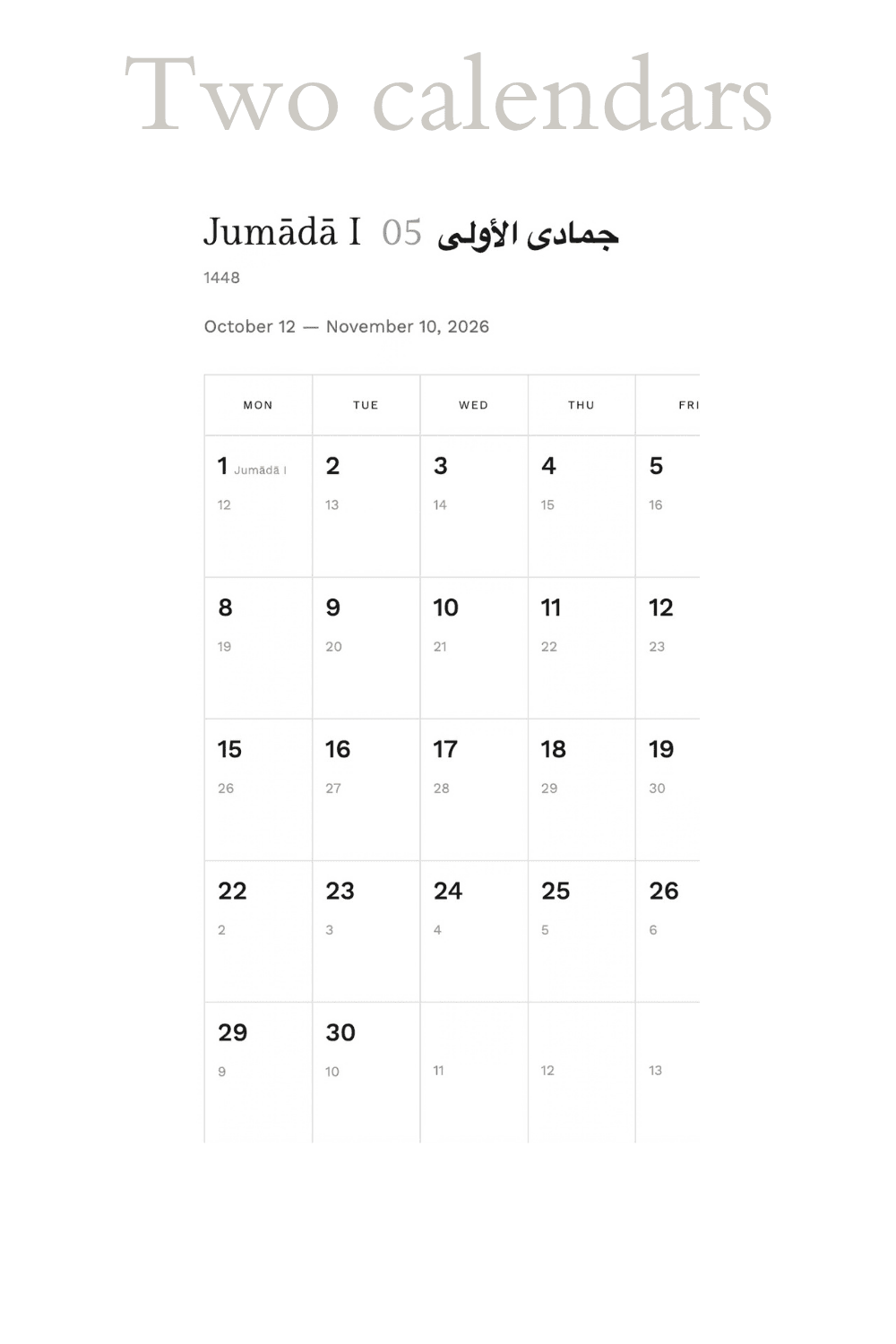
This year, Muslims around the world are living the year 1447 AH (After Hijrah) in the Islamic lunar calendar, a calendar that begins with the migration of Prophet Muhammad ﷺ from Makkah to Madinah, one of the foundational moments of Islamic history.
More than 1.5 to 2 million pilgrims are expected to gather in Saudi Arabia during the days of Hajj, joining one of the largest annual spiritual gatherings on earth.
Languages differ.
Cultures differ.
Histories differ.
But the direction remains one.
The Qur’an and the Sacred Days of Dhul Hijjah
Allah ﷻ says:
“…that they may mention the name of Allah ﷻ on known days…”
Qur’an 22:28
Many scholars explained that these “known days” refer to the first ten days of Dhul Hijjah.
The verse appears in the context of Hajj.
Not isolated worship.
Collective worship.
Movement.
Pilgrimage.
Sacrifice.
Remembrance.
Allah ﷻ also says:
“Hajj is during well-known months…”
Qur’an 2:197
These verses establish Dhul Hijjah not simply as a date on a calendar, but as a sacred season within the architecture of Islam itself.
The Only Time the Five Pillars Unite
Nowhere else in the year do the five pillars of Islam appear together so completely.
During these days:
- The Shahada is renewed through remembrance of Allah ﷻ.
- Prayer intensifies.
- Charity expands through sacrifice and generosity.
- Fasting increases throughout these sacred days, especially on the Day of Arafah.
- And millions perform Hajj.
This is the only season where the entire structure of Islam becomes visible at once.
Not as abstraction.
As reality.
A global movement of worship unfolding across continents.
This is why Dhul Hijjah carries such magnitude.
It is not only a spiritual season.
It is a manifestation of unity.
Hajj: The Return to Essential Humanity
Every year, millions travel to Makkah.
Not to elevate status.
But to erase it.
The garments become simple.
Titles disappear.
Wealth becomes invisible.
Human beings stand equal before Allah ﷻ.
Hajj strips life back to its essential truth:
You came from Allah ﷻ.
And you return to Him.
This is why Hajj remains one of the most powerful acts of collective worship on earth.
It is not tourism.
It is remembrance embodied.
A continuation of the path of Prophet Ibrahim عليه السلام, Hajar عليها السلام, and Prophet Ismail عليه السلام.
A living memory carried across generations.
The Day of Arafah: One of the Greatest Days in Islam
Among these ten days stands the Day of Arafah.
The Prophet Muhammad ﷺ said:
“Fasting the Day of Arafah expiates the sins of the previous year and the coming year.”
Sahih Muslim
One day.
Two years of mercy.
But Arafah is greater than fasting alone.
It is the spiritual summit of Hajj.
Millions stand exposed beneath the sky with no protection except du’a, repentance, and hope in Allah ﷻ.
And perhaps this is one of the deepest lessons of Islam:
The strongest human being is not the one who controls everything.
It is the one who knows how to stand before Allah ﷻ with humility.
Eid al-Adha and the Meaning of Sacrifice
Modern culture often understands sacrifice as loss.
Islam understands sacrifice as alignment.
The story of Prophet Ibrahim عليه السلام teaches humanity that faith sometimes requires releasing attachment in order to return fully to Allah ﷻ.
Not because Allah ﷻ needs sacrifice.
But because the human heart becomes imprisoned by what it refuses to surrender.
Eid al-Adha is therefore not simply ritual slaughter.
It is a reminder:
Faith is trust before comfort.
Submission before ego.
Alignment before desire.
The Two Eids: The Sacred Celebrations of Islam
Islam has two major religious celebrations each year.
The first is Eid al-Fitr, which marks the end of Ramadan after one month of fasting.
The second is Eid al-Adha, which takes place during Dhul Hijjah and coincides with the season of Hajj.
While Eid al-Fitr celebrates gratitude after fasting, Eid al-Adha is centered around sacrifice, generosity, and the legacy of Prophet Ibrahim عليه السلام.
Together, these two Eids structure the spiritual rhythm of the Islamic year:
one linked to purification,
the other to surrender.
The Forgotten Rhythm of Sacred Time
Modern life measures productivity.
Islam measures barakah.
The Islamic calendar was never designed to produce constant sameness. It creates sacred intensities throughout the year.
Jumu’ah.
Ramadan.
Laylat al-Qadr.
Arafah.
The first ten days of Dhul Hijjah.
These moments interrupt distraction.
They remind the believer that time itself belongs to Allah ﷻ.
And perhaps this is why many Muslims feel something different during these days, even before they can explain it.
A slowing.
A softening.
A return.
What To Do During the First Ten Days of Dhul Hijjah
The Prophet Muhammad ﷺ taught that righteous deeds during these days are deeply beloved to Allah ﷻ.
These days are an opportunity to realign the soul through simple but intentional acts:
- Increase dhikr and Takbir.
- Fast as much as you can during these ten days, especially on the Day of Arafah.
- Read Qur’an daily.
- Wake before Fajr.
- Give sadaqah generously.
- Protect your tongue.
- Make sincere du’a.
- Strengthen family ties.
- Pray with greater presence.
Islam is not only built through extraordinary acts.
It is built through repeated sincerity.
Dhul Hijjah and the Living Civilization of Islam
The first ten days of Dhul Hijjah reveal something profound about Islam:
It is not merely a religion of isolated rituals.
It is a complete civilizational rhythm.
A faith capable of organizing worship, movement, economics, sacrifice, memory, pilgrimage, and collective identity around the remembrance of Allah ﷻ.
And every year, these days return to remind humanity of that forgotten harmony.
Not all systems teach human beings how to reconnect with the sacred.
Islam does.
Return to the Source
The first ten days of Dhul Hijjah are not simply dates on a calendar.
They are an invitation.
To return to sincerity.
To return to discipline.
To return to remembrance.
To return to Allah ﷻ.
Because in a fragmented world, these sacred days remind us that unity still exists.
One qiblah.
One pilgrimage.
One Ummah.
One Creator.
And perhaps this is why these days feel so powerful.
For a brief moment every year, the noise of the world weakens.
And the soul remembers what it was created for.