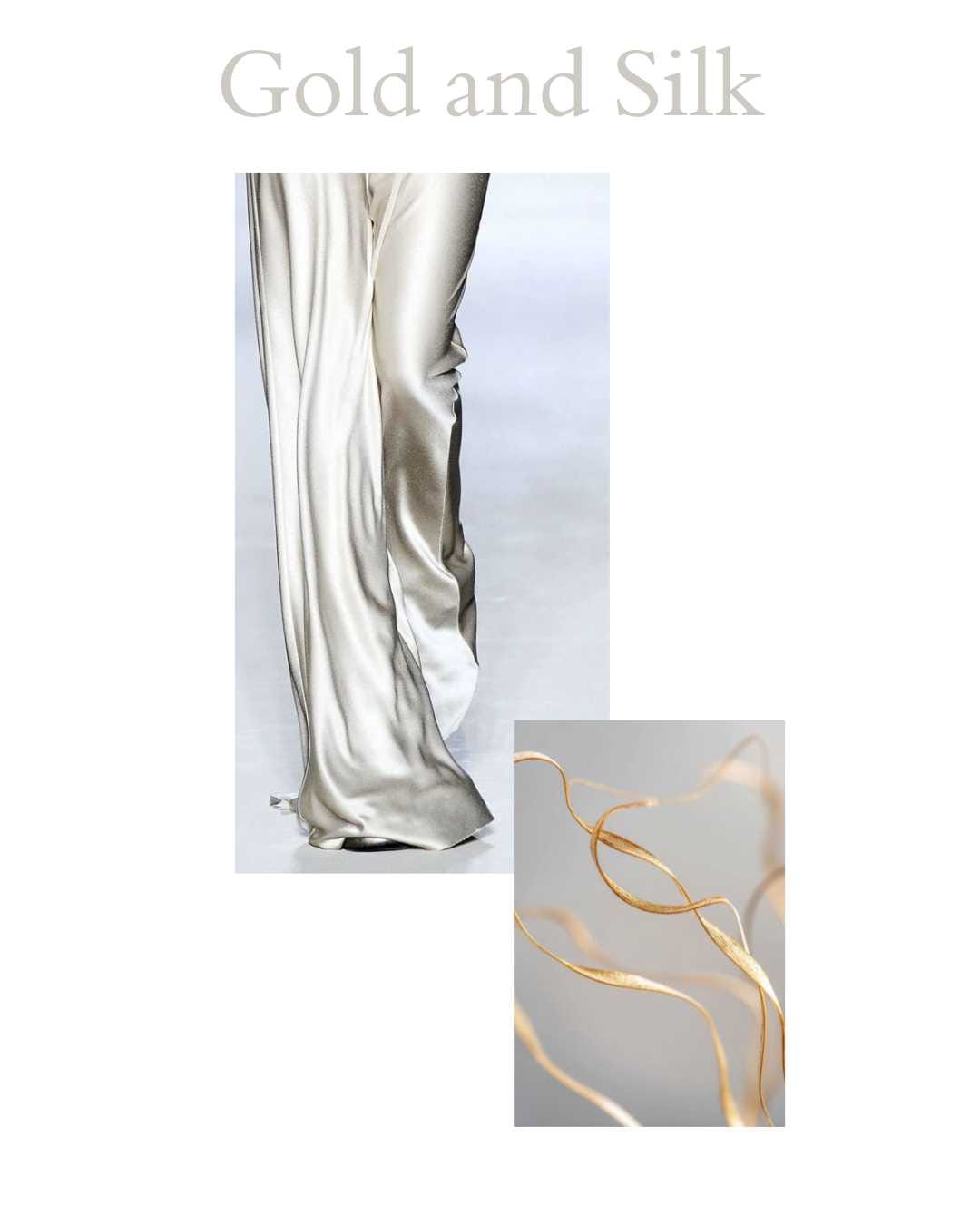
The Forgotten Philosophy of Beauty in Islamic Civilization
There are materials that civilizations have treasured for thousands of years.
Stone.
Wood.
Silver.
Silk.
Gold.
Some have symbolized power.
Others, wealth.
Others, artistic mastery.
Yet within the Islamic tradition, silk and gold occupy a unique place.
They appear in the Qur’an, in the Sunnah, and among the descriptions of Jannah.
This is no coincidence.
Again and again, Allah ﷻ draws our attention to gardens, flowing rivers, pearls, coral, silk, gold, shade, fruits, and garments of extraordinary beauty.
Not because Paradise is defined by luxury.
But because Revelation teaches through signs.
Nothing repeatedly mentioned by Allah ﷻ is without meaning.
Every blessing invites contemplation.
Every element of creation becomes a language.
Why, then, did Islam permit silk and gold for women while prohibiting them for men?
The answer is not merely a legal ruling.
It is an invitation to discover how Islam understands beauty, human dignity, and the quiet wisdom that often lies behind Revelation.
What Does Islam Say About Silk and Gold?
The Prophet Muhammad ﷺ held silk in one hand and gold in the other and said:
“These two are forbidden for the males of my nation and lawful for its females.”
Jami’ al-Tirmidhi, Hadith 1720; Sunan Ibn Majah, Hadith 3595 (authenticated as Sahih by Al-Albani).
The ruling itself is clear.
For Muslim men, wearing pure silk garments and gold jewelry is prohibited.
For women, both are permissible.
For more than fourteen centuries, scholars have carefully explained the legal dimensions of this teaching.
Yet the Qur’an repeatedly encourages believers not only to obey Revelation, but also to reflect upon its signs.
The legal ruling belongs to fiqh.
The contemplation belongs to every heart.
Beauty Is Never Opposed to Faith
Allah ﷻ says:
“Say, who has forbidden the adornment of Allah which He has produced for His servants and the good things of provision?”
Surah Al-A’raf (7), verse 32
Beauty itself is never presented as the enemy of faith.
Arrogance is.
Vanity is.
Excess is.
Islam does not ask believers to reject beauty.
It teaches them to place beauty in its proper place.
When received with gratitude, beauty becomes another language through which
we recognize the generosity of Allah ﷻ.
The Beauty of Paradise
One of the most remarkable aspects of the Qur’an is the way Allah ﷻ describes Paradise.
He could have spoken only of eternal life.
Only of forgiveness.
Only of peace.
Instead, Revelation repeatedly returns to beauty.
Silk garments.
Bracelets of gold.
Pearls.
Coral.
Flowing rivers.
Gardens beneath which rivers flow.
Shade.
Pure garments.
Fragrance.
Why?
The Qur’an does not explicitly answer this question.
So neither shall we.
But we are invited to reflect.
Perhaps beauty itself is one of the languages through which Allah ﷻ speaks to the human heart.
Perhaps beauty nourishes hope.
Perhaps it reminds us that human beings were not created merely to survive.
But to long for excellence.
For harmony.
For Jannah.
A Civilization Inspired by Revelation
Civilizations are shaped by what they choose to admire.
Islamic civilization grew beneath the light of the Qur’an.
It is therefore unsurprising that beauty occupies such a central place within its artistic and cultural heritage.
Calligraphy.
Architecture.
Gardens.
Perfume.
Ceramics.
Textiles.
Jewelry.
Hospitality.
These are not isolated expressions.
They reflect a civilization inspired by a Revelation
that repeatedly points toward beauty as one of the signs of Allah ﷻ.
Gold occupied a special place in many Muslim societies not because it created dignity, but because dignity was already recognized.
Adornment became an expression of honor.
Not its source.
The Miracle Hidden Inside a Thread
Before silk became one of the world’s most precious fabrics, it was already a miracle of creation.
A tiny silkworm, created by Allah ﷻ, patiently spins a single continuous filament around itself, thread after thread, until it forms a cocoon of astonishing precision.
From this delicate creature emerges a fibre that can extend for hundreds of metres.
From apparent fragility comes extraordinary strength.
From something almost unnoticed comes one of the most refined textiles humanity has ever known.
The Qur’an repeatedly invites us to contemplate the smallest creatures.
The bee.
The ant.
The spider.
Each reveals something of the wisdom of its Creator.
Although the silkworm is not mentioned in Revelation, it invites the same reflection.
Greatness is often hidden within what appears small.
Beauty, like many blessings, begins quietly.
Gold, Pearls and Coral
Allah ﷻ says:
“From both of them emerge pearl and coral.”
Surah Ar-Rahman (55), verse 22
Elsewhere, the Qur’an describes the people of Paradise wearing bracelets of gold and garments of silk.
“…they will be adorned therein with bracelets of gold and pearls, and their garments therein will be of silk.”
Surah Fatir (35), verse 33
Again, these descriptions are not presented merely as ornaments.
They belong to a broader vision of perfected beauty.
We cannot know with certainty why Allah ﷻ chose these particular materials.
Only He possesses complete knowledge.
But perhaps we are invited to notice them.
To contemplate them.
To ask ourselves why Revelation returns to them again and again.
Nothing repeatedly mentioned by Allah ﷻ is insignificant.
Every sign gently redirects the heart toward its Creator.
Perhaps We Have Been Asking the Wrong Question
For generations, many have asked:
Why can’t Muslim men wear silk and gold?
It is a legitimate question.
But perhaps another question leads us further.
Why did Allah ﷻ permit these adornments for women?
The Qur’an does not explicitly tell us.
So we cannot claim certainty.
Yet we may reflect.
Perhaps it reminds us that honor deserves to be expressed.
That beauty can become gratitude.
That elegance can become remembrance.
Not because a woman’s value comes from what she wears.
But because her dignity already comes from Allah ﷻ.
Adornment follows.
Honor comes first.
A Gift That Remembers Paradise
Perhaps this reflection also changes the way we give.
A husband offering gold to his wife.
A father to his daughter.
A son to his mother.
A brother to his sister.
The gift itself remains worldly.
Nothing in this life resembles the reality of Jannah.
Yet perhaps such a gift can become something more than an ornament.
A quiet remembrance.
A gentle echo of the beauty Allah ﷻ has prepared for the righteous.
Not an imitation of Paradise.
But a reminder that our true home is more beautiful than anything our eyes have yet seen.
Learning to See Through Revelation
Perhaps this is the deepest lesson.
Islam is not merely a religion that tells us what is permitted and what is prohibited.
It teaches us how to see.
The olive tree.
The bee.
Honey.
The date palm.
The stars.
The mountains.
The sea.
Pearls.
Coral.
Silk.
Gold.
Again and again, the Qur’an invites us to contemplate creation.
Not because creation is the destination.
But because it is filled with signs pointing beyond itself.
This is the Islamic art of seeing.
And perhaps that is where the Islamic Art of Living begins.
Frequently Asked Questions
Why can’t Muslim men wear silk?
According to authentic hadiths, the Prophet Muhammad ﷺ prohibited Muslim men from wearing pure silk while permitting it for women. This ruling is narrated in Jami’ al-Tirmidhi (Hadith 1720) and Sunan Ibn Majah (Hadith 3595).
Why is gold allowed for women in Islam?
Gold jewelry is permissible for women according to authentic hadiths. While the legal ruling is explicit, the Qur’an also invites believers to contemplate beauty as one of Allah’s blessings and signs.
What does the Qur’an say about silk?
The Qur’an repeatedly describes the people of Paradise wearing garments of silk, including in Surah Al-Hajj (22), verse 23, Surah Fatir (35), verse 33, and Surah Al-Insan (76), verse 21.
What does the Qur’an say about gold?
Gold appears in several descriptions of Paradise, particularly as bracelets adorning the righteous, emphasizing beauty, honor, and eternal reward.
Does Islam encourage beauty?
Yes.
The Prophet Muhammad ﷺ said:
“Allah is Beautiful and loves beauty.”
Sahih Muslim, Hadith 91.
Islam encourages beauty when accompanied by humility, gratitude, and ihsan (excellence).
Continue Exploring
→ This Deen was never meant to be monochrome