Why Muslims Measure Time From a Migration Instead of a Victory
Every civilization chooses what it remembers.
Some begin their calendars with the birth of a king.
Others with the founding of a nation.
Others with a military victory.
Islam begins differently.
The Islamic calendar does not begin with the birth of the Prophet Muhammad ﷺ.
It does not begin with the first revelation of the Qur’an.
It does not begin with the conquest of Makkah.
It begins with a migration.
And perhaps that choice reveals one of the most profound ideas in Islamic civilization.
What Is The Islamic New Year?
The Islamic New Year begins on the 1st of Muharram, the first month of the Islamic calendar.
This year marks the beginning of 1448 AH.
The letters AH stand for Anno Hegirae — “The Year of the Hijrah.”
The Hijrah refers to the migration of the Prophet Muhammad ﷺ and his companions from Makkah to Madinah.
More than a journey, it marked the moment when a message became a community, and a community began to build a civilization.
That journey, known as the Hijrah, became the starting point of the Islamic calendar.
Not because it was the beginning of Islam.
Islam had already begun.
But because it was the moment when faith became action.
What Year Is It In Islam?
For many non-Muslims, this raises an obvious question.
If much of the world follows the year 2026, why are Muslims entering 1448 AH?
The answer lies in the Hijrah.
Unlike the Gregorian calendar, which counts years from the birth of Issa, Jesus عليه السلام, the Islamic calendar begins with a defining moment in Muslim history: the migration from Makkah to Madinah.
This event became Year One of Islamic history.
A remarkable choice.
Islam chose to measure time not from a birth, a coronation, or a conquest, but from a sacrifice and a journey.
Why Does The Islamic Calendar Begin With The Hijrah?
This is one of the most fascinating decisions in the history of calendars.
The early Muslim community could have chosen many starting points
- The birth of the Prophet Muhammad ﷺ
- The first revelation of the Qur’an
- The conquest of Makkah
- The beginning of prophethood
Yet none of these became Year One.
Instead, Muslims chose the Hijrah.
Why?
Because the Hijrah transformed belief into action.
It was the moment when a small community left behind comfort, security, and familiarity in order to preserve faith and build a better future.
The Islamic calendar begins not with an achievement. It begins with a decision.
And perhaps the most remarkable aspect of that decision is what the Prophet Muhammad ﷺ was willing to leave behind.
Makkah was not an ordinary city.
It was home to the Kaaba.
The most sacred sanctuary in Islam.
The city of his birth.
The place he loved.
Yet the Hijrah teaches a timeless lesson,
Sometimes faith requires movement.
Sometimes remaining aligned with our beliefs, our values, and our practice requires leaving behind what is familiar.
Even when what we leave behind is precious.
Even when what we leave behind is beloved.
The Islamic calendar begins with this lesson.
A reminder that true success is not always found in staying where we are comfortable.
Sometimes it is found in having the courage to move toward what is right.
A Lunar Calendar
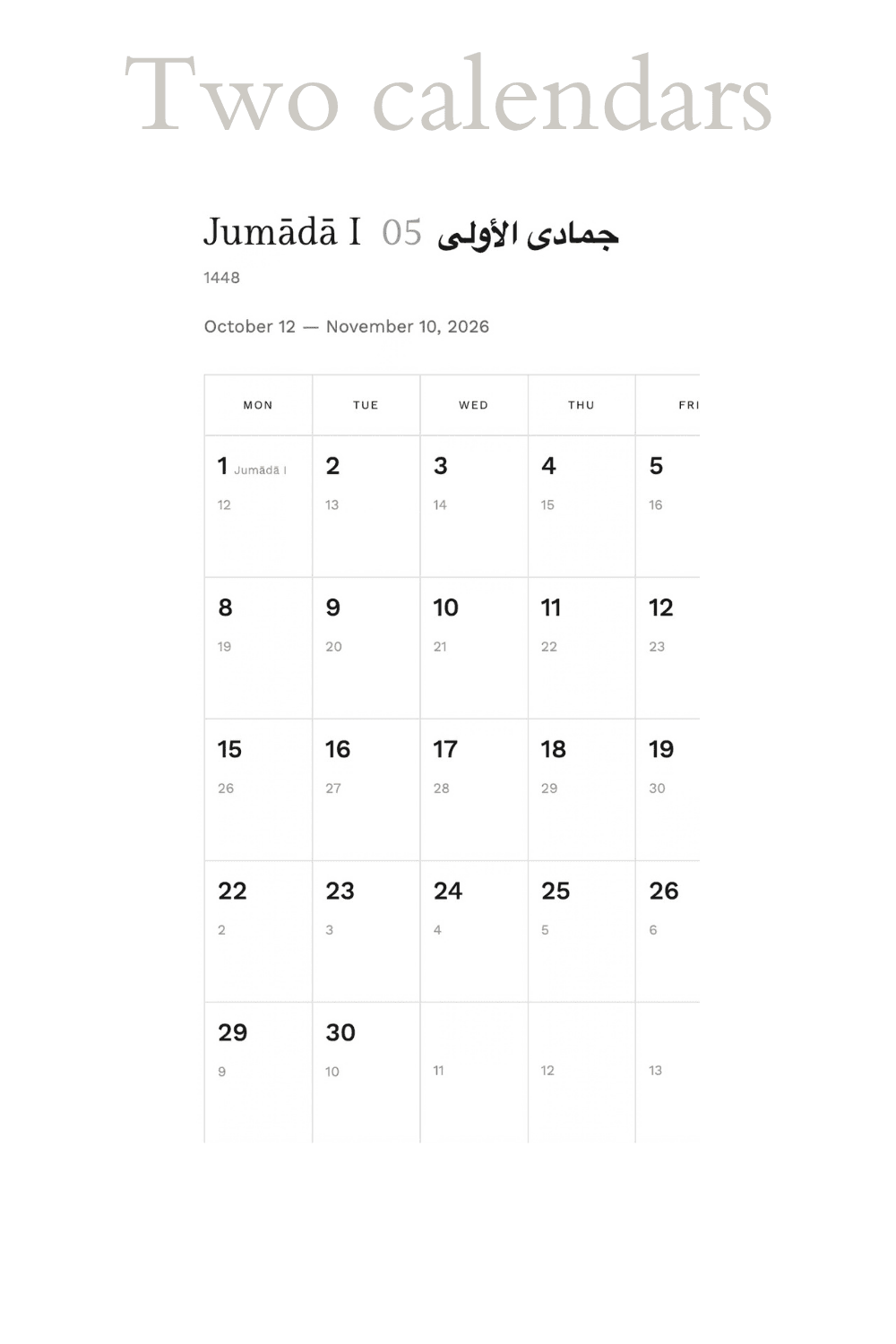
The Islamic calendar follows the moon.
Each month begins with the sighting of the new crescent.
Unlike the Gregorian calendar, which follows the sun, the Islamic year contains approximately 354 or 355 days.
As a result, Islamic months move through all seasons over time.
Ramadan may occur in winter during one decade and in summer during another.
The calendar continuously rotates through the natural cycles of the earth.
A reminder that sacred time belongs to all peoples, all climates, and all generations.
When Does An Islamic Day Begin?
One of the most distinctive aspects of the Islamic calendar is that a new day begins at sunset rather than at midnight.
In practical terms, this means that the first day of Muharram begins at Maghrib on the evening before.
The rhythm of Islamic time follows the movement of the moon and the natural transition between day and night.
Just as the Islamic year is measured by lunar months, the Islamic day itself begins with the setting of the sun.
It is a reminder that Islamic time is deeply connected to the natural rhythms of creation.
Twelve Months Since The Creation Of The Heavens And The Earth
Allah ﷻ says:
“Indeed, the number of months with Allah is twelve months in the register of Allah since the day He created the heavens and the earth.”
Surah At-Tawbah (9:36)
The Islamic year contains twelve lunar months
- Muharram
- Safar
- Rabi’ al-Awwal
- Rabi’ al-Thani
- Jumada al-Ula
- Jumada al-Akhirah
- Rajab
- Sha’ban
- Ramadan
- Shawwal
- Dhul-Qa’dah
- Dhul-Hijjah
Together, they create a rhythm that has guided Muslim life for more than fourteen centuries.
The Year Begins With A Sacred Month
Muharram holds a unique distinction.
Not only does it open the Islamic year, it is also one of the four Sacred Months mentioned in the Qur’an.
Allah ﷻ says:
“Indeed, the number of months with Allah is twelve months in the register of Allah since the day He created the heavens and the earth; of these, four are sacred.”
Surah At-Tawbah (9:36)
The four Sacred Months are
- Muharram
- Rajab
- Dhul-Qa’dah
- Dhul-Hijjah
The Islamic year therefore begins not only with a new month. It begins with a sacred month.
A reminder that time itself can carry meaning.
The Two Great Celebrations Of Islam
Many people assume that the Islamic New Year is one of the major religious celebrations in Islam.
It is not.
Islam centers around two principal celebrations.
Eid al-Fitr
Observed at the end of Ramadan.
A celebration of gratitude, prayer, charity, and community.
Eid al-Adha
Observed during the days of Hajj.
A commemoration of the devotion of Prophet Ibrahim عليه السلام and his willingness to submit to the command of Allah ﷻ.
Together, these two Eids form the major celebrations of the Islamic year.
Muharram serves a different purpose.
It invites reflection.
To explore these sacred moments further, read our articles
- Why the First Ten Days of Dhul-Hijjah Are So Sacred
- Arafah: The Day That Changes Everything
- Eid al-Adha and the Halal Economy
The Major Seasons Of The Islamic Year
The Islamic calendar is not merely a way of counting days.
It is a map of sacred seasons.
Among the most significant are
- Ramadan
- Laylat al-Qadr
- Eid al-Fitr
- The first ten days of Dhul-Hijjah
- The Day of Arafah
- Eid al-Adha
- Muharram
- Rajab
Each season carries its own lessons, opportunities, and rhythms.
Together, they create a calendar designed not only to measure time but to guide human life.
Is The Islamic New Year Celebrated?
Unlike Eid al-Fitr and Eid al-Adha, the Islamic New Year is not traditionally marked by a specific celebration prescribed in Islam.
Muharram is less about celebration and more about reflection.
It is an opportunity to remember the Hijrah and the lessons it teaches
- Courage
- Sacrifice
- Trust
- Patience
- Purposeful change
The beginning of a new Islamic year is therefore not simply a date.
It is an invitation to ask where we are going.
And who we are becoming.
A Civilization That Measures Time Differently
Perhaps the most fascinating aspect of the Islamic calendar is what it chooses to remember.
Most calendars begin with power. Islam begins with a journey.
Most calendars remember victory. Islam remembers sacrifice.
Most calendars celebrate arrival. Islam begins with departure.
The first year of Islam is not the year a city was conquered.
It is the year a community chose faith over certainty.
And perhaps that is why the Hijrah remains relevant today.
Every generation faces its own migration.
A movement away from what diminishes us.
A movement toward what elevates us.
A movement from intention to action.
Closing Reflection
As 1448 AH begins, perhaps the question is not:
“What year is it?”
But rather:
“Where is my own journey leading me?”
More than fourteen centuries ago, the Hijrah changed the course of history.
Today, it continues to remind us that meaningful transformation rarely begins with comfort.
It begins with courage.
Because sometimes the future begins the moment we find the strength to leave something behind.
And perhaps that is why the Islamic calendar begins with a migration.
Frequently Asked Questions
What is the Islamic New Year?
What is the Islamic New Year?
The Islamic New Year begins on the 1st of Muharram, the first month of the Islamic lunar calendar.
What year is it in Islam?
What year is it in Islam?
Muslims enter the year 1448 AH, measured from the Hijrah of the Prophet Muhammad ﷺ.
What does AH mean?
What does AH mean?
AH stands for Anno Hegirae (“Year of the Hijrah”), referring to the migration from Makkah to Madinah.
Why does the Islamic calendar begin with the Hijrah?
Why does the Islamic calendar begin with the Hijrah?
AH stands for Anno Hegirae (“Year of the Hijrah”), referring to the migration from Makkah to Madinah.
How many months are there in the Islamic calendar?
How many months are there in the Islamic calendar?
There are twelve lunar months in the Islamic calendar.
What are the four sacred months in Islam?
What are the four sacred months in Islam?
Muharram, Rajab, Dhul-Qa’dah, and Dhul-Hijjah.
Is Muharram a sacred month?
Is Muharram a sacred month?
Yes. Muharram is one of the four Sacred Months mentioned in the Qur’an and the first month of the Islamic year.
Is the Islamic New Year a religious celebration?
Is the Islamic New Year a religious celebration?
No. The two major celebrations in Islam are Eid al-Fitr and Eid al-Adha. Muharram is traditionally a time of reflection rather than celebration.
When does a new Islamic day begin?
When does a new Islamic day begin?
A new Islamic day begins at sunset (Maghrib), not at midnight.
How long is the Islamic year?
How long is the Islamic year?
The Islamic lunar year contains approximately 354 or 355 days.