Water, Shade and the Architecture of Paradise
Most people see a garden beside a palace and assume that it was added to soften the architecture: to bring colour to stone, to make power more beautiful.
But in the Islamic world, the garden was never simply decoration around a building. It was another way of building.
An Islamic garden is not one fixed style. It is a family of landscapes developed across Muslim societies, shaped by different climates and cultures, and often composed through enclosure, water, shade, geometry, fragrance and cultivated planting. These elements served life before they became images: water irrigated and cooled; walls and trees made heat inhabitable; fruit nourished; scent and sound gathered attention.
Its beauty is visible. Its intelligence is quieter.
At its most profound, the garden teaches the human being how to occupy the earth without imagining that the earth belongs to them. We draw the channel, but we do not create the water. We plant the tree, but we do not command it to live.
The Islamic garden is where design encounters dependence.
What Makes a Garden Islamic?
There is no universal blueprint called the Islamic garden.
The courtyards of al-Andalus are not identical to the terraced gardens of Kashmir. A walled garden in Iran does not speak exactly the same landscape language as an Ottoman garden or a shaded courtyard in Fez. They emerged from different dynasties, materials, climates and social worlds.
What connects them is not uniformity, but a recurring way of thinking. Across many Islamic garden traditions, water is used for irrigation, cooling, reflection and sound. Shade is made by walls, arcades and trees. Geometry gives order without denying life. Enclosure protects intimacy and attention. Plants offer fruit, fragrance, colour or shelter. Architecture and landscape are conceived as one composition, making room for rest, encounter and contemplation.
Not every garden contains all these elements. The four-part plan is influential, not universal. Symmetry orders many gardens, while others respond more freely to slope, view and terrain.
The word Islamic, then, should not become a decorative checklist. It describes landscapes made within Muslim civilizations and, at times, shaped by an Islamic understanding of creation, measure, hospitality, responsibility and remembrance.
The Garden in the Qur’an
The Arabic word Jannah—a garden whose growth conceals and shelters, is one of the Qur’an’s recurring names and images for Paradise. Revelation speaks of gardens, shade, fruit, springs and flowing rivers. Surah Muhammad describes rivers of unpolluted water, milk, wine and purified honey, together with fruit and forgiveness from Allah ﷻ (Qur’an 47:15). Surah al-Rahman evokes lush branches, flowing springs and fruit brought near (Qur’an 55:46–54).
These descriptions have profoundly shaped the Muslim imagination. They give the human mind images it can recognise, water, shade, fruit, gardens and flowing rivers and through them, a direction toward something it cannot yet fully comprehend.
At the scale of earthly life, Muslim builders and gardeners could work only with what they knew and with the materials available to them: water channelled through stone, trees offering shade, fruit growing within enclosed gardens, the sound of a fountain interrupting silence.
To draw upon these images was not to claim that Paradise could be reproduced on earth.
It was something more humble.
An earthly garden could become a living act of remembrance: a human attempt, within the narrow limits of what we know, to evoke what Revelation has taught us to long for, while knowing that the reality of Paradise remains infinitely beyond anything human hands could build.
It does not give designers a plan for reproducing Paradise on earth. Paradise belongs to the unseen and exceeds what human craft can contain. Historical gardens under Muslim patronage were also places of agriculture, ceremony, politics, poetry, pleasure and rest. Their meanings were never symbolic alone.
An earthly garden may awaken longing. It may make shade, water and fruit newly legible as gifts. It may remind the believer of what has been promised. But it does not become Paradise because four channels meet at its centre.
That distinction protects both history and faith.
A Persian Inheritance, Transformed
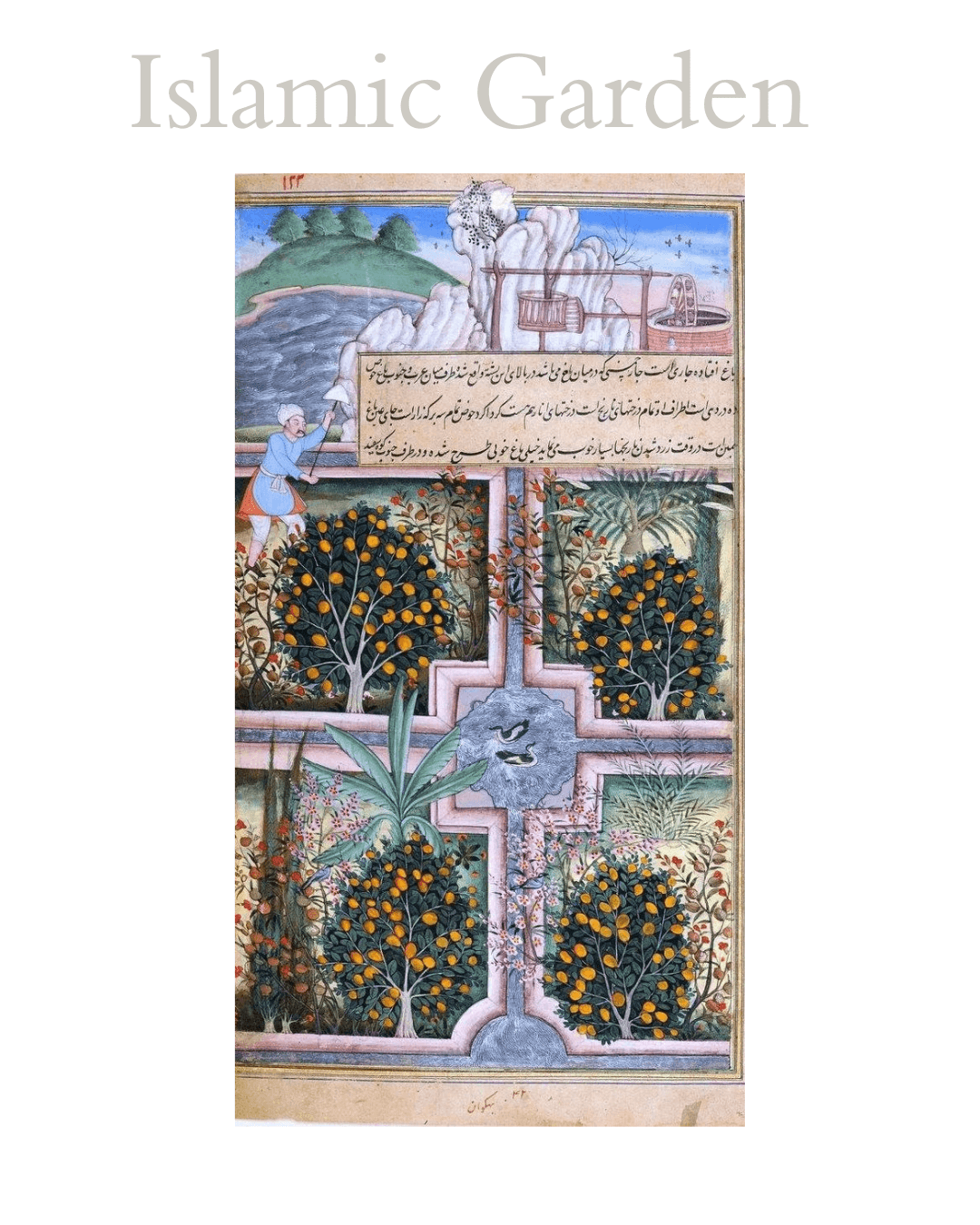
The term chahār bāgh—also written charbagh—is Persian for “four gardens.” It usually describes a landscape divided into four parts by paths or water channels arranged along central axes. It is one of the forms most readily associated with Islamic garden design.
It is also older than Islam.
At Pasargadae, in present-day Iran, the royal landscape established by Cyrus the Great in the sixth century BCE united palace, geometric garden and stone-lined water channels. It is often presented as an ancestor of the four-part Persian garden. Yet the archaeological evidence only confirms two rectangular divisions; the reconstruction of a complete fourfold plan remains speculative.
This earlier history does not make the chahār bāgh less meaningful when it appears in later Muslim cultures. It reveals a more truthful and more interesting process. Islamic civilization did not begin by erasing every form that came before it. It inherited languages of land, water, craft and power, then examined, adapted and transformed them.
Across centuries, the four-part garden travelled through Persian, Central Asian and Mughal worlds. Each expression changed with patronage, climate, engineering and local knowledge. Qur’anic descriptions of gardens and rivers offered Muslim viewers a powerful language through which such landscapes could be contemplated, but symbolism alone cannot explain their history.
The Islamic garden is not a frozen object. It is an inheritance in motion.
Water: Life Given Form
“And We created from water every living thing.”
Qur’an 21:30
In an Islamic garden, water is never merely an accessory. It irrigates roots, cools the air, reflects a façade and makes light visible. It gathers the sky into a pool. Moving through a narrow channel, it gives sound to silence.
The most refined water feature is not necessarily the largest. A thin line of water can organize an entire courtyard. A shallow basin can hold a building upside down. A small fountain can alter the temperature and rhythm of a room open to the sky.
This is not abundance without limit. In dry regions, a garden existed only because water had been found, lifted, transported, channelled and distributed with precision. Its apparent ease concealed knowledge: gradients calculated, soils understood, evaporation anticipated, maintenance sustained.
Water was beautiful because it was life.
And life required measure.
This may be one of the garden’s most urgent lessons for the present. To honour water is not to display it carelessly. It is to make its necessity visible while refusing waste.
Shade and the Education of Attention
Contemporary images of luxury often begin with exposure: broad glass, open views, landscape converted into spectacle.
The Islamic garden frequently begins elsewhere, with shelter.
A wall receives the heat. An arcade slows the sun. Leaves filter light into movement. A narrow entrance gives way to an interior world where the body can rest.
Shade is not empty space; it is a condition made for life.
It allows a conversation to last longer, makes noon inhabitable and gives people, birds and plants a shared refuge.
Enclosure, too, is easily misunderstood. It need not mean withdrawal from the world. At its best, it creates the intimacy through which the world can be noticed again.
The sound of water becomes clearer.
The scent of citrus reaches us.
The passage from darkness to light acquires meaning.
The garden does not demand attention. It disciplines it.
A Garden for the Whole Human Being
Architecture is often discussed as if the eye were the only human sense.
The Islamic garden refuses this reduction.
It can be heard in water and birdsong; felt through cool tile, warm stone and the texture of a leaf; smelled in rose, jasmine, herbs or orange blossom; tasted through fruit; crossed slowly as changing light marks the hours.
Planting varied by geography and time. Citrus, pomegranate, fig, date palm, rose, cypress, plane trees and aromatic herbs appear in different traditions, but there was no canonical Islamic planting list.
The principle was more intelligent than repetition: the garden responded to place.
It used what could grow, what could shade, what could nourish and what could endure.
The result was neither nature left untouched nor nature conquered by geometry. It was a negotiated order between cultivation and life.
Geometry gave structure.
Growth kept the structure alive.
One Tradition, Many Landscapes
To speak accurately of Islamic gardens is to speak in the plural.
Persian gardens brought walls, axes, pavilions, planting and sophisticated water systems into ordered relationships, often under severe climatic conditions.
In al-Andalus, the Alhambra and Generalife joined courtyards, channels, vegetation, architecture and distant views into experiences of movement and repose.
In Mughal South Asia, gardens expanded across terraces and monumental complexes, adapting water and planting to local terrain and imperial ambition.
Ottoman palace gardens often followed topography more freely, combining formal spaces with less rigid landscapes.
The differences matter. They prevent “Islamic garden” from becoming a label placed on any symmetrical courtyard with a fountain.
Islam did not produce one aesthetic culture spread unchanged across the world. It created a civilizational space in which peoples inherited, exchanged and transformed forms while remaining distinct.
Unity did not require sameness. It still does not.
Planting as an Act of Charity
The deepest meaning of a garden may not be found in its plan.
It may be found in what the garden gives away.
Prophet Muhammad ﷺ taught that when a Muslim plants a tree or sows seed, and a person, animal or bird eats from it, what was eaten is counted as charity for the one who planted it.
Sahih al-Bukhari, Hadith 2320.
This teaching moves the garden beyond private beauty.
A tree gives shade to someone who did not plant it.
Fruit may nourish a person whose name the gardener will never know.
A bird takes what it needs without asking permission.
The planted thing enters a world of benefit larger than its owner.
An Islamic understanding of landscape cannot end at visual perfection. It must ask whom the space shelters, what it sustains, how it uses water and whether its beauty remains accessible only to power.
A garden is not complete when it is photographed. It is complete when life can enter it.
What Can an Islamic Garden Mean Today?
A contemporary Islamic garden need not imitate a Persian palace or repeat an inherited pattern without context.
Tradition is not preserved by copying its surface.
It is preserved by understanding its intelligence.
In Cairo, Al-Azhar Park transformed a former dumping ground into a major public landscape, returning green space, dignity and social possibility to a dense city.
At the Aga Khan Centre in London, several gardens and terraces interpret traditions from Muslim regions within a contemporary building and climate. One draws on the courtyards of southern Spain, Morocco and Egypt; another adapts the Mughal chahār bāgh on a rooftop.
Their very difference makes the essential point:
the Islamic garden is capable of translation.
For today’s cities, its principles may be more necessary than its motifs:
shade before spectacle;
water used with responsibility;
planting suited to climate;
biodiversity rather than sterile perfection;
human scale within urban density;
public rest treated as a form of dignity;
beauty that serves life.
These concerns are not nostalgic.
They belong to a future of hotter cities, diminished water and exhausted attention.
The question is no longer whether we can recreate the gardens of the past.
It is whether we can recover the intelligence that made them necessary.
Where Architecture Learns Humility
An Islamic garden is a meeting place between human intention and a life no human being can manufacture.
The architect may establish an axis.
The gardener may prepare the soil.
The engineer may guide the water.
But germination remains beyond them.
This is what the garden quietly returns to architecture:
humility.
It reveals that order need not become domination.
That enclosure can protect rather than imprison.
That beauty can cool, nourish, shelter and give.
That the most meaningful spaces do not separate contemplation from responsibility.
The garden was never decoration around Islamic architecture.
It was one of its clearest lessons:
Build carefully.
Use what has been entrusted with measure.
Make room for life.
And remember that what grows was never ours to command.