Look at a cloud.
For most of us, the word arrives almost immediately.
Cloud.
White or grey. Thin or heavy. Moving quickly or barely moving at all.
One word seems enough.
The Qur’an looks longer.
Its Arabic moves through several different expressions for what English frequently renders simply as cloud: saḥāb, ghamām, ʿāriḍ, muzn and muʿṣirāt. Elsewhere, it describes clouds indirectly as al-ḥāmilāt — “those carrying a heavy load” — an expression interpreted in classical tafsīr as clouds carrying water.
These are not six neat meteorological categories.
Nor can every word be assigned one fixed theological function.
Language is more subtle than that.
But the distinctions are there.
A cloud moving across the sky.
A cloud that covers.
A rain-bearing cloud.
A formation appearing across the horizon.
Something carrying what cannot yet be seen from below.
The difference matters because the Qur’an does not merely teach us to identify the world.
It teaches us to pay attention to it.
And then, through one extraordinary cloud in the story of ʿĀd, it teaches us something harder:
seeing something correctly does not mean we understand what it means.
When One Word Is Not Enough
A 2016 semantic study by Arif Imam Zulfahmi at Universitas Islam Negeri Walisongo examined a group of Qur’anic expressions associated with clouds and argued that they should not simply be treated as interchangeable synonyms.
The study offers a useful point of departure, although the Qur’anic vocabulary is even broader than its five-word framework suggests.
For example, muzn appears in Surah Al-Wāqiʿah, where Allah ﷻ asks:
“Is it you who bring it down from the clouds, or is it We Who do so?”
Surah Al-Wāqiʿah (56), verse 69 — The Clear Quran, Dr. Mustafa Khattab
The Qur’anic Arabic Corpus identifies al-muzn here as rain clouds. Al-Qurṭubī, citing Ibn ʿAbbās and Mujāhid, explains al-muzn as al-saḥāb — the clouds.
Elsewhere, Surah Adh-Dhāriyāt speaks not by naming a cloud at all, but by describing al-ḥāmilāt wiqran — “those carrying a heavy load.”
Ibn Kathīr and al-Qurṭubī record reports from ʿUmar ibn al-Khaṭṭāb and ʿAlī ibn Abī Ṭālib interpreting these “carriers” as clouds bearing the weight of water or rain.
Already, something becomes visible.
The Qur’an can name an object.
But it can also draw our attention to what that object is doing.
What it carries.
How it moves.
How it appears.
What emerges from it.
Language becomes a way of training attention.
Saḥāb: Watch What Happens
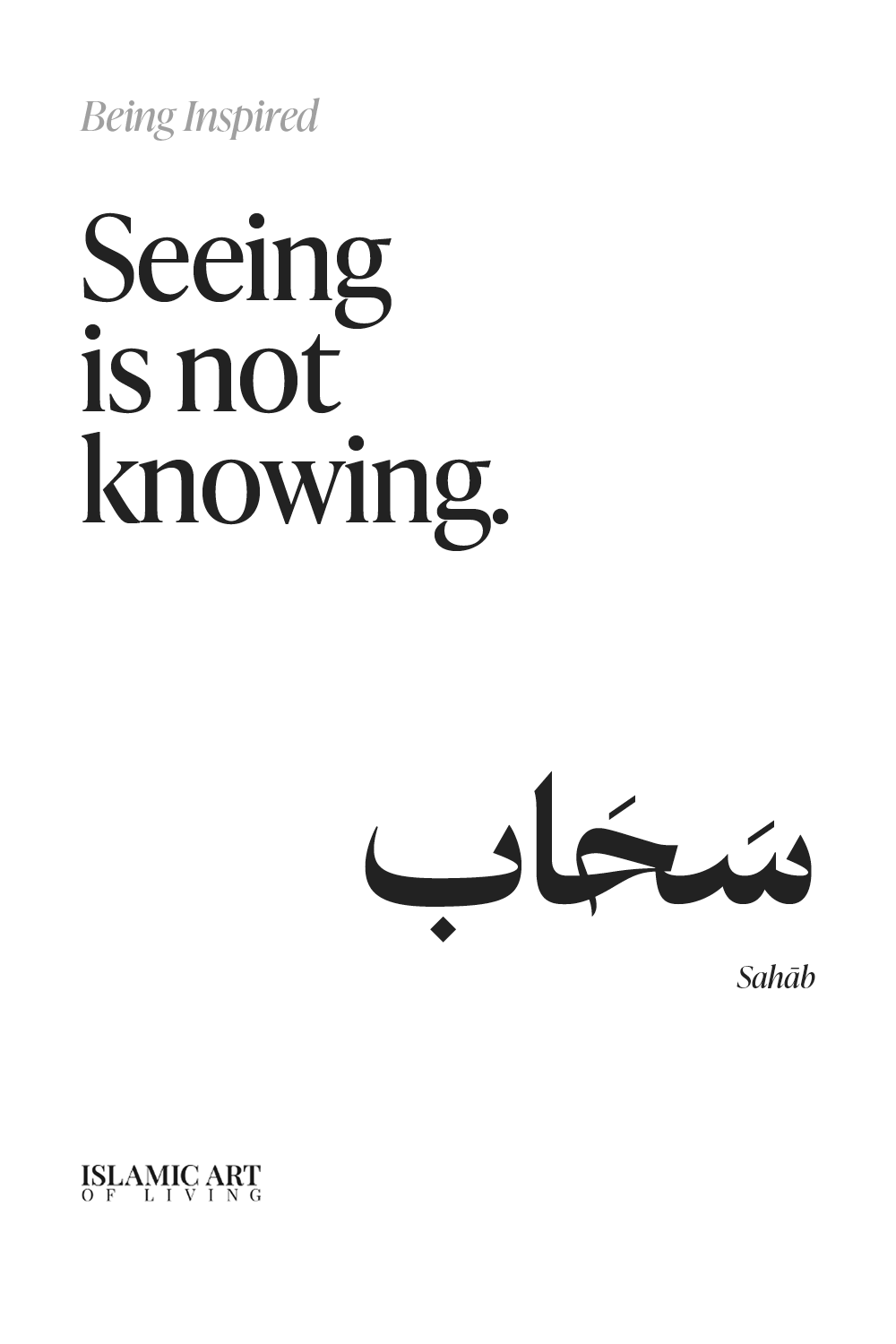
The most common Qur’anic term for cloud is saḥāb.
In Surah An-Nūr, the word appears inside a remarkable sequence:
“Do you not see that Allah gently drives the clouds, then joins them together, piling them up into masses…”
Surah An-Nūr (24), verse 43 — The Clear Quran, Dr. Mustafa Khattab
The verse continues with rain, hail and lightning.
But before all of that comes a question.
Do you not see?
That beginning matters.
The Qur’an does not introduce the cloud through an abstract definition.
It directs the eye.
Watch it move.
Watch it gather.
Watch separate formations become a mass.
Watch water emerge.
Look again at something you have seen thousands of times.
This is why I would resist turning this verse into an argument about a “scientific miracle.”
The Qur’an is not asking us to prove Revelation by retrofitting a modern meteorology textbook onto the verse.
Its own invitation is already profound.
Look.
Something utterly ordinary has been happening above us all our lives.
Have we really been seeing it?
Different Clouds, Different Conditions
Other Qur’anic words change what our attention is directed toward.
Ghamām appears when Allah ﷻ recalls shading the Children of Israel with clouds in Surah Al-Baqarah (2:57) and Surah Al-Aʿrāf (7:160).
The root carries associations of covering and concealment. Yet the same word also appears in an eschatological scene in Surah Al-Furqān (25:25). The word itself therefore cannot simply be reduced to “the merciful cloud of shade.” Its meaning emerges through the verse in which it appears.
Muzn appears in connection with the water we drink.
Muʿṣirāt appears in Surah An-Nabaʾ in connection with pouring rain:
“and sent down from rainclouds pouring water,”
Surah An-Nabaʾ (78), verse 14 — The Clear Quran, Dr. Mustafa Khattab
And ʿāriḍ describes something appearing across the horizon.
None of this requires us to transform Qur’anic Arabic into an artificial taxonomy.
The deeper point is simpler.
The text notices condition.
It does not flatten every cloud into the same visual object.
And that sensitivity to difference prepares us for the cloud at the centre of this article.
The Cloud They Misread
The people of ʿĀd had been warned by Prophet Hūd (peace be upon him).
They rejected him.
Then one day, something appeared on the horizon.
The Qur’an describes the moment:
“Then when they saw the torment as a ˹dense˺ cloud approaching their valleys, they said ˹happily˺, ‘This is a cloud bringing us rain.’”
Surah Al-Aḥqāf (46), verse 24 — The Clear Quran, Dr. Mustafa Khattab
Their reaction is striking because it is so understandable.
They see a familiar shape.
They recognise it as a cloud.
They know what clouds can bring.
They expect rain.
And they rejoice.
The problem is not that they failed to see.
They saw correctly.
There was something cloud-like approaching their valleys.
Their error came one step later.
They believed they knew what its appearance meant.
What they interpreted as rain was the beginning of the punishment they had demanded to see hastened: a destructive wind.
This is where the story becomes larger than the vocabulary of clouds.
They did not fail in perception.
They failed in interpretation.
Recognition Is Not Understanding
Human beings do this constantly.
We see.
Then we interpret.
And because interpretation happens almost instantly, we often forget that these are two separate acts.
A door opens.
This must be good.
A door closes.
This must be bad.
Something arrives quickly.
This was meant for me.
Something is delayed.
I am being denied.
A plan succeeds.
I understood correctly.
A plan collapses.
Something has gone wrong.
A cloud appears.
Rain is coming.
We move from observation to meaning with extraordinary speed.
Sometimes our inference is reasonable.
Sometimes it is correct.
But reasonableness is not certainty.
The people of ʿĀd had experience of clouds. Their expectation was not irrational.
It was simply wrong.
The Qur’an does not only teach us to look at the world. It teaches us to be careful about what we think our looking allows us to know.
That is a much more demanding discipline.
An Āyah Is Not a Code
The Qur’an repeatedly calls features of creation āyāt — signs.
The sky.
Night and day.
Rain.
Plants.
Animals.
Our own bodies.
But a sign is not the same thing as a private code through which every event can be decoded into a message about our individual lives.
That distinction matters.
To contemplate creation is not to claim unrestricted knowledge of Allah’s intention in every circumstance.
Islam invites observation.
Reflection.
Reason.
Gratitude.
Humility.
It does not invite us to turn every coincidence, delay, success, failure or natural phenomenon into a certainty about what Allah ﷻ has decreed behind it.
We can recognise that something is an āyah without pretending we possess its entire meaning.
This is one reason the cloud of ʿĀd is so instructive.
The visible object was real.
Their interpretation was not.
An āyah invites us to look, reflect and interpret. We may perceive meaning in what Allah ﷻ places before us, and allow what we see to deepen our understanding.
The limit is not interpretation itself.
It is believing that our interpretation exhausts the meaning.
We may understand something without understanding everything. We may recognise a sign without possessing the whole of what it carries. Its fullest meaning, and the wisdom beyond what has been made accessible to us, remain with Allah ﷻ.
This distinction — between what we can perceive and interpret, and what remains beyond the limits of our knowledge — is explored more deeply in Al-Ghayb in Islam: What the Unseen Means.
What the Cloud Carries
There is another Qur’anic image that deepens this reflection.
Surah Adh-Dhāriyāt speaks of al-ḥāmilāt wiqran — those carrying a heavy burden.
Ibn Kathīr and al-Qurṭubī transmit reports interpreting the expression as clouds bearing water.
From below, a cloud can appear almost weightless.
Soft.
Remote.
Moving without effort.
Yet it carries something invisible to the person standing beneath it.
That image does not need to become an allegory the Qur’an itself has not made.
Its visible reality is already enough.
We see the exterior.
We do not immediately see what it holds.
And this physical fact mirrors the epistemic discipline running through the story of ʿĀd:
appearance gives us information, but not necessarily the whole.
The same discipline of contemplating what is visibly before us without claiming to reproduce or possess what remains beyond us also runs through What Is an Islamic Garden?
The Prophet ﷺ Remembered ʿĀd When He Saw Clouds
The story did not remain abstract.
ʿĀʾishah (may Allah be pleased with her) noticed that when the sky became stormy or dark with clouds, concern could be seen on the face of the Prophet Muhammad ﷺ.
When rain actually came, he became relieved.
She asked him about this.
He referred to the people of ʿĀd, who had seen a cloud approaching and assumed it would bring rain. The narration is recorded in Sahih Muslim 899b, with a closely related report in 899c.
This does not mean Muslims should fear clouds.
The same narrations report the Prophet ﷺ recognising rain as mercy.
The lesson is subtler.
A familiar natural phenomenon can carry different outcomes.
Its appearance alone does not place those outcomes under our control.
The believer looks at creation with attention, but not arrogance.
What Translation Can Hide
This brings us back to language.
When several Qur’anic expressions are repeatedly translated into English as cloud, something is inevitably compressed.
That is not an accusation against translation.
Translation always involves choices.
Without it, millions of readers would lose access to meaning altogether.
But translation can give us the object while leaving some of its texture behind.
Saḥāb.
Ghamām.
Muzn.
Muʿṣirāt.
ʿĀriḍ.
And the descriptive al-ḥāmilāt.
Words and expressions directing attention toward different conditions, appearances or contexts.
Returning to them reminds us that language can preserve distinctions our habits no longer notice.
And this is where vocabulary and reflection finally meet.
We flatten clouds into one word.
We often flatten events in exactly the same way.
Success.
Failure.
Blessing.
Loss.
Opportunity.
Delay.
We name quickly.
Then we behave as though the name has explained the meaning.
The Qur’an asks for a more attentive gaze.
Between What We See and What Allah ﷻ Knows
There is no invitation here to stop interpreting life.
Human beings have to interpret.
We weigh evidence.
Make decisions.
Notice patterns.
Anticipate consequences.
Islam does not ask us to abandon reason.
It asks us to know its limits.
We can interpret what unfolds before us. We can recognise patterns, weigh circumstances, and even perceive meaning in them.
What requires humility is not the act of interpretation, but the belief that our reading contains the whole.
A circumstance may reveal something without revealing everything. The visible can offer meaning without yielding the full wisdom it carries.
We are not asked to suspend interpretation, but to leave room for what exceeds it.
And that remainder belongs to Allah ﷻ.
We can recognise hardship without pretending we already know the complete wisdom behind it.
We can prepare for rain while knowing that the cloud does not belong to us.
There is a difference between reading circumstances responsibly and claiming knowledge of what remains beyond us.
That space between the two is not ignorance.
It is intellectual humility.
Look Again
The Qur’an could have spoken of the sky without asking us to look at it.
Instead, again and again, it directs human attention back toward the visible world.
And clouds may be among the most fitting objects for that invitation.
They form while we watch them.
They change shape almost immediately.
They gather.
Separate.
Darken.
Carry.
Release.
Disappear.
We can identify them.
Study them.
Forecast their movement with extraordinary scientific precision.
And still, standing beneath one particular cloud at one particular moment, we do not possess everything that it will bring.
The people of ʿĀd saw the cloud.
They knew what clouds usually brought.
They recognised the shape.
They named the expectation.
And they were wrong.
The Qur’an does not ask us to stop interpreting the world.
It asks us to look carefully enough to know the difference between what we see, what we infer, and what only Allah ﷻ knows.
That may be why the cloud remains such a powerful āyah.
It changes shape while we are looking at it.
It carries what we cannot see from below.
And sometimes, even when we recognise it perfectly,we still do not know what it is bringing.
Further Reading
Al-Ghayb in Islam: What the Unseen Means
On the unseen, Revelation and the limits of what human beings can claim to know.
What Is an Islamic Garden?
On water, shade, creation and the difference between remembrance and reproduction.
From Cave to Civilization: How Ramadan Truly Begins
On Revelation, observation and how sacred time is recognised.
Frequently Asked Questions
How many words for cloud are used in the Qur’an?
The Qur’an uses several distinct Arabic terms and expressions associated with clouds. This article follows saḥāb, ghamām, ʿāriḍ, muzn and muʿṣirāt, together with the descriptive expression al-ḥāmilāt. They are not interchangeable scientific categories; their meanings depend on language and context.
What does saḥāb mean in the Qur’an?
Saḥāb is the most common Qur’anic noun for cloud. It appears in passages describing clouds being driven, gathered and connected with rain, including Surah An-Nūr (24:43).
What does ghamām mean?
Ghamām refers to clouds and carries associations with covering or concealment. In the Qur’an it appears both in descriptions of shade given to the Children of Israel and in an eschatological context.
What does muzn mean in the Qur’an?
Muzn appears in Surah Al-Wāqiʿah (56:69) in connection with the water human beings drink. Al-Qurṭubī records explanations from Ibn ʿAbbās and Mujāhid identifying al-muzn as clouds.
What are the muʿṣirāt?
The term muʿṣirāt appears in Surah An-Nabaʾ (78:14), where The Clear Quran translates it as “rainclouds.” Al-Qurṭubī records several classical interpretations, including clouds heavy with water and rain-bearing winds.
What does ʿāriḍ mean in the story of ʿĀd?
In Surah Al-Aḥqāf (46:24), ʿāriḍ describes the dense cloud-like formation approaching the valleys of ʿĀd. The people believed it was bringing rain, but it carried the punishment they had demanded.
Does Surah An-Nūr 24:43 describe modern meteorology?
The verse describes clouds being driven, joined, piled into masses, followed by rain, hail and lightning. This article treats the passage as a Qur’anic invitation to observe creation rather than as a claim that the Qur’an provides a modern meteorological textbook.
Why did the Prophet Muhammad ﷺ show concern when he saw clouds?
ʿĀʾishah (may Allah be pleased with her) reported that the Prophet Muhammad ﷺ remembered the people of ʿĀd, who had mistaken an approaching punishment for a rain cloud. The report is found in Sahih Muslim 899b–c.
What is the main lesson of the cloud of ʿĀd?
The people of ʿĀd recognised what appeared to be a cloud but misunderstood what it would bring. Their story illustrates the difference between perception and interpretation: seeing something does not mean possessing complete knowledge of its meaning.
Is every natural phenomenon an āyah with a specific personal message?
The Qur’an repeatedly presents creation as āyāt, or signs, inviting observation and reflection. That does not mean every natural event can be decoded into a certain personal message about Allah’s intention. Reflection and claims to knowledge are not the same thing.
Sources
Qur’an translation
Dr. Mustafa Khattab, The Clear Quran. All English Qur’anic quotations in this article follow this translation. The wording of Surah An-Nūr 24:43, Al-Aḥqāf 46:24 and Al-Wāqiʿah 56:69 has been checked against published editions of Khattab’s translation.
Qur’anic Arabic Corpus
University of Leeds / Quran.com project. Used for morphology, occurrences and lexical identification, including muzn in Surah Al-Wāqiʿah 56:69.
Al-Qurṭubī
Tafsīr al-Jāmiʿ li-Aḥkām al-Qurʾān. On Surah Al-Wāqiʿah 56:69, al-Qurṭubī records the explanations of Ibn ʿAbbās and Mujāhid that al-muzn means the clouds. On Surah An-Nabaʾ 78:14, he records several interpretations of al-muʿṣirāt.
Ibn Kathīr and al-Qurṭubī
Classical tafsīr material on Surah Adh-Dhāriyāt 51:1–4, including reports from ʿUmar ibn al-Khaṭṭāb and ʿAlī ibn Abī Ṭālib interpreting al-ḥāmilāt as clouds bearing water.
Arif Imam Zulfahmi
Clouds in the Quran (A Semantic Study), Universitas Islam Negeri Walisongo Semarang, 2016. Used as a starting point for the semantic distinction between Qur’anic cloud vocabulary, not as the sole authority for the lexical thesis.