Not decoration, but discipline. Not ornament, but authority made visible.
Some civilisations build.
Others compose.
They do not fill space.
They define it.
In the heart of the Ottoman Empire, something quiet emerged,
not loud, not excessive, not seeking attention.
But precise.
Iznik was never made to impress.
It was made to command space.
And centuries later,
it still does.
Color restrained becomes power.
Light guided becomes presence.
And what repeats,
without end,
teaches the eye
to see beyond itself.
The Ottoman Empire: A Civilisation of Alignment
To understand Iznik is to understand the world that produced it.
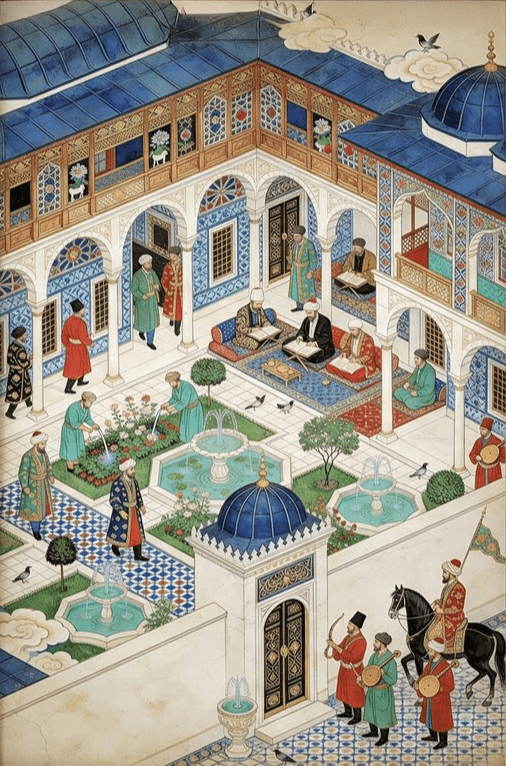
The Ottoman Empire was not only a political power.
It was a civilisational project.
A space where governance, knowledge, spirituality, and aesthetics were not separated but aligned.
Architecture was not an afterthought.
It was a language of authority.
Mosques were not only places of prayer.
They were centers of life,
spaces of learning, transmission, and order.
But this language did not stop at monumental scale.
It extended into homes, into objects, into daily life.
Because in this civilisation, beauty was not reserved for the exceptional.
It was structured into daily life, where aesthetics themselves became a form of remembrance of Allah ﷻ.
Art was not autonomous.
It was accountable
to a vision,
to a structure,
and ultimately, to Allah ﷻ.
What Are Iznik Tiles? Beyond Ornament, A Civilisational Language
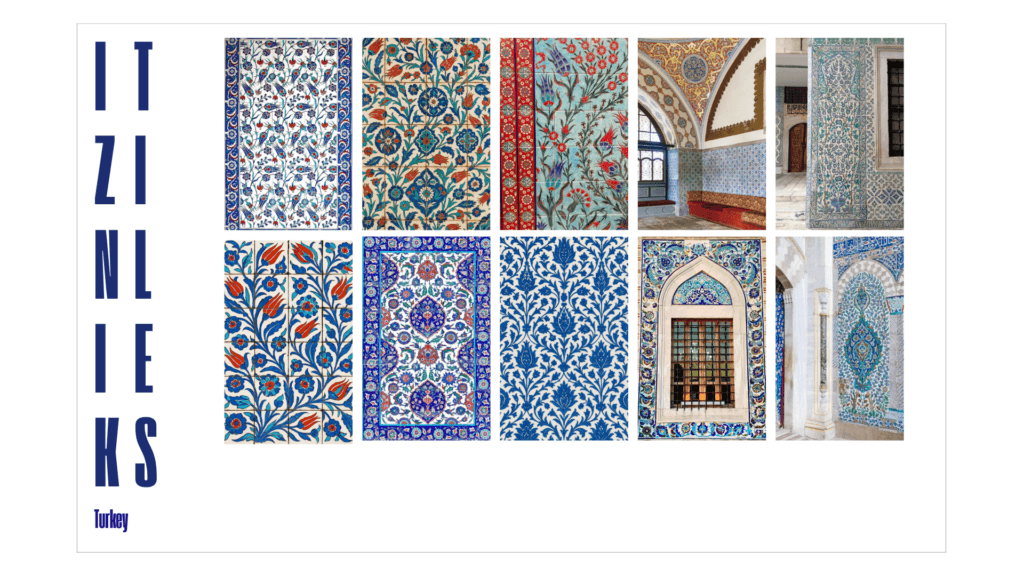
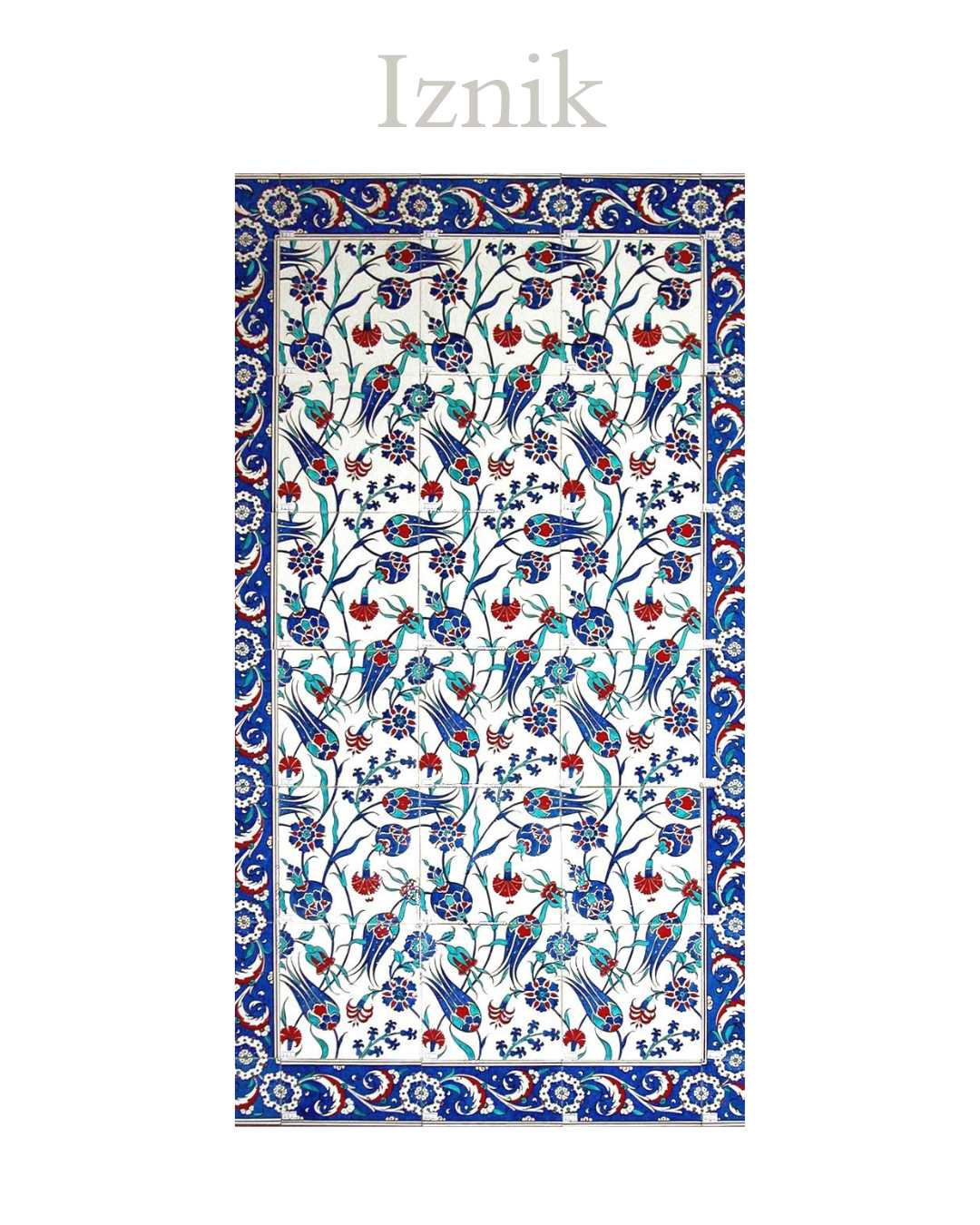
Iznik tiles are a form of Ottoman ceramic art developed in the 15th and 16th centuries, designed to structure space through geometry, light, and controlled ornamentation within Islamic architecture.
They were not created for decoration.
They were conceived under imperial direction
to shape mosques, palaces, and public space.
This was not folklore.
This was state vision made visible.
A language where:
- science meets material
- nature submits to geometry
- power becomes silent
Material Intelligence: When Light Travels Through Matter
What makes Iznik extraordinary is not only its beauty.
It is its construction.
A body composed of up to 85% quartz, blended with glass,
a formulation that few mastered.
This is why Iznik does not reflect light.
It absorbs it.
It diffuses it.
It allows it to travel.
Five centuries before modern material science,
Ottoman ateliers were already engineering luminosity.
Not for spectacle
but for atmosphere.
The Conquest of Color
Iznik colors were not chosen.
They were conquered.
- Cobalt blue, drawn from rare minerals
- Turquoise, born from copper
- Emerald green, from controlled chemical reactions
- And that impossible coral red, achieved only when heat, oxygen, and glaze aligned with precision
These were not pigments.
They were achievements.
Even Europe attempted to replicate them.
It failed.
Because what Iznik required was not technique alone
but patience, discipline, and mastery of process.
Botanical Geometry: Nature Under Order
And then, there are the flowers.
Tulips.
Carnations.
Hyacinths.
Vines.
They are not copies of nature.
They are its refinement.
In Islamic aesthetics, figuration withdraws.
Nature remains but it is governed.
Every curve obeys symmetry.
Every petal follows an axis.
Every composition extends infinitely.
This is not decoration.
This is life placed inside order.
Hidden Mathematics: The Discipline of Infinity
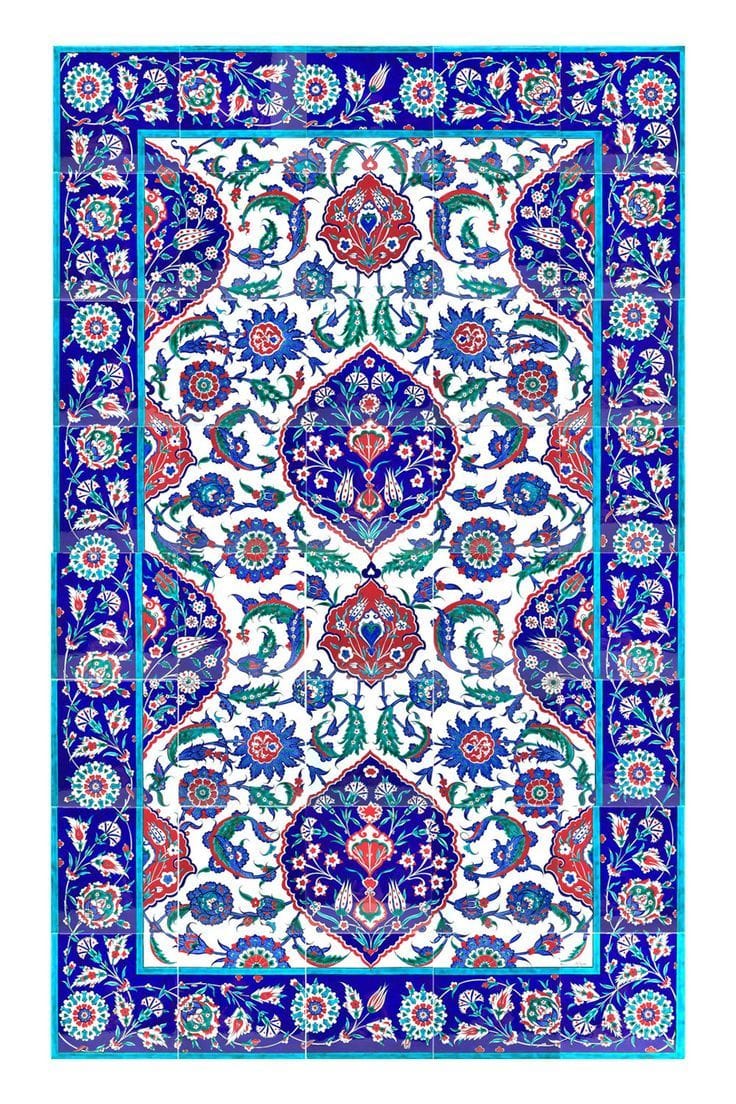
Behind every Iznik surface lies a structure unseen.
Symmetry.
Repetition.
Endless extension.
Patterns do not stop at the wall.
They suggest continuation.
Beyond space.
Beyond time.
Even what appears organic
is governed by mathematical law.
Emotion
contained within structure.
Where Iznik Lived: The Heart of an Empire
Iznik did not belong to a single type of space.
It belonged to civilisation itself.
It lived in
- the Süleymaniye Mosque
- the Rüstem Pasha Mosque
- the Selimiye Mosque
- the Topkapı Palace
But also
within refined interiors, private homes, and crafted objects.
In plates, in panels, in quiet domestic spaces where beauty accompanied daily life.
Not only in places where people gathered
but in places where they lived.
People did not simply come to admire Iznik.
They moved within it.
They ate beside it.
They prayed with it.
They grew up surrounded by it.
It was not distant.
It was present.
Turkey Today: A Living Continuity of Islamic Aesthetics
Today, Turkey carries more than a geographical identity.
It carries a continuity.
Across its cities,
from Istanbul to Edirne
Iznik remains visible.
Not as a relic.
But as a living trace.
It exists in mosques, in museums, in restored spaces
but also in homes, ateliers, and contemporary reinterpretations.
It is part of a broader language:
one through which Islamic culture has expressed beauty, discipline, and presence.
Through the Ottoman legacy, Turkey stands today as one of the most tangible expressions of this heritage, where art, architecture, and faith once moved together.
And where their echoes still remain.
A Philosophy of Power
This is how the Ottomans expressed power
- alive, but contained
- ornate, but governed
- rich, but never noisy
Power did not need to dominate.
It needed to endure.
And endurance requires restraint.
Beyond Art: A Civilisation Made Visible
Iznik is not nostalgia.
It is proof.
Proof that a civilisation once aligned:
- faith
- science
- aesthetics
- authority
on a single surface.
And that alignment still vibrates today.
To stand before Iznik is not to look.
It is to be recalibrated.
To understand that beauty can be disciplined.
That power can be quiet.
That space can be shaped without excess.
And perhaps, more importantly,
That what we build
reveals what we believe.
If you ever walk through Turkey,
do not only look at the monuments.
Look closer.
At the walls.
At the details.
At the surfaces that seem silent.
Because Iznik is one of the languages through which Islamic civilisation speaks.
A language shaped by Ottoman hands,
refined by artists,
and carried through centuries.
Not only to be admired
but to be understood.
And if you live far from these lands
remember,
Across time, across territories,
the Ummah has already written its presence
in light,
in geometry,
in silence.
And it still speaks.