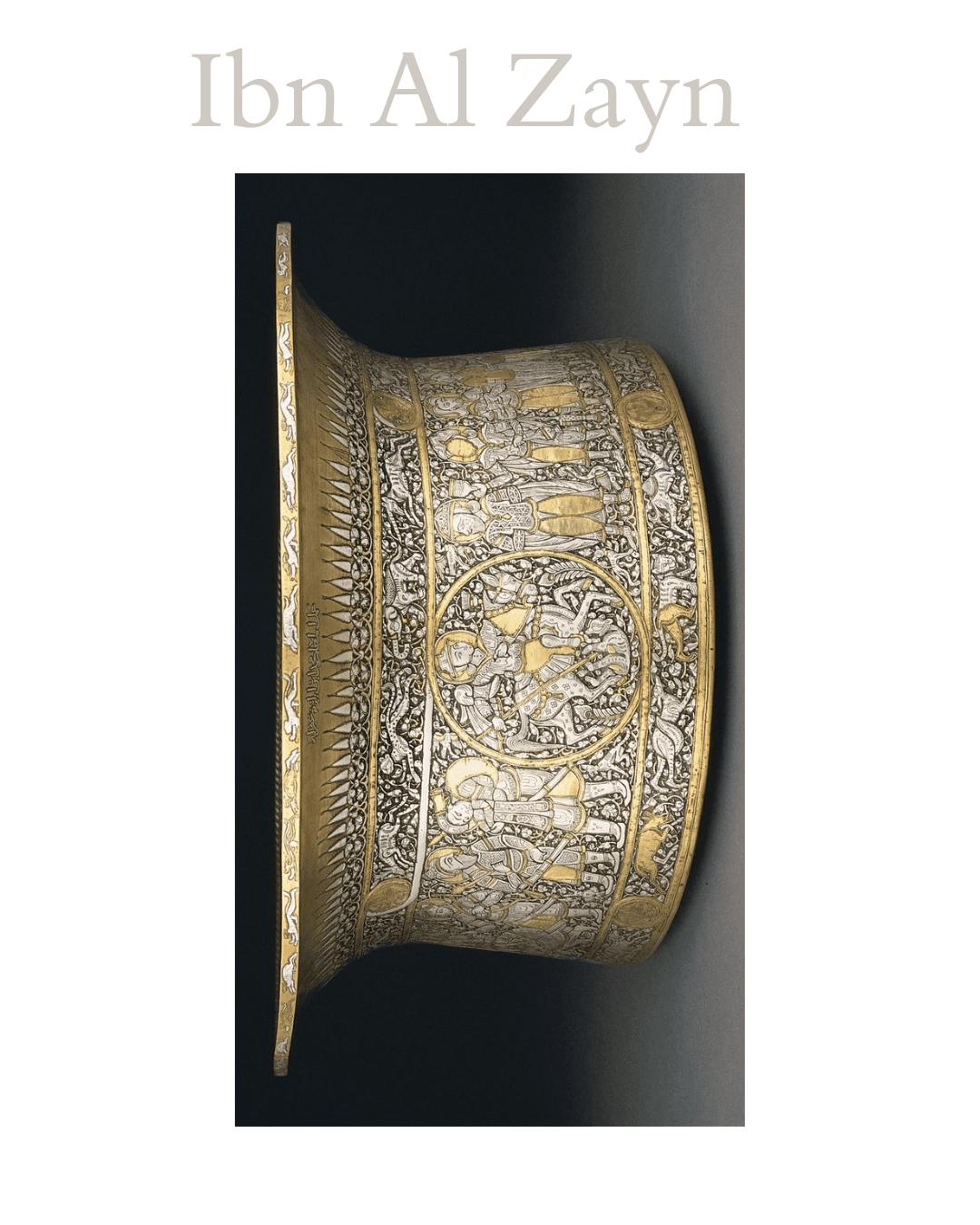
How Muhammad ibn al-Zayn’s Mamluk basin crossed civilizations, acquired a French royal identity and kept the name of its maker
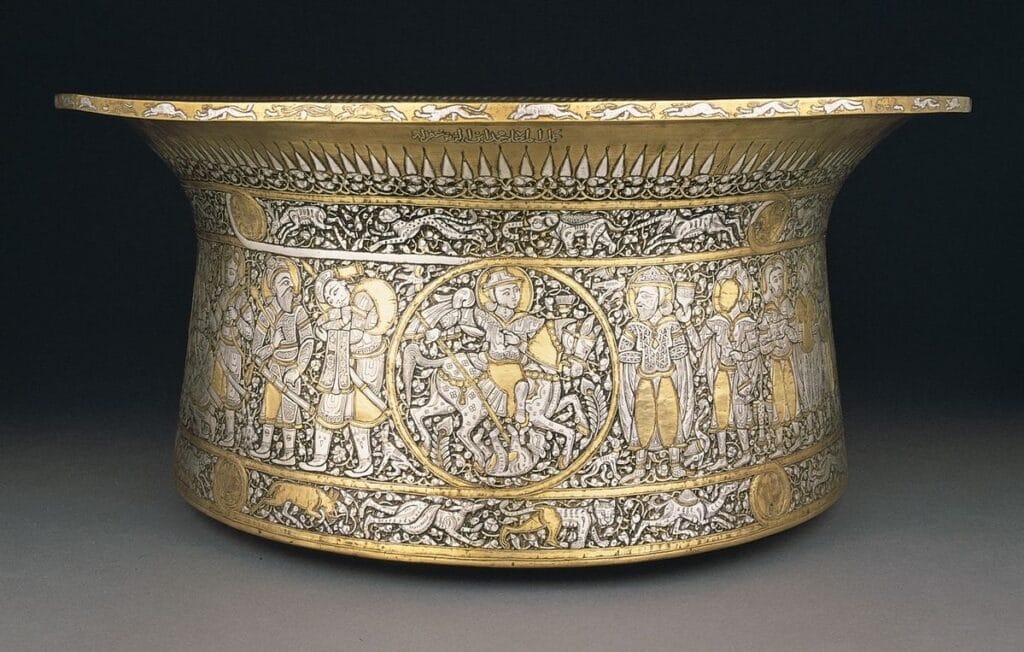
In September 2026, one of the Louvre’s most enigmatic masterpieces will cross the Atlantic. The Smithsonian’s National Museum of Asian Art in Washington, D.C., will open From the Louvre: Masterpieces of Islamic Art on September 26, bringing twenty-six works of Islamic art to the United States for their only American presentation. Among them is an extraordinary fourteenth-century basin known today as the Baptistère de Saint Louis.
Its French name, however, tells almost nothing about where it came from.
Made in Egypt or Syria around 1325–1340, under the Mamluks, the basin is an exceptional work of copper alloy engraved and inlaid with silver, gold and black compound. Its surface is almost entirely alive: mounted hunters, courtiers, warriors, princes, falcons, dogs, leopards, antelopes and other animals move across bands and medallions, while an extraordinary aquatic world unfolds at the bottom.
Look closely and one assumption about Islamic art immediately begins to collapse.
An Islamic Masterpiece Filled with Human Figures
Geometry, vegetal ornament and calligraphy have become some of the most recognizable languages of Islamic art. Yet the Baptistère de Saint Louis reminds us that figural representation also occupied an important place in the secular and courtly arts of the Muslim world.
This basin tells another story.
The Louvre itself emphasizes the extraordinary attention paid to the figures: their clothing, attributes and even their individualized physiognomies. Figural courtly and hunting scenes were well established in secular Islamic art, particularly on luxury objects produced for elite patrons.
Some faces on the basin today appear incomplete or damaged. It is tempting to read this as religious hesitation on the part of the maker. But there is no evidence that Muhammad ibn al-Zayn deliberately left his figures faceless. What survives instead is evidence of a remarkably confident pictorial language.
And then there is his name.
Not hidden.
Repeated.
The Name That Survived
Muhammad ibn al-Zayn signed the basin six times. The identity of the person who commissioned such an extraordinary object is unknown; the artisan, however, made certain that his own authorship would remain visible.
One inscription, written in Arabic thuluth along the exterior rim, reads:
“Work of the master Muhammad ibn al-Zayn, may he be forgiven.”
The words deserve attention.
ʿAmal — عمل: the work of. A conventional formula through which artisans in the Islamic world identified their craftsmanship.
Duʿāʾ — دعاء: invocation. His name is followed not by praise of himself, but by a prayer.
Maghfira — مغفرة: forgiveness. Ghafara lahu places the maker under the hope of Allah’s forgiveness.
And behind it stands tawāḍuʿ — تواضع: humility before Allah ﷻ.
We should not turn those words into a confession Muhammad ibn al-Zayn never gave us. Pious formulas, prayers and invocations were widespread in Islamic epigraphy, and “may he be forgiven” does not prove that the artist regretted depicting human figures or felt guilty about producing this particular work.
Yet history would give his prayer an extraordinary afterlife.
Because we do not know for whom he made the basin.
We do not know exactly how it left the Islamic world.
And he could not have known what France would eventually do with it.
The Fleurs-de-Lis That Were Not French
Among the basin’s most intriguing details are its heraldic emblems.
Fleur-de-lis forms appear repeatedly within its decoration. To a European eye, they seem immediately French. Yet D. S. Rice’s landmark study of the basin showed why that reading is too simple: the fleur-de-lis also belonged to an eastern heraldic vocabulary and was associated with Mamluk power, including the house of Qalāwūn.
Other heraldic traces have generated still more debate: a rampant lion, as well as a tamgha-like device connected by scholars to a broader Turco-Mongol heraldic language. The identity of the original patron remains unresolved. Rice famously noted the paradox: the maker is known, but nowhere does the magnificent vessel reveal the name of its owner.
That ambiguity would only deepen over time.
Centuries later, genuinely French arms would be placed upon it.
How a Mamluk Basin Became the “Baptistère de Saint Louis”
Saint Louis, King Louis IX of France died in 1270.
The basin was created decades later.
It could never have belonged to him. The Louvre now states this plainly.
Yet in 1791, antiquarian Aubin-Louis Millin published the object in his Antiquités nationales and coined the appellation by which it is still known: “Baptistère de Saint-Louis.” Louvre curator Carine Juvin has traced precisely how an Islamic object gradually became constructed in French historiography as a national historical monument.
By 1866, Adrien de Longpérier was already describing it scientifically as a “Arab metal vessel” kept at the Louvre under the name Baptistère de Saint Louis. The attribution to the medieval French king could no longer withstand the evidence.
The name nevertheless survived.
And France did more than rename the object.
For the baptism of the future comte de Chambord in 1821, two coats of arms of France were physically added to the basin. The Louvre also records its earlier use for the baptism of the future Louis XIII in 1606, and again in 1856 for the son of Napoleon III.
A masterpiece born in the Islamic Mamluk world had entered the ritual life of the French Christian monarchy.
A Prayer Across Civilizations
This is where the history becomes almost vertiginous.
A Muslim master produces an object of extraordinary refinement.
He engraves his name into its metal.
And beside that name, he leaves a prayer:
May he be forgiven.
Centuries pass.
Its patron disappears from memory.
Its original function becomes uncertain.
The basin crosses borders.
A foreign civilization gives it another name.
Royal arms are placed upon it.
And the work of Muhammad ibn al-Zayn becomes a vessel used in the Christian baptism of heirs belonging to a monarchy whose own political theology understood royal authority through a sacred relationship with God.
We cannot know what Muhammad ibn al-Zayn would have thought.
We should not pretend to know.
But we can contemplate the extraordinary irony of the trajectory.
His object’s meaning changed.
Its religion of use changed.
Its national identity changed.
Its supposed history changed.
His name did not.
France gave the basin another name.
Royal ritual gave it another purpose.
Later scholarship recovered its Mamluk origin.
But Muhammad ibn al-Zayn had already written himself into the metal.
Six centuries of reinterpretation could not erase him.
And perhaps this is where the story of the basin becomes larger than the extraordinary fate of a single object.
Its successive identities do not cancel one another; they reveal the way civilizations meet, borrow, reinterpret and sometimes absorb what came from elsewhere.
Beneath the French name, the royal baptisms and the centuries of accumulated memory, the Mamluk object never entirely disappeared. Its metal continued to carry another geography, another artistic language and, above all, the name of the Muslim master who made it.
And perhaps this is where the story of the basin becomes larger than the extraordinary fate of a single object.
An Object Between Worlds
The Baptistère de Saint Louis unsettles the reassuring idea that civilizations develop inside sealed borders.
It was born in the Mamluk world, shaped by the artistic vocabulary of Islamic civilization and probably made for an elite context whose precise identity has been lost. Centuries later, it entered French royal memory and acquired a Christian ritual function.
None of these histories completely erases the others.
They accumulate.
The basin can be Mamluk by origin, Islamic in its artistic language, French in part of its dynastic memory and Christian in its later ritual use.
This does not make its identity less precise.
It makes its history more revealing.
Objects travel.
Forms migrate.
Meanings change.
A motif may be read differently by another culture. A luxury object may become a ritual vessel. A foreign masterpiece may eventually be perceived as part of a national heritage.
And sometimes the stories attached to an object become so powerful that they almost conceal the civilization that first produced it.
Recovering that origin does not require erasing everything that came afterwards.
It requires learning to see all the layers at once.
Perhaps this is one of the most fascinating lessons of Islamic art itself.
Its history has never been confined to the geographical borders we draw today. Objects made in Cairo, Damascus, Mosul or elsewhere in the Muslim world travelled through courts, treasuries, churches and collections far beyond their places of origin.
They became admired.
Collected.
Reinterpreted.
Sometimes misunderstood.
And sometimes absorbed so deeply into another culture that their Islamic origin nearly disappeared from view.
The Baptistère de Saint Louis carries that entire history on a single surface.
The Object Travels Again
In September 2026, the basin will travel once more.
This time, from Paris to Washington, as part of From the Louvre: Masterpieces of Islamic Art at the Smithsonian’s National Museum of Asian Art.
And there is something almost circular about that journey.
For centuries, the basin was remembered primarily through the identity France gave it.
Today, it travels internationally as what scholarship has gradually allowed us to see again:
a masterpiece of Islamic art.
We may never recover the name of its original patron.
We may never know precisely what Muhammad ibn al-Zayn intended its first function to be.
We may never reconstruct every stage of its journey from the Mamluk world to France.
But history has returned something essential to the surface.
The civilization that produced it.
The extraordinary intelligence embedded in its decoration.
And the identity of the man who made it.
France gave the basin another name.
Royal ritual gave it another purpose.
Centuries of interpretation gave it other identities.
Muhammad ibn al-Zayn had already given it something stronger.
His own.
And beside it, a prayer that survived every transformation:
ʿamal al-muʿallim Muḥammad ibn al-Zayn — ghafara lahu.
The work of the master Muhammad ibn al-Zayn.
May he be forgiven.