What can a fruit native to Mexico, adopted by the Mediterranean and woven into Arab memory teach us about ṣabr?
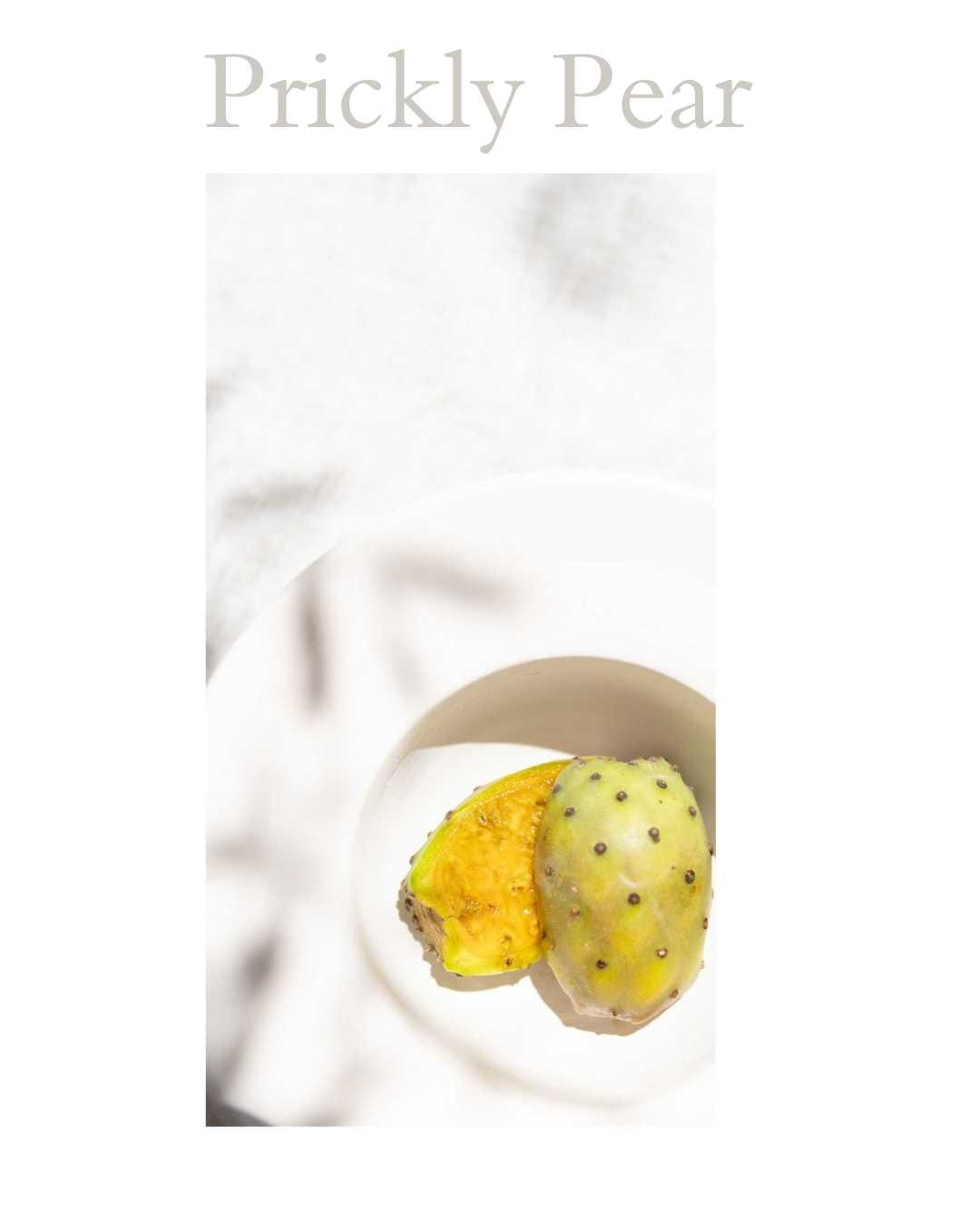
Oval. Brightly coloured. Armoured in almost invisible spines. Something to admire, perhaps, but not quite to touch.
Across Mexico, the Mediterranean and much of North Africa and the Middle East, it carries another life.
In Mexico it is tuna, the fruit of the nopal. In Palestinian ethnographic research, the cactus and its fruit appear as saber: a plant associated with land boundaries, communal life, patience and endurance.
One fruit. Many names. Several civilisations.
And beneath them all, the same surprise: sweetness protected by thorns.
A conventional article about prickly pear would begin with nutrients. But this fruit also carries a history of travel, a remarkable botanical structure and, in Palestinian culture, a language of endurance.
What Is Prickly Pear?
Prickly pear is the edible fruit of Opuntia, a genus native to the Americas. The cultivated species at the centre of this article, Opuntia ficus-indica, has a native range in Oaxaca, Mexico, according to the Royal Botanic Gardens, Kew. Molecular research likewise places its closest relatives and centre of domestication in central and southern Mexico. After European contact with the Americas, cacti were carried across the Atlantic; O. ficus-indica later became established throughout the Mediterranean and in arid regions far beyond it.
Its journey matters.
The cactus was not born in Morocco, Algeria, Tunisia or Palestine. Kew now records O. ficus-indica as introduced in each of these places. Over time, cultivation made it part of Mediterranean and North African landscapes and food cultures.
A plant can be foreign to a continent and still become native to memory.
Its movement across languages is preserved in documented names such as the Spanish tuna and nopal, and the English “Indian fig” or “cactus pear.” Regional Arabic names vary considerably. This article therefore does not present any one term as universal across the Arab world.
A name can become a small archive. Foods do not merely travel across land. They enter language, acquire affection and become part of how a people recognises a season.
The Architecture of Endurance
The prickly pear cactus does not survive dry landscapes by ignoring their severity.
It survives by responding to them with extraordinary precision.
The Stem Becomes More Than a Stem
The broad green pads, called cladodes, are not leaves. They are flattened stems that perform several tasks at once: they support the plant, carry out photosynthesis and hold substantial reserves of water.
The leaves themselves are reduced and short-lived. The work that a leaf would ordinarily perform has been transferred to a thicker structure with a smaller water-losing surface. Inside the cladode, enlarged water-storage tissues and mucilage-rich cells help retain moisture. Outside, a protective cuticle slows evaporation.
Nothing is ornamental excess. Form answers condition.
The Plant Opens to the Night
Most plants open microscopic pores called stomata during the day to take in carbon dioxide for photosynthesis. That exchange also releases water vapour. Opuntia ficus-indica uses Crassulacean Acid Metabolism, or CAM: much of its gas exchange takes place at night, when temperatures are lower and water loss is reduced. Carbon is stored temporarily and used when daylight returns.
It does not abandon photosynthesis because the day is severe. It changes the time at which part of the work is done.
The Roots Do Not Waste the Rain
Below ground, the plant develops a shallow root system able to respond rapidly when moisture reaches the upper soil. Scientific studies describe temporary “rain roots” that emerge after rewetting and decline again as the soil dries. The plant does not require the rain to remain before it begins to receive it.
Its architecture is therefore not only about keeping a reserve. It is also about recognising a brief opening.
The Wound Learns to Close
Even a detached cladode can remain viable for months. FAO research describes how a cut surface undergoes healing and suberisation, forming a seal that limits further water loss. Mucilage released by wounded cells assists this process, while water already held inside the cladode can support the formation of new roots and shoots.
The same structure that stores water also participates in repair.
Protection Does Not Cancel Generosity
Spines and tiny barbed glochids protect the plant from being consumed without resistance. Yet protection is not the final purpose of the structure.
From it comes fruit.
Green, yellow, orange, red or purple according to the cultivar, the prickly pear offers water, fibre, colour, sweetness and seeds. The exterior demands care from the hand. The interior gives nourishment.
This is not passive survival. It is an architecture of endurance: receive quickly, conserve carefully, open at the right time, protect what is vulnerable, repair what is wounde and continue to bear fruit.
Perhaps this is why the prickly pear lends itself so naturally to reflection. It does not teach that hardship is beautiful. Thorns wound. Drought exhausts. Difficulty should never be romanticised.
It reveals something more exact: living structures can respond to difficult conditions through forms of precision that comfort would never require.
The Book of Creation and the Book of Revelation
The prickly pear is not named in the Qur’an. The connection we make here is therefore not scriptural identification, but contemplation.
The Book of Revelation gives us the language of ṣabr. The Book of Creation gives us forms through which endurance can be observed.
The two must not be confused. A cactus is not a tafsīr of a verse. But the Qur’an repeatedly asks human beings to look at what grows from the earth and to recognise signs for those who reflect.
Allah ﷻ says of the rain and what He brings forth through it:
“With it He produces for you various crops, olives, palm trees, grapevines, and every type of fruit. Surely in this is a sign for those who reflect.”
Surah An-Naḥl, 16:11
The prickly pear belongs to that field of attention: not a sign whose meaning we may claim to exhaust, but a created structure whose precision invites the gaze.
From Saber the Fruit to Ṣabr the Virtue
In a peer-reviewed study of Palestinian botanical symbolism, anthropologist Nasser Abufarha records the Palestinian term as saber. He explains that it means “patience” and documents the proverb saber as-sabbar—“the patience of the cactus.” His study connects the plant with rural community, endurance and the sweetness of village life alongside hardship. This is a specifically documented Palestinian cultural meaning; it should not be presented as a universal Arabic name or symbolism.
That meaning opens naturally toward ṣabr—صبر—the Qur’anic virtue of patience and steadfastness through difficulty.
Allah ﷻ says:
“O believers! Seek comfort in patience and prayer. Allah is truly with those who are patient.”
Surah Al-Baqarah, 2:153
The relationship is evocative, but it must be handled with care. The cactus is not a botanical commentary on this verse, and the reflections drawn from its structure are contemplative rather than revealed meanings.
Yet cultures often recognise moral truths through the forms around them.
Yet the prickly pear gives endurance a visible language.
It does not wait for the landscape to become gentle before it grows.
It does not surrender its tenderness because protection is necessary.
It bears fruit without pretending that the thorns are absent.
Ṣabr is not the denial of pain. It is the discipline that prevents pain from deciding what we become.
When a Plant Becomes a Witness
In Palestine, the cactus carries another layer of meaning.
Before 1948, rows of cactus were traditionally planted in Palestine to demarcate orchards and fields and to act as protective fences, according to Abufarha’s ethnographic research. Their dense pads marked boundaries while the fruit was shared within the village community.
In the late 1980s and early 1990s, Palestinian researchers documenting villages depopulated and destroyed in 1948 repeatedly noted cactus growth at the sites. Abufarha describes the plant as an indicator in the landscape and explains how its persistence acquired new meaning in Palestinian cultural memory.
The cactus became more than a metaphor for endurance. It became botanical memory.
This is why sabr in Palestinian culture can speak simultaneously of patience, land, survival and belonging. Not because the cactus has always been native to Palestine, it has not but because people made a relationship with it, and history gave that relationship weight.
Roots do not always begin where they become meaningful.
Sometimes belonging is created through care, continuity and the refusal to forget.
Prickly Pear Benefits—Without the Superfood Myth
Prickly pear does not need exaggerated promises to be worth eating.
USDA FoodData Central records raw prickly pear at approximately 88 per cent water and 41 calories per 100 grams, with 3.6 grams of fibre, 14 milligrams of vitamin C, and minerals including magnesium, calcium and potassium. Values vary by species, cultivar, ripeness and growing conditions. Its yellow, orange, red and purple hues come partly from betalain pigments and other bioactive compounds studied for antioxidant activity.
Research into Opuntia is promising, but the fruit should not be presented as a treatment for diabetes, inflammation, high cholesterol or any other medical condition. Studies vary by species, preparation and dose; a fresh fruit is not equivalent to a concentrated extract.
Its most honest benefits are simpler.
It contributes water. It provides fibre and micronutrients. It offers natural sweetness. And when eaten in season, it reconnects nourishment with place and time.
As with watermelon and the wisdom of balance, the lesson is not that one ingredient must save us. Nourishment is rarely found in the cult of a single food. It lives in proportion, variety and attention.
How Do You Eat a Prickly Pear?
The fruit must be handled carefully because its skin carries tiny hair-like spines called glochids, even when it appears smooth.
Traditionally, experienced vendors remove them and peel the fruit in a few swift movements. At home, use tongs or thick gloves, rinse the fruit carefully, cut off both ends, score the skin lengthwise and peel it away without touching your face or eyes. The pulp can then be eaten fresh and chilled.
Its seeds are edible, although they are firm. They may be swallowed, removed while eating or strained out when the fruit is used for juice, syrup or jam.
The flavour varies by colour and ripeness: gently sweet, fresh and delicate rather than intense. But for those who grew up with it, taste is only part of the experience.
The real flavour is often memory.
What Sweetness Chooses to Become
Modern wellness teaches us to look at prickly pear and ask what it can do for us.
How many antioxidants?
How much fibre?
What result can be extracted from it?
These questions have their place. But they are not the only way to encounter food.
Look again.
At a traveller from Mexico that found new languages around the Mediterranean.
At a cactus that transformed water scarcity into a lesson in measure.
At a fruit whose Palestinian name carries patience, community and land.
At sweetness that did not require the disappearance of every thorn before it could exist.
Perhaps ṣabr is not standing still until hardship ends.
Perhaps it is the sacred work of remaining faithful, lucid and capable of bearing goodness while moving through it.
Through the gaze Islam teaches one that reads Creation without confusing it with Revelation, the prickly pear becomes an invitation.
Not to glorify the thorn.
To ask what, despite it, we will continue to grow.