From Jujube Fruit to Sidrat al-Muntaha
Some forms of beauty come from design.
Others come from nature.
But the rarest ones come from Revelation.
Long before wellness trends, superfoods, and beauty rituals became global industries, the Islamic tradition already carried a profound relationship with the natural world.
Not every treasure arrived in the form of gold.
Some arrived as fruits.
Some as leaves.
Some as trees.
Among them stands a remarkable lineage often overlooked today:
the lineage of Sidr and Nabq.
A Tree Mentioned in the Qur’an
The jujube, known in Arabic as Nabq (نبق), belongs to the wider botanical family of the Sidr tree.
A family honored in the Qur’an:
“And the companions of the right will be among lote trees without thorns.”
Surah Al-Waqi’ah (56:28)
For many Muslims, the Sidr is associated with beauty, abundance, and the signs of Allah ﷻ found throughout creation.
But the story does not end there.
The Tree That Accompanied Life
Across the Muslim world, the Sidr tree accompanied people through every stage of life.
Its leaves were used for cleansing.
Its fruits for nourishment.
Its shade for protection.
Its honey for healing.
Its wood for daily use.
The Prophet Muhammad ﷺ recommended Sidr leaves in specific purification practices, including the washing of the deceased.
A reminder that dignity does not end with death.
Even farewell deserves beauty.
Beauty Passed From Generation To Generation
Long before modern shampoos and hair masks, women across the Arab and Muslim world used powdered Sidr leaves mixed with water, rose water, or natural oils.
Applied as a paste to the hair and scalp, Sidr became part of beauty rituals passed from generation to generation.
Not as a trend.
Not as a brand.
But as inherited knowledge.
A beauty rooted in nature.
A beauty rooted in transmission.
A beauty rooted in memory.
Even today, Sidr powder remains widely used across the Arabian Peninsula, North Africa, and parts of South Asia as a natural hair treatment associated with cleansing and caring for the hair.
Another reminder that many contemporary wellness practices have much older roots than we often imagine.
A Family of Treasures
Today, many people know Sidr honey.
Harvested across Yemen, Saudi Arabia, Oman, Pakistan, and other regions, it is often considered among the most prized honeys in the world.
Golden.
Dense.
Fragrant.
A product born from the same botanical lineage.
The same family that gives us the humble jujube.
A fruit that rarely appears in luxury stores.
Yet carries centuries of wisdom.
If you enjoyed discovering the story of Sidr honey, you may also appreciate our reflection on Iron, another natural gift whose significance extends far beyond its material properties.
The Forgotten Fruit
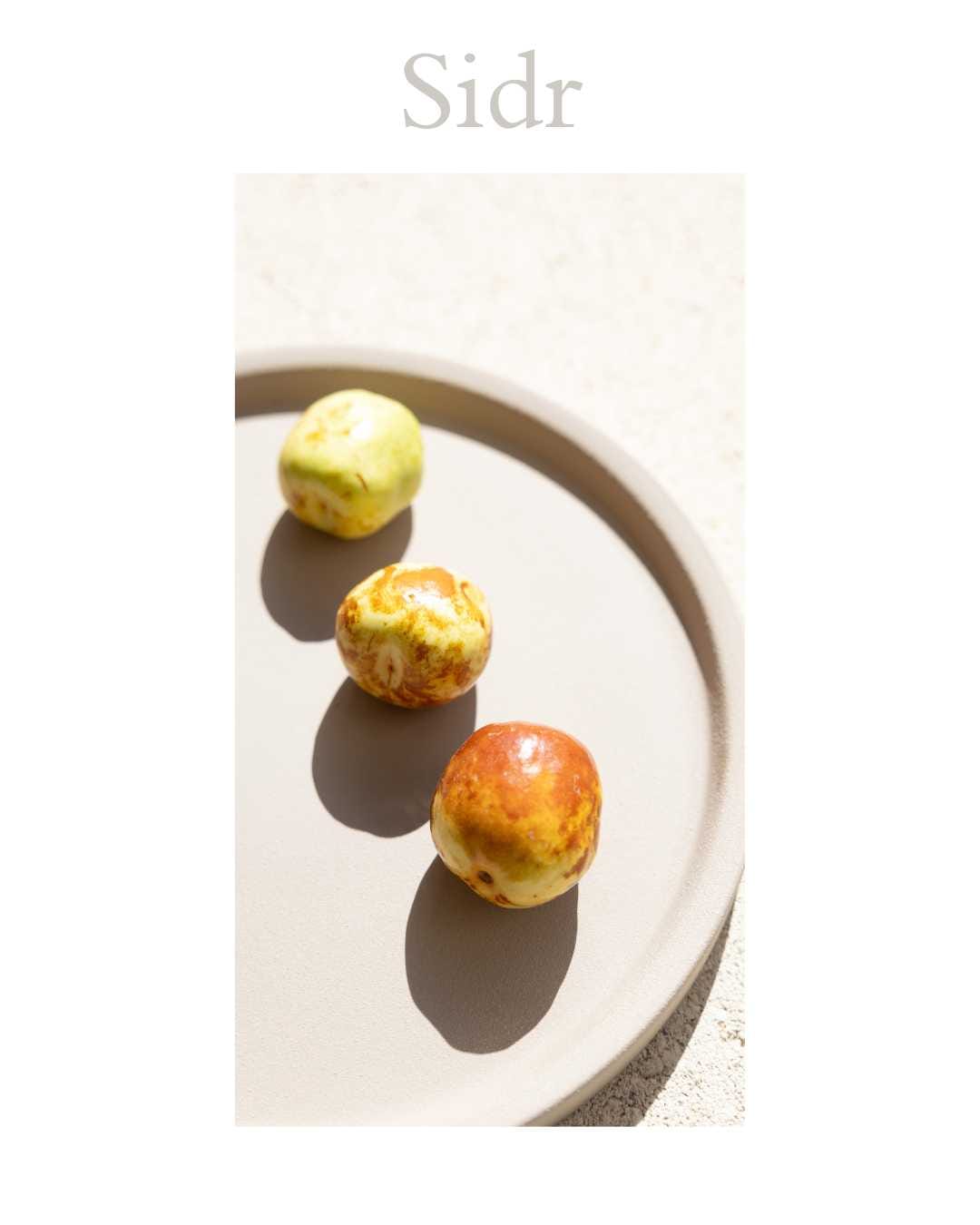
Fresh jujube begins pale green.
As it matures, it develops golden tones before turning deep red when dried.
In many parts of Asia, it is known as the Red Date.
For centuries it has been used in:
- teas
- tonics
- cakes
- sweets
- herbal preparations
- traditional wellness practices
Quietly nourishing generations.
Modern nutritional research has highlighted many of the qualities traditional cultures already recognized.
Jujube contains:
- Vitamin C
- antioxidants
- dietary fiber
- beneficial plant compounds
Yet perhaps its greatest value is not nutritional.
It is cultural.
In a world searching for the next superfood, we often overlook the gifts already rooted in our own heritage.
The Tree At The Edge Of Creation
The Sidr is not only a tree of the earth.
It is also one of the most powerful symbols in Islamic tradition.
During the Night Journey and Ascension (Al-Isra’ wal-Mi’raj), the Prophet Muhammad ﷺ reached a place known as:
Sidrat al-Muntaha
(The Lote Tree of the Utmost Boundary).
Allah ﷻ mentions it in the Qur’an:
“At the Lote Tree of the Utmost Boundary.”
Surah An-Najm (53 verse 14)
A place beyond which creation does not pass.
A place associated with proximity, knowledge, mystery, and the limits of the created world.
Its exact reality belongs to Allah ﷻ.
But its symbolism remains profound.
The same botanical family that gives us a humble fruit on earth also appears in one of the most majestic passages of the Qur’an.
From the soil to the heavens.
From nourishment to transcendence.
From the ordinary to the sacred.
Why We Still Look For The Sidr
The Sidr mentioned in the Qur’an and the Sidrat al-Muntaha mentioned during the Night Journey are not the same reality.
One belongs to this world.
The other belongs to a realm beyond it.
And yet the connection remains striking.
Perhaps this is why Muslims have never entirely forgotten this tree.
Not because it is rare.
Not because it is expensive.
Not because it became fashionable.
But because it was mentioned.
And when something is mentioned by the One you love, you begin to notice it differently.
You look for it.
You remember it.
You pay attention to it.
The jujube remains widely used across parts of Asia in teas, cakes, sweets, and traditional preparations.
Sidr leaves continue to be used in beauty rituals throughout the Arab and Muslim world.
Outside these regions, however, many people know little about the tree beyond Sidr honey.
Yet its presence endures.
Its fragrance, sometimes reminiscent of henna, carries memories.
Its leaves, fruits, and flowers continue to accompany daily life.
And perhaps that is the deeper invitation.
Not simply to learn about a tree.
But to search for meaning.
To search for alignment between the earthly and the celestial.
To recognize that creation is filled with signs pointing beyond themselves.
The great Muslim poets often described love as a state of heightened attention.
The lover notices what others overlook.
Remembers what others forget.
Searches for traces wherever they appear.
Perhaps the Sidr invites a similar gaze.
Not a gaze of possession.
But a gaze of recognition.
One that sees the world not as a collection of objects, but as a landscape of signs.
And once a thing has been mentioned in the Qur’an, it is never entirely ordinary again.
Nourishment Beyond Calories
Islamic civilization never viewed food solely as fuel.
Food was also memory.
Identity.
Transmission.
A way of remembering the Creator through creation.
The jujube reminds us that nourishment is not only about what enters the body.
It is also about what reconnects us to our story.
In many ways, this reflection echoes our article on Mountains, where a familiar element of the natural world reveals a deeper layer of meaning once viewed through the lens of the Qur’an.
A Seasonal Gift
Fresh, it is crisp and delicate.
Dried, it becomes soft, rich, and concentrated.
A fruit that transforms without losing its essence.
Perhaps there is a lesson in that.
Some things mature with time.
And become more valuable because of it.
Closing Reflection
Sometimes the most meaningful gifts are the ones we stopped noticing.
The jujube may never become as famous as dates or pomegranates.
Yet it remains part of a lineage planted deep within the landscape of Islamic civilization.
A quiet fruit.
A noble tree.
A forgotten inheritance waiting to be rediscovered.
And perhaps that is one of the recurring lessons of Islamic heritage:
before searching elsewhere, learn to recognize the treasures already growing at your feet.