Iftar in Islam, Seasonal Provision, and Preparing for Taraweeh and Tahajjud
Breaking the fast in Ramadan, known as iftar, is one of the most spiritually and physically significant moments of the day.
After abstaining from food and drink from dawn (Fajr) until sunset (Maghrib), Muslims worldwide gather to break their fast.
But how we break the fast matters.
Iftar is not only about satisfying hunger.
It is about discipline, moderation, and preparing for the night of worship.
What Is Iftar in Islam?
Iftar (إفطار) is the evening meal eaten at sunset to break the daily fast during Ramadan
The Prophet Muhammad ﷺ said:
“The people will remain upon goodness as long as they hasten to break the fast.”
(Sahih al-Bukhari, Sahih Muslim)
Iftar begins immediately at sunset.
It is a moment of gratitude, not excess.
How Did the Prophet ﷺ Break His Fast?
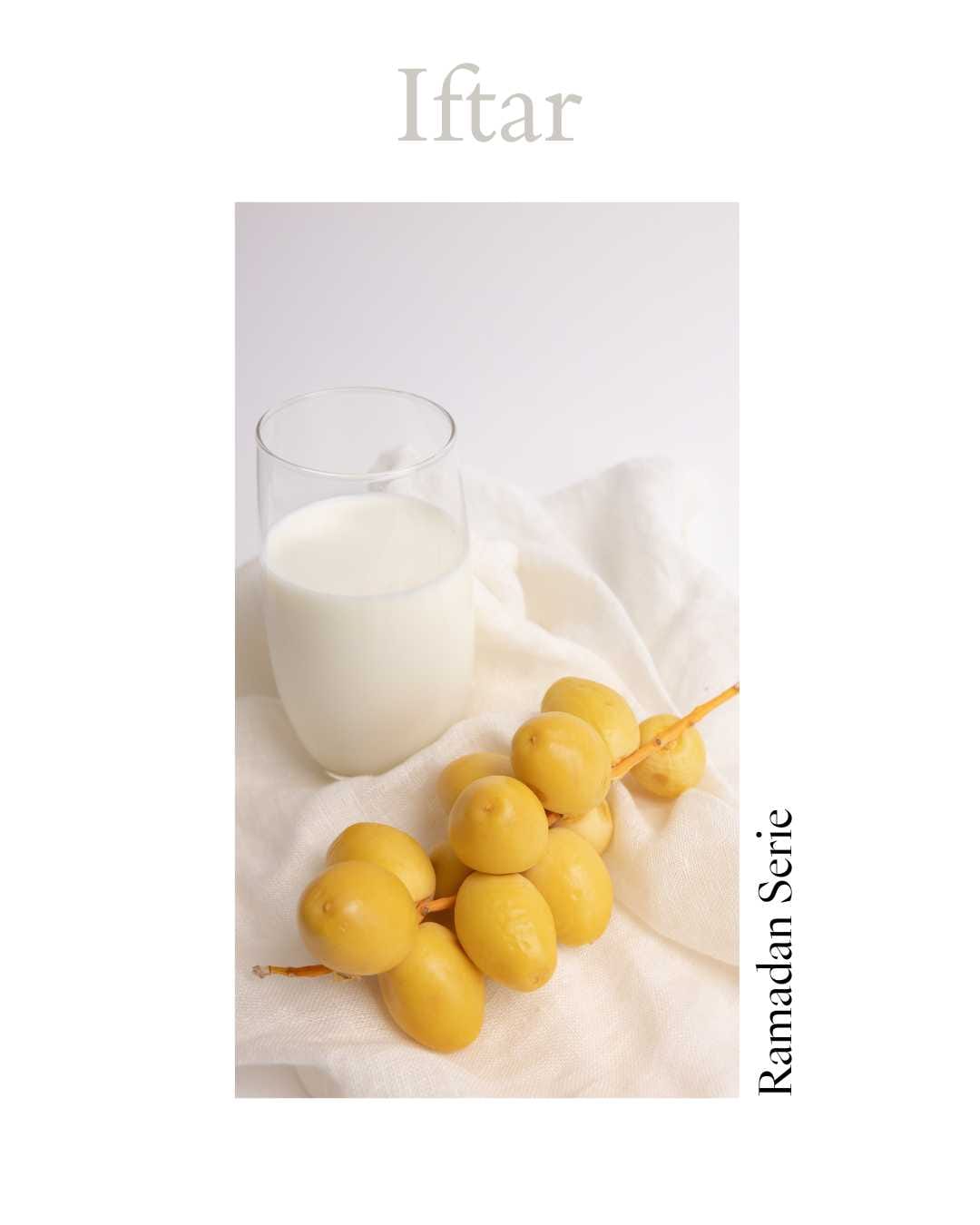
Authentic narrations report that the Prophet ﷺ would break his fast with:
- Fresh dates
- If unavailable, dry dates
- If unavailable, water
(Sunan Abu Dawud)
He also consumed:
- Dates with cucumber
- Dates with melon
- Milk
These were natural, balanced foods not elaborate meals.
The Prophetic model of iftar prioritizes:
- Simplicity
- Gradual nourishment
- Moderation
Dates provide immediate natural energy.
Water restores gently.
Milk nourishes steadily.
The goal was restoration — not overload.
Provision as Rahma: Food Is a Mercy, Not a Performance
In Islam, food is not neutral.
It is not merely fuel.
It is Rahma — mercy.
The Qur’an repeatedly reminds us that what grows from the earth, what ripens on trees, what flows from animals, is a gift from Allah سبحانه وتعالى.
Milk.
Dates.
Grain.
Olives.
Water.
These are not industrial inventions.
They are signs.
Across Morocco, Saudi Arabia, Makkah, Dakar, Jakarta — what appears on the Ramadan table differs. But the source does not.
Provision is local.
Mercy is universal.
Ramadan invites us to remember that what enters our body is not a right — it is a trust (Amanah).
And trust requires measure.
The One-Third Rule: Moderation in Islam
The Prophet ﷺ said:
“The son of Adam fills no vessel worse than his stomach…
If he must, then a third for food, a third for drink, and a third for air.”
(Ibn Majah)
This principle, often called the One-Third Rule — establishes moderation as a discipline.
If there is no space to breathe after eating,
there was no space for measure.
Ramadan trains restraint during the day.
Iftar reveals whether that restraint survives the night.
For a deeper exploration, see our article on The One-Third Principle: Appetite and Consciousness in Ramadan.⇗
Seasonal Provision: The Geography of Mercy
Breaking the fast in Ramadan looks different across the world.
What fills the markets in March in Morocco
is not identical to what is abundant in Saudi Arabia.
What is present in Makkah
differs from what families prepare in Dakar.
In Jakarta, climate shapes the evening table differently.
Islam does not impose one universal Ramadan menu.
It teaches:
Gratitude.
Consciousness.
Moderation.
Ramadan invites us to return to what is present in our land and season, the foods that grow where we live, at the time we live.
Provision changes by geography.
The principle does not.
And that diversity itself is mercy.
Hunger, Desire, and the Illusion of Abundance
After long hours of fasting, desire intensifies.
But often what we feel is not pure hunger, it is anticipation.
We imagine the table.
We anticipate satisfaction.
Yet within ten or fifteen minutes, we are full.
This mirrors life.
We pursue accumulation.
We chase abundance.
But in the end, only what is essential remains.
Ramadan compresses this lesson daily.
Iftar is a reminder that excess is rarely necessary.
Eating for Taraweeh and Tahajjud
Breaking the fast in Ramadan is not the end of worship.
It is preparation for the night.
After Maghrib comes:
- ‘Isha (night prayer)
- Taraweeh (special Ramadan prayer)
- Qur’an recitation
- Reflection
- Tahajjud (late-night prayer before Fajr)
As explained in Your Last Ten Nights Are Preparing Now: Laylat al-Qadr and the Architecture of Ramadan ⇗, the final third of the night holds particular significance.
In Sahih al-Bukhari and Sahih Muslim, it is reported that during the last third of the night, الله descends in a manner befitting His Majesty and says:
“Who is calling upon Me so that I may answer him?
Who is asking of Me so that I may give him?
Who is seeking My forgiveness so that I may forgive him?”
The last third of the night is sacred time.
Heavy eating makes standing in prayer difficult.
Moderate nourishment makes worship possible.
As discussed in Ramadan is a marathon of alignment, stamina is spiritual discipline.
And discipline begins at the table.
Sleep as a Reminder of Return
The Qur’an states:
(Qur’an, Surah Az-Zumar verse 42)
“الله takes the souls at the time of their death, and those that do not die during their sleep…”
Sleep is described as a form of temporary taking.
Each night we are returned.
Ramadan makes this cycle visible:
We fast.
We break the fast.
We pray.
We sleep.
We rise again.
One day, there will be a final return.
Ramadan trains awareness of that reality.
Practical Tips for a Conscious Iftar
• Begin with dates and water or milk.
• Pause before continuing.
• Choose seasonal vegetables and fruits available where you live.
• Avoid overeating in the first minutes of hunger.
• Leave physical space in the stomach.
• Eat in a way that supports Taraweeh and Tahajjud.
Iftar should restore strength — not exhaust it.
Conclusion :
Breaking the fast in Ramadan is not about filling the stomach.
It is about restoring balance.
Dates restore gently.
Water revives gradually.
Seasonal foods nourish wisely.
The fast lightens the body by day
so the heart can rise by night.
Ramadan is not only restraint.
It is elevation.
FAQ
What is iftar in Islam?
What is iftar in Islam?
Iftar is the meal eaten at sunset (Maghrib) to break the daily fast during Ramadan.
Why do Muslims break their fast with dates?
Why do Muslims break their fast with dates?
The Prophet ﷺ broke his fast with dates and water. Dates provide quick natural energy and gentle restoration after fasting.
What is the One-Third Rule in Islam?
What is the One-Third Rule in Islam?
The One-Third Rule advises that one-third of the stomach be for food, one-third for drink, and one-third for air to avoid excess.
Why is moderation important when breaking the fast?
Why is moderation important when breaking the fast?
Moderation helps maintain spiritual focus and supports night worship such as Taraweeh and Tahajjud.
What is Taraweeh?
What is Taraweeh?
Taraweeh is a special night prayer performed during Ramadan after the ‘Isha prayer.
What is Tahajjud?
What is Tahajjud?
Tahajjud is voluntary prayer performed during the last third of the night before Fajr.
Why is the last third of the night important in Islam?
Why is the last third of the night important in Islam?
Authentic hadith report that during the last third of the night, Allah descends in a manner befitting His Majesty and invites believers to supplicate and seek forgiveness.