What Sleep Reveals About the Limits of Human Control
Every night, we disappear from ourselves.
We close our eyes knowing almost nothing about what will happen next.
We do not witness the precise moment consciousness leaves us. We do not decide how deeply we will sleep. We cannot observe ourselves while we are gone. And, however carefully we may organise the following morning, we do not possess the certainty that we will wake to meet it.
For those hours we are ourselves part of what lies beyond our sight.
Sleep is so ordinary that we rarely consider what it asks us to do.
For several hours, every human being — powerful or powerless, wealthy or poor, surrounded or alone — relinquishes awareness of the world.
The day may have been filled with decisions.
The night eventually places all of them beyond our hands.
In the Qur’an, sleep is not treated merely as the biological interruption between two days.
It is an āyah.
A sign.
And one worth reflecting upon.
“And one of His signs is your sleep by night and by day ˹for rest˺ as well as your seeking His bounty ˹in both˺. Surely in this are signs for people who listen.”
— Qur’an, Surah Ar-Rūm (30:23), The Clear Qur’an, Dr. Mustafa Khattab
LE MOT
āyah (pl. āyāt) — a sign. The same Arabic word names a verse of the Qur’an and a sign placed in creation. Sleep is named among the second kind.
Sleep sits here among the signs of Allah ﷻ.
Not because it is extraordinary.
Perhaps precisely because it is not.
It comes to us every day.
We know it intimately.
And yet we control remarkably little of it.
The hours we do not govern
There is an illusion that accompanies waking life.
We move, choose, build, calculate, prepare, postpone, protect.
We learn to believe that because we can act upon the world, the world is therefore ours to command.
Sleep interrupts that illusion without argument.
It simply arrives.
The Qur’an offers a striking description:
“˹It is˺ Allah ˹Who˺ calls back the souls ˹of people˺ upon their death as well as ˹the souls˺ of the living during their sleep. Then He keeps those for whom He has ordained death, and releases the others until ˹their˺ appointed time.”
— Qur’an, Surah Az-Zumar (39:42), The Clear Qur’an, Dr. Mustafa Khattab
The verse does not ask us to transform sleep into a scientific mystery.
Nor does it invite us to speculate beyond what has been revealed about the nature of the soul.
Its language is already powerful enough.
Allah ﷻ calls back.
Allah ﷻ keeps.
Allah ﷻ releases.
The verbs belong to Him.
The sleeper does not call himself back.
He does not keep himself.
He does not release himself into the morning.
And the verse ends by telling us exactly what to do with this knowledge:
“Surely in this are signs for people who reflect.”
— Qur’an, Surah Az-Zumar (39:42)
Reflection is therefore not an addition to the verse.
It is part of its invitation.
Every night, something we consider entirely ordinary exposes a fundamental limit of human autonomy.
We can prepare a bed.
We cannot command consciousness to remain.
We can intend to rise.
We cannot guarantee the return.
“I die and I live”
The Prophetic tradition makes this relationship between sleep, death and awakening even more explicit.
Ḥudhayfah رضي الله عنه reported that when the Prophet Muhammad ﷺ went to bed, he would say:
Bismika Allāhumma amūtu wa aḥyā.
In Your name, O Allah, I die and I live.
And when he woke, he would say:
Al-ḥamdu lillāhi’lladhī aḥyānā baʿda mā amātanā wa ilayhi’n-nushūr.
Praise belongs to Allah who gave us life after causing us to die, and to Him is the resurrection.
There is something remarkable in the simplicity of these two invocations.
The night begins with death and life.
The morning begins with life restored.
And it ends with nushūr — resurrection.
A Muslim who recites these words does not merely mark the beginning and end of sleep.
The ordinary rhythm of evening and morning becomes a reminder of a much larger rhythm:
departure and return.
Life and death.
Sleep and awakening.
The return of one morning, and the final Return still to come.
And the word is not kept for the end of the world.
The Qur’an uses it for the morning.
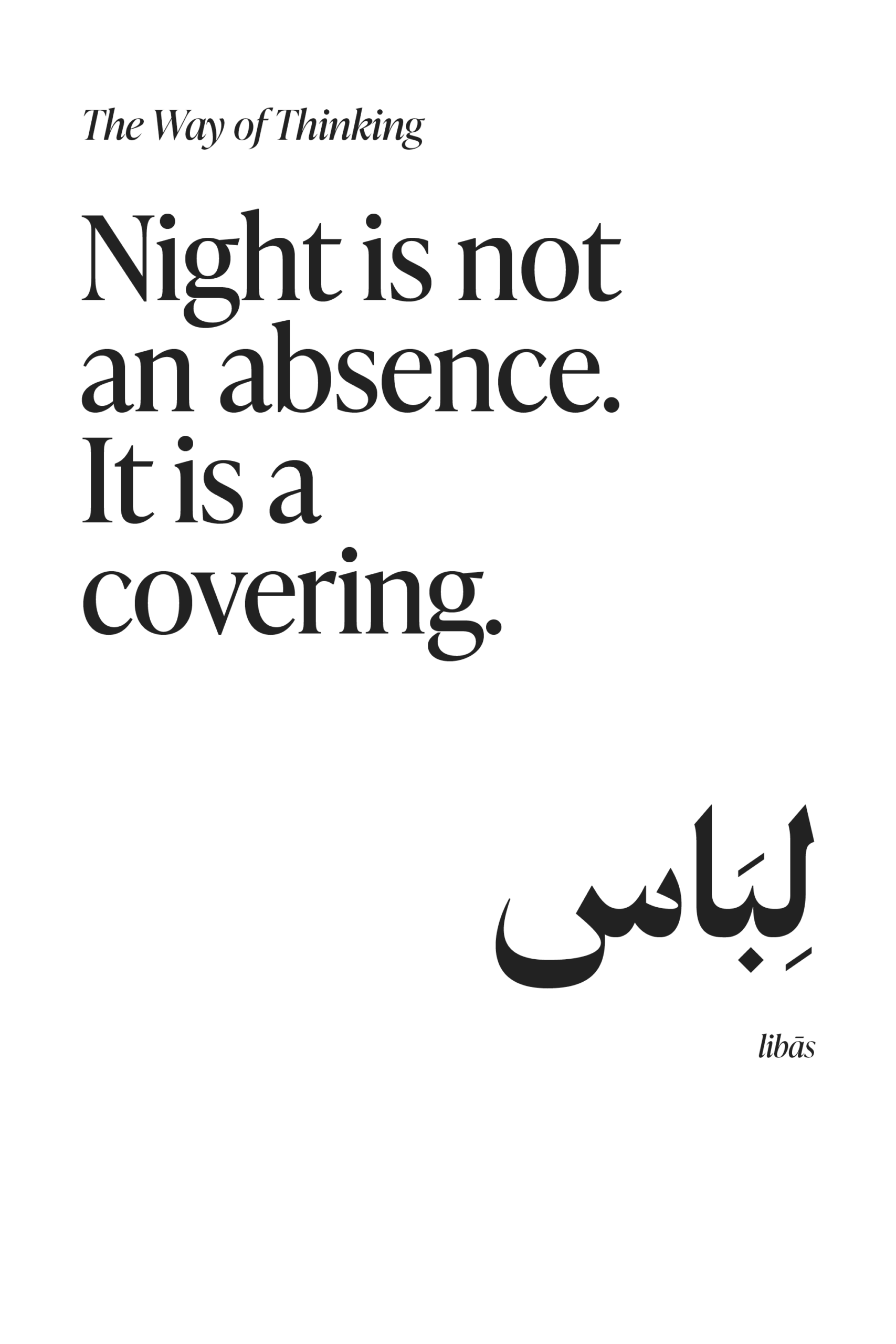
“He is the One Who has made the night for you as a cover, and ˹made˺ sleep for resting, and the day for rising.”
— Qur’an, Surah Al-Furqān (25:47), The Clear Qur’an, Dr. Mustafa Khattab
Night, sleep and day, held together in a single verse.
The night a covering.
Sleep a rest.
And the day a rising — nushūran, the same word that closes the morning invocation.
The day you are about to live carries the name of the resurrection.
The alternation of night and day runs through the Qur’an as one of the signs it asks us to read.
Sleep is where the two meet.
The word for that covering is libās.
A garment.
The Qur’an uses it again, of husband and wife: each is called a garment for the other.
Qur’an, Surah Al-Baqarah 2:187
The commentators do not settle on a single sense. Lisān al-ʿArab lists covering, and also mingling. Al-Rabīʿ ibn Anas read it as a blanket.
But the reading carried by Ibn ʿAbbās, Mujāhid, al-Ḥasan, Qatāda and al-Suddī is sakan — stillness, the place where one comes to rest.
No classical source joins the two verses.
The word does it on its own.
These readings are gathered in April Haji, Sidik Saiful Anwar, Andri Nirwana and Ahmad Nurrohim, Meaning of the Word Libās in Q.S. Al-Baqarah 2:187, International Conference on Islamic and Muhammadiyah Studies, Universitas Muhammadiyah Surakarta, 2022.
The language is not meant to make sleep frightening.
Quite the opposite.
The morning invocation is praise.
Awakening is received with al-ḥamdu lillāh.
The lesson is not that we should fear closing our eyes.
It is that waking was never as ordinary as we thought.
The minor death
Classical commentary has a name for what the invocation describes.
Sleep is called the minor death — al-mawt al-aṣghar.
Ibn Kathīr uses the term in his commentary on the verse of Az-Zumar. The expression is older than his commentary: al-Iṣfahānī records it as a saying already in circulation — sleep is a minor death, and death a deep sleep.
On what exactly is taken, they do not agree.
Al-Rāzī, in al-Tafsīr al-kabīr, holds that in sleep only part of our faculties stops, while in death the whole body does.
Al-Zamakhsharī, in al-Kashshāf, distinguishes two souls, and says that what is taken at night is the soul of intellect, not the soul of life.
The disagreement is old, and it is not settled.
It is worth leaving open.
What they do not disagree about is the shape of the thing.
Something is taken.
Something is given back.
These classical positions are gathered in Khan Sardaraz and Roslan bin Ali, Conceptualisation of Death and Resurrection in the Holy Quran: A Cognitive-Semantic Approach, Journal of Nusantara Studies, Universiti Sultan Zainal Abidin, vol. 1 no. 2, 2016.
When waking is received
Much of modern life teaches us to think of waking as the obvious continuation of yesterday.
We speak naturally of tomorrow.
We make appointments for it.
We prepare clothes for it.
We write lists for it.
We place things in calendars months ahead.
This ability to plan is not the problem.
Islam does not ask us to live without foresight.
But sleep quietly places planning back in its proper place.
We prepare for what may come.
We do not possess what comes.
Perhaps this is why waking can begin with gratitude before it begins with activity.
Before the first task, the first conversation, the first pursuit of provision, there is the recognition:
I have been returned.
Not because I engineered my return.
Not because I deserved another morning more than someone else.
But because another portion of time has been given.
The night therefore teaches something the day can easily make us forget:
our capacities are real.
Our control is not absolute.
A different architecture of rest
The life of the Prophet Muhammad ﷺ also prevents us from reducing sleep to a single block placed at the edge of the day.
ʿĀ’ishah رضي الله عنها was asked about his prayer at night. She explained that he would sleep during the first part of the night and rise during its latter part to pray. He could then return to his bed until the call to prayer.
And the sources preserve another form of rest within the day itself: al-qaylūlah, the midday pause.
Anas ibn Mālik رضي الله عنه reported that Umm Sulaym رضي الله عنها would spread a leather mat for the Prophet ﷺ in her home, and that he would take his midday rest there.
Al-qaylūlah deserves an exploration of its own.
But even briefly, it reveals something important.
Rest did not necessarily exist outside meaningful life.
It could belong within its architecture.
Night prayer, Fajr, the movement of the day, and a period of rest around its middle do not describe an obsession with sleeping less.
Nor do they offer a productivity formula fourteen centuries before the word existed.
They suggest something more subtle:
rest could serve wakefulness, and wakefulness could serve what mattered.
The body was not treated as an inconvenience to overcome.
Its limits were acknowledged.
Time was arranged around worship, responsibility and rest rather than demanding that one erase the others.
Al-qaylūlah was not an escape from the day.
It belonged to the day.
The body has a right over you
There is also a right involved.
ʿAbdullāh ibn ʿAmr رضي الله عنه fasted every day and prayed through every night. The Prophet ﷺ told him to stop.
“Your body has a right over you, your eyes have a right over you, and your wife has a right over you.”
The man being corrected was not idle.
He was worshipping.
And he was still told that his body held a claim his devotion did not cancel.
That is a harder standard than most of us apply to our work.
We treat sleep as the one variable that can always be reduced.
The hour we borrow from when a deadline moves, when a company is being built, when a child is small.
But it was given for rest.
And what is given for one thing is not ours to spend on another.
And what is owed is not the same for everyone.
No one is given a number.
Sleep and the illusion of self-sufficiency
There are experiences in life that reveal our dependence because they are exceptional.
Illness can do it.
Loss can do it.
Age can do it.
Sleep is different.
It reveals dependence while nothing is wrong.
No crisis is required.
No catastrophe needs to arrive.
A healthy person, at the height of strength and ability, will still eventually need to lie down and relinquish consciousness.
The powerful sleep.
The brilliant sleep.
The disciplined sleep.
The one who has mastered his craft sleeps.
The one who commands thousands of people sleeps.
There is no rank that exempts the human being from this return to limitation.
And perhaps that is part of the mercy of sleep.
We are not only allowed to stop.
We are made unable to continue indefinitely.
There is a limit built into us.
Not as humiliation.
As truth.
The Qur’an does not present human limitation as an error in the design.
It continually reminds us that we were never designed to be self-sufficient.
Sleep makes that knowledge physical.
For several hours, we cannot perform independence even if we wanted to.
The world continues without us
There is another lesson hidden in the night.
While we sleep, the world continues.
The earth does not wait.
The rain falls.
People are born.
People die.
Ships cross oceans.
Someone is praying Fajr while someone elsewhere has only just closed their eyes.
Night is arriving in one place while morning is breaking in another.
Creation continues its course without requiring our consciousness.
For people accustomed to carrying responsibilities, this may be one of sleep’s quietest teachings.
Everything does not depend on us.
Our work may matter.
Our families matter.
Our commitments matter.
What we build may matter enormously.
But the world is not held together by our vigilance.
We are participants in creation.
Not its sustainers.
Night after night, sleep demonstrates the difference.
The nightly return
There is a strange familiarity to awakening.
We open our eyes.
We recognise the room.
Memory returns.
Names return.
Responsibilities return.
Yesterday reconnects itself to today almost instantly.
So quickly, in fact, that we forget how extraordinary the transition is.
But the Prophetic words do not allow the transition to become invisible:
Who gave us life after causing us to die.
The first recognition of morning is not productivity.
It is return.
Perhaps this is one reason sleep belongs among the signs.
Because an āyah does not always need to be rare.
Sometimes the sign is precisely what happens so often that we have stopped seeing it.
The night takes us away from the illusion that consciousness, strength and tomorrow belong entirely to us.
Morning gives them back.
And between the two lies one of the most ordinary mysteries of human life:
we surrender the world every night,
and every morning we receive it again.
Until one morning,
the return will be of another kind.
LAYL WA NAHĀR ÉDITIONS
Islamic Art of Living is the editorial home of Layl wa Nahār Éditions. Our first book is in preparation.