Lunar time, social immersion and the challenge of keeping another rhythm visible
A calendar can look like one of the most neutral objects in our lives.
Dates.
Months.
Appointments.
School holidays.
Deadlines.
But a calendar is never only a system for counting days.
It tells a society when to work, when to stop, when to gather, when to remember and when something important is approaching.
It organises time.
But it also organises attention.
For Muslims living outside Muslim-majority countries, this creates a particular experience: living fully within one public calendar while trying to remain conscious of another rhythm moving through exactly the same days.
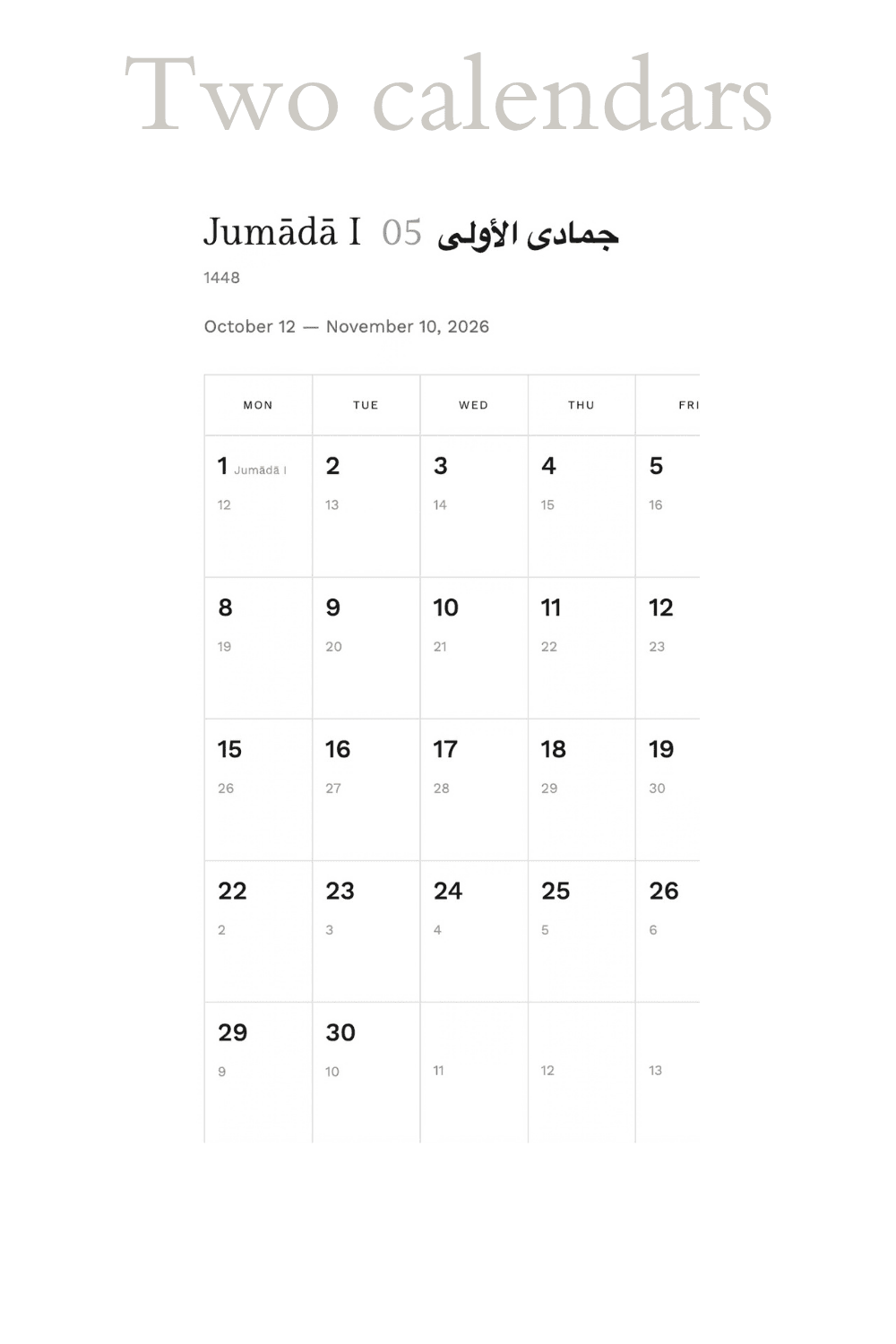
This is the experience from which our new Living Time Hijri Calendar was created.
Not because calendars do not already exist.
I needed something more specific.
I needed orientation, clarity, and a beauty that is useful.
A place where I could understand where we were in the Hijri year, what was approaching and why it mattered, while living in an environment where almost every external stimulus directed my attention toward another calendar.
When One Calendar Is Everywhere
Living with two calendars does not mean experiencing them equally.
One of them may be almost impossible not to know.
It appears on our phones.
On school documents.
In professional agendas.
On transport tickets.
On invoices.
In shop windows.
In advertising campaigns.
In public holidays.
In everyday language: next month, the end of the year, back to school, summer holidays.
The environment continuously tells us where we are within it.
And when an important period is approaching, the calendar often becomes physical.
Streets change.
Schools reorganise.
Shops change.
Food changes.
Conversations change.
The environment begins remembering before we consciously decide to remember.
For many Muslims living outside Muslim-majority societies, Islamic time does not receive the same collective reinforcement.
There may be no adhan moving through the streets and interrupting ordinary time five times a day.
Nothing visible announces that Rajab has begun.
No public rhythm tells us that the first ten days of Dhul Hijjah have entered.
A meeting can be scheduled on Arafah as if it were any other day.
The city does not necessarily become quieter before Maghrib during Ramadan.
The beginning of a new Hijri month can arrive while almost everything around us remains unchanged.
One can therefore be socially immersed in one temporal system while intentionally trying to remain conscious of another.
Calendars Are Social
Sociology helps us understand why this matters.
In The Elementary Forms of the Religious Life (1912), Emile Durkheim argued that the divisions through which we measure time are not natural or individual but borrowed from social life. He put it in a single sentence:
“A calendar expresses the rhythm of collective activity at the same time that it functions to ensure its regularity.”
Emine Durkheim, The Elementary Forms of the Religious Life, 1912
A calendar does not simply measure time.
It also reflects and helps maintain the rhythm of collective life.
Schools, institutions, workplaces, religious practices, public ceremonies, family traditions and social habits continually reinforce particular ways of experiencing the year.
From a cultural perspective, calendars also transmit memory.
They tell a community which dates deserve preparation.
Which moments interrupt ordinary life.
Which events should be remembered.
Which rhythms should be carried from one generation to another.
When an entire environment marks a date, the environment remembers with you.
When streets, institutions, sounds and collective habits do not mark it, remembering becomes more intentional.
This helps explain something many Muslims living outside Muslim-majority countries experience intuitively.
The question is not only what is today’s Hijri date?
It is also
How do we remain aware of a rhythm that the society around us rarely reflects back to us?
A Calendar Connected to the Moon
There is another dimension that makes the Hijri calendar fundamentally different from simply keeping a list of religious dates.
It is lunar.
Allah ﷺ says:
“They ask you ˹O Prophet˺ about the phases of the moon. Say, ‘They are a means for people to determine time and pilgrimage.’”
Surah Al-Baqarah (2), verse 189 ” The Clear Quran, Dr. Mustafa Khattab.
The relationship between the moon and time is explicit.
A Hijri month does not exist only as a number inside an application.
Its movement can be observed.
A crescent appears.
The moon grows.
It reaches fullness.
Then it diminishes.
And another cycle begins.
Because twelve lunar cycles make a year of roughly 354 days, the Hijri year is about eleven days shorter than the solar year which is why every Islamic date arrives a little earlier each year and never settles into a season. It is also why how Ramadan truly begins remains a question of observation rather than of dates written in advance.
The calendar may now appear on our screens, but its rhythm remains connected to something outside them.
The sky itself participates in our orientation.
The Moon and the Tides
The moon is not merely a visual marker.
Its gravitational relationship with Earth plays a major role in the movement of ocean tides.
Around the new and full moons, when the Sun, Earth and Moon are approximately aligned, their gravitational effects combine and tidal ranges become greater. These are known as spring tides.
Around the quarter moons, when the gravitational forces of the Sun and Moon act from different directions, tidal ranges are generally more moderate.
These cycles repeat throughout the lunar month.
There is no need to give this an explanation that Islam has not given us.
The existence of tides does not allow us to construct a religious theory around every movement of the moon.
But it does invite observation.
Observing the sky is, in any case, an old habit in this civilization: the astronomers who mapped the fixed stars were reading the same sky by which the months are still counted.
The moon by which Muslims orient the lunar month is not detached from the physical world below it.
Its gravitational presence participates in measurable movements on Earth.
The water rises and falls.
The moon waxes and wanes.
The month progresses.
Time remains connected to creation.
The White Days
Within that same lunar rhythm, Islam gives particular attention to the middle of the month.
The 13th, 14th and 15th days are known are known as al-ayyām al-bīḍ — the White Days — occurring around the period when the moon is full and the nights are brightest.
Abu Dharr reported that the Prophet Muhammad ﷺ said:
“When you fast three days out of a month, then fast the thirteenth, fourteenth, and fifteenth.” Jamiʿ at-Tirmidhi 761 — Hasan.
The Sunnah gives us the practice.
It does not tell us that these days were prescribed because of tides, lunar gravity or a particular physiological effect of the full moon.
That distinction matters.
We can observe the correspondence.
We can study the natural phenomenon.
We can follow the Sunnah.
But we should not manufacture causality where Revelation has not established it.
Allah ﷺ knows best.
There is already enough to contemplate without forcing an explanation.
One Moon, Across an Ummah
The lunar calendar also creates an extraordinary connection across geography.
A Muslim in Indonesia, Senegal, Morocco, Saudi Arabia, France, Malaysia, Algeria or the United States may live within entirely different public cultures.
Different languages.
Different climates.
Different social environments.
Yet the Islamic year leads all of us toward the same months.
Muḥarram.
Rajab.
Shaʿbān.
Ramadan.
Dhul Hijjah.
The same Arafah.
The same search for Laylat al-Qadr.
The same lunar cycle.
This does not mean Muslims always agree on the Gregorian date on which a lunar month begins.
Different communities and authorities may follow different approaches to moon sighting and calendrical determination. As a result, Ramadan or Eid can occasionally begin on different civil dates, even between Muslims living relatively close to one another.
For people already navigating Islamic time within a society that does not collectively follow it, those differences can sometimes create another layer of uncertainty.
But disagreement should not make us lose sight of something much larger.
We are still looking for the same point of orientation.
Different methodologies may exist.
Different announcements may follow.
But Muslims across the world are seeking to identify the same lunar months and to align their worship with them as faithfully as possible.
That shared intention matters.
It is part of what connects an Ummah stretching across continents, cultures and languages.
The same search for alignment.
Al hamdulillah.
Why We Used the Umm Al-Qura Calendar
When developing the Living Time Hijri Calendar, we needed a clear and consistent reference that would allow us to organise the year in advance.
We chose the Umm Al-Qura Calendar as our practical framework.
The Umm Al-Qura Calendar is the official calendar used in Saudi Arabia and provides Hijri dates and their Gregorian correspondence, together with tools for navigating the Islamic calendar.
For our work, we used its official calendar platform as the principal reference for structuring dates in advance.
Using Umm Al-Qura does not mean suggesting that every Muslim community will necessarily observe every date on exactly the same Gregorian day.
Nor is our calendar intended to resolve the different scholarly and communal approaches to determining the beginning of lunar months.
It gives the platform a clear reference point for orientation and planning, while allowing us to remain transparent about dates that may still depend on local or national confirmation.
Clarity does not require eliminating every difference.
Sometimes clarity means understanding where the difference begins.
And those differences should not obscure what remains shared.
The same months.
The same lunar signal.
The same effort to align worship with the right moment.
Two Calendars, Not Two Identities
Living between two calendars does not require choosing between two worlds.
A Muslim living in Paris, London, New York or anywhere outside a Muslim-majority society naturally participates in the civil calendar surrounding them.
We work within it.
We travel within it.
Our children attend school within it.
We organise appointments, responsibilities and professional lives through it.
The tension appears when one calendar becomes so immersive that another meaningful rhythm becomes difficult to locate.
The Hijri calendar gives another kind of orientation.
Knowing that Dhul Hijjah has begun means knowing that Arafah is approaching.
Knowing that Shaʿbān has entered changes the way Ramadan is anticipated.
Knowing where we are within Muḥarram situates ʿĀshūrā inside a month rather than allowing it to appear as an isolated date.
Knowing the 13th, 14th and 15th makes the White Days visible.
A calendar gives events context.
Without that context, sacred moments can suddenly appear as notifications.
With it, we begin to experience their approach.
When There Is No Adhan in the Street
This becomes particularly important when we think about transmission.
A child growing up in an environment where Islamic rhythms structure public life can absorb many cues before anyone formally explains them.
They hear.
They see.
They notice.
Family schedules shift.
The mosque changes.
People begin preparing.
Conversations change.
The streets themselves may indicate that Ramadan or Eid is approaching.
For a Muslim child growing up elsewhere, parents and communities often have to create those cues much more intentionally.
There may be no adhan outside.
No public holiday.
No visible change across the city.
No shared conversation announcing that a sacred month has entered.
The same intentional effort runs through fasting Ramadan in a non-Muslim country, where the month has to be held without the city holding it with you.
This is not a judgement on the society in which one lives.
It is simply part of the sociology of immersion.
What an environment repeatedly makes visible becomes easier to inhabit.
What it does not display requires intentional transmission.
And time is part of what we transmit.
Why We Created the Living Time Calendar
That was the starting point of this project.
I did not need another technical calendar.
I needed orientation, clarity, and a beauty that is useful.
A place I would want to return to.
A space where the Hijri year could become visually present again.
The calendar was developed through a long process of research, structure and design together with Amine Touil, who has been shaping the digital experience of Islamic Art of Living.
The intention was not simply to build another calendar.
It was to create something useful enough to become part of everyday orientation while remaining consistent with the visual language of the platform.
Based on the Umm Al-Qura Calendar as our practical reference, the new Living Time Hijri Calendar brings together the Hijri months, their Gregorian correspondence, key moments of the Islamic year and, whenever available, articles that allow readers to understand why those moments matter.
A date becomes a doorway.
You see Arafah.
You can explore what makes Arafah significant.
A sacred month begins.
You can understand the larger rhythm within which it sits.
The calendar tells you when.
The platform helps explore why.
Explore the Living Time Hijri Calendar
The Calendar Does Not Replace the Moon
There is one thing I hope this digital tool never makes us forget.
It is still only a tool.
The Hijri calendar existed before applications.
Before digital reminders.
Before notifications.
The platform can tell us that the middle of the month is approaching.
But we can also look outside and watch the moon becoming full.
It can tell us that a new lunar month is approaching.
But above us, the crescent remains part of the rhythm by which Islamic time has been recognised.
There is something important in that relationship, particularly in a world in which so much of our sense of time now comes through screens.
The lunar calendar invites observation again.
To know the date.
But also to look.
Living in One Rhythm Without Losing Another
Muslims outside Muslim-majority societies do not need to withdraw from the public time of the places in which they live.
We have responsibilities within it.
We participate fully in it.
But another rhythm continues through those same days.
The crescent appears.
The moon grows.
The White Days arrive.
A sacred month begins.
Arafah approaches.
Ramadan returns.
The city will not tell us.
The school calendar will not tell us.
No adhan in the street will remind us.
So we build other ways to remember.
Our Living Time Hijri Calendar is one of them.
A tool for orientation.
A tool for clarity.
A tool created with the visual care that Islamic Art of Living tries to bring to everything it makes.
And behind all of our methodologies, calculations and occasional differences remains something much larger,
one Ummah trying to orient itself toward the same lunar rhythm.
The same months.
The same sacred moments.
The same search for alignment.
Al hamdulillah.
And whenever the screens become confusing, there is still one thing we can do.
Look up.