How two extraordinary pen cases connect Mughal India, Safavid Iran, Parisian luxury and the transmission of beauty.
On 26 September 2026, two small objects will cross the Atlantic.
From the collections of the Musée du Louvre in Paris, they will travel to Washington for From the Louvre: Masterpieces of Islamic Art, presented at the Smithsonian’s National Museum of Asian Art until 18 January 2027.
Twenty-six works will trace more than a thousand years of artistic production across the Islamic world, from Spain to India. Among them are two objects small enough to be held in the hand.
Pen cases.
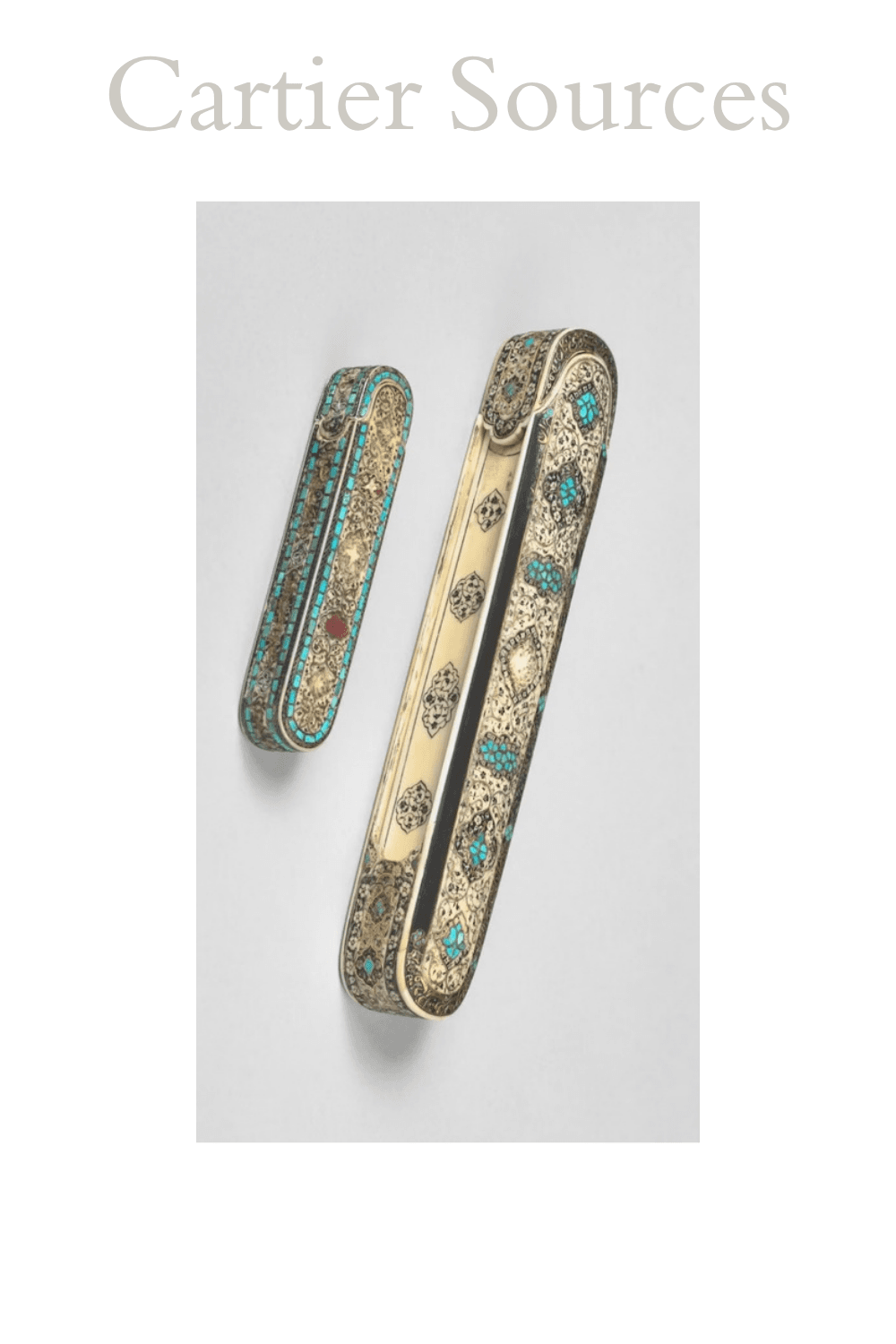
Yet their history connects Mughal India, Safavid Iran, Parisian luxury and Cartier. The Smithsonian identifies them as two jewel-inlaid ivory pen cases thought to have been commissioned by the Mughal emperor Jahangir and presented to Shah Abbas I of Iran and his grand vizier. Louis Cartier later acquired them, and they became important sources of inspiration for the Maison.
Their journey raises a question larger than the history of one jewellery house:
What exactly travels when one civilization inspires another?
Two Pen Cases Between Two Great Courts
To understand the objects, we first need to understand the world in which they circulated.
Jahangir, who ruled the Mughal Empire from 1605 to 1627, inherited one of the wealthiest and most sophisticated courts of the early modern world. He was deeply interested in painting, collecting and the observation of nature, and his court attracted artists and intellectuals from India, Iran and Central Asia. Persian artistic culture remained particularly important within the Mughal environment.
To the west ruled Shah Abbas I, sovereign of Safavid Iran from 1587 to 1629. His reign transformed Iran politically, commercially and artistically. Isfahan developed into one of the great capitals of the period, and Shah Abbas cultivated diplomatic and commercial relationships across the Islamic world, Russia and Europe.
The two rulers were contemporaries, but their relationship cannot be reduced to friendship.
The Mughal and Safavid empires were neighbours, diplomatic partners and political rivals. The strategic city of Kandahar remained a recurring source of tension between them. Diplomatic language could emphasize friendship even while competition continued beneath it; Shah Abbas eventually seized Kandahar from the Mughals in 1622.
It is within this world of diplomacy, rivalry and courtly exchange that the two pen cases become particularly meaningful.
The Louvre’s records allow us to place them precisely.
| Pen case of Shah Abbas | Pen case of Mirza Muhammad Munshi | |
| Inventory number | RFML.AI.2018.36.1 | RFML.AI.2018.36.2 |
| Date | 1575–1625 | circa 1586–1588 |
| Place of production | Iran and India | Iran and India |
| Dimensions | 12.2 × 2.5 × 2.1 cm | 23 × 4 × 3 cm |
| Materials | Carved and engraved walrus ivory, inlaid with gold, turquoise and black paste; red silk textile | Carved and engraved walrus ivory, inlaid with gold, turquoise and black paste; metal composite |
| Inscription | Persian, in nastaʿlīq. The Louvre records a dedication to Shah Abbas invoking wisdom and virtue, the throne, crown and jewel, and closing on the wish that equity, knowledge and justice reign in his kingdom. | Persian, in nastaʿlīq. The title ṣāḥib-e seyf va qalam — master of the sabre and the calame — allows the Louvre to attribute it to the grand vizier. |
| Institution | Musée du Louvre, Department of Islamic Arts | Musée du Louvre, Department of Islamic Arts |
These were therefore not arbitrary luxury objects.
They belonged to the world of government, knowledge and authority.
When a Gift Is Also a Political Language
Today, a gift is often understood as something private.
At an early modern royal court, a gift could function very differently.
In Safavid political culture, gift-giving formed part of diplomacy, hierarchy and political negotiation. Envoys arrived with precious textiles, horses, weapons, jewels, manuscripts and rare objects. The value and suitability of a gift could communicate the importance of the relationship and the rank of its recipient; gifts could even be rejected if judged inadequate.
So if these pen cases were indeed commissioned within the Mughal world and offered to Shah Abbas and his grand vizier, their meaning was not contained only in their monetary value.
A diplomatic gift could say:
I recognise your status.
I understand your court.
I know what is worthy of you.
And choosing a pen case made the gesture especially eloquent.
The pen was an instrument of rule.
Orders were written. Treaties were recorded. Accounts were kept. Knowledge circulated. Royal decisions became documents.
In the case of Mirza Muhammad Munshi, the inscription brings together the two traditional dimensions of political authority: the sabre and the calame. Force and administration. Military power and intellectual authority. The capacity to conquer and the capacity to govern.
The materials therefore do more than beautify a functional object.
Carved walrus ivory. Gold. Turquoise. Black paste. Persian calligraphy.
They transform an instrument of administration into an object worthy of the person who exercised administration.
And that leads to a larger question:
What does a civilization reveal about its values through the things it chooses not to make carelessly?
From the Safavid Court to the Rue de la Paix
Centuries later, the objects travelled again.
Louis Cartier acquired the two pen cases for his personal collection. The Louvre’s research describes them as important sources of inspiration for Cartier designers, and the Smithsonian notes explicitly that they inspired later Cartier creations.
That connection was not accidental.
Louis Cartier developed a serious interest in the arts of the Islamic world at a moment when Paris itself was becoming an important centre for their collection, exhibition and study.
His personal collection was never comprehensively inventoried and was dispersed after his death in 1942, but research around these two pen cases helped reconstruct the scale of that interest. The Louvre acquired them in 2018.
In 2021, the exhibition Cartier et les arts de l’Islam. Aux sources de la modernité placed this relationship at the centre of an entire exhibition. The Louvre described the arts of Islam as being at the heart of Cartier’s creative process, tracing how Islamic artworks, patterns, objects and visual structures contributed to the Maison’s modern vocabulary from the early twentieth century onward.
This changes the way we understand influence.
Cartier did not need to become Persian, Mughal or Muslim in order to recognise something exceptional in these objects.
Civilizations do not need to become one another to recognise what is remarkable in one another.
What Does Inspiration Actually Transmit?
When we speak about artistic influence, we often focus on motifs.
A shape travels. A colour combination reappears. An ornamental structure is reinterpreted.
The statement is true. But it is incomplete.
The history of these pen cases suggests something deeper. Civilizations transmit not only forms.
They can transmit ways of treating material. Ways of approaching proportion. Standards of craftsmanship. Expectations of detail. Ideas about what an object deserves.
And conceptions of beauty itself.
This is where, as a Muslim woman born and raised in the West, another word enters the way I read these objects:
Iḥsān.
What Does Iḥsān Mean?
Iḥsān is often translated as excellence.
But reducing it to technical perfection would empty the concept of its deepest meaning.
In the Hadith of Jibril, the Prophet Muhammad ﷺ was asked about Iḥsān. He replied:
“That you worship Allah as if you see Him, for though you do not see Him, He sees you.”
Sahih Muslim, Hadith 8.
Iḥsān therefore belongs first to a relationship with Allah ﷻ.
It is not a theory of luxury. It is not a design philosophy. And it would be inaccurate to describe Cartier itself as an expression of Iḥsān in the Islamic sense.
The concept is treated at length in The Hidden Art of Ihsan.
Yet Iḥsān carries a principle through which a Muslim eye can read craftsmanship differently: how something is done matters.
The detail that could have been ignored. The part that may never receive attention. The refusal to treat execution as secondary. The consciousness that the quality of an action is not determined only by the applause it receives.
This is why the pen cases interest me beyond their beauty.
Someone decided that an instrument for holding writing tools deserved this degree of attention.
It could have fulfilled its function without turquoise. Without minute engraving. Without gold. Without the extraordinary care applied to its surface.
But it did not.
That does not prove an intention of Iḥsān on the part of its makers.
It gives us something else: an object through which to think about excellence.
Luxury Has a Genealogy
Modern luxury often presents itself through innovation. The new collection. The new form. The new object.
But luxury also has a genealogy.
Techniques have ancestors. Aesthetic languages have memories. Ideas travel before they are renamed.
The two pen cases make that genealogy unusually visible.
An object moves through Mughal and Safavid worlds. It enters Louis Cartier’s collection. Its visual intelligence becomes material for twentieth-century design. A century later, the Louvre reconstructs that relationship. Now the objects travel again, from Paris to Washington, as masterpieces of Islamic art.
Mughal India. Safavid Iran. Paris. Washington.
The question of what precious material carries and of who is permitted to wear it runs through this history too. We have looked at it elsewhere, in Why Did Islam Give Silk and Gold to Women?.
Beauty has a memory.
And excellence can travel.
When an Object Crosses Civilizations
There is another reason these objects belong naturally within Islamic Art of Living.
They join a larger family of objects whose histories reveal how porous our later civilizational categories can become.
The same Smithsonian exhibition includes the extraordinary Mamluk basin known as the Baptistère de Saint Louis. Made in Egypt or Syria in the fourteenth century and signed by the Muslim master Muhammad ibn al-Zayn, it later entered French royal Christian ritual and acquired a name associated with Saint Louis, despite having been made decades after his death.
We told that story in The Islamic Masterpiece That Baptized the Heirs of France.
The pen cases tell a different story.
They were not renamed into another civilization. Their journey is one of recognition and inspiration.
The Baptistère asks what happens when an object acquires another identity. The pen cases ask what happens when another artistic culture recognises something within an object that it wants to carry forward.
That distinction matters.
Because cultural transmission is rarely a simple story of copying.
Sometimes it begins with recognition.
Someone looks at what another civilization has produced and understands: there is something here worth learning from.
From Courtly Gift to Museum Object
The biography of the pen cases did not stop with their makers, their recipients or Louis Cartier.
The objects continued to move.
The Louvre records their presence in the Paris and Dallas exhibitions devoted to Cartier and Islamic art, at Louvre Abu Dhabi, and more recently in Shanghai. They will now enter another exhibition narrative in Washington.
Their status has changed repeatedly.
An instrument of writing. A courtly object. A possible diplomatic gift. A collector’s object. A source of design inspiration. A museum acquisition. An exhibition masterpiece.
Each context adds meaning without completely erasing what came before.
And this may be why objects are such powerful historical witnesses.
They allow us to follow not only where beauty was produced, but also who recognised it later, what they saw in it and what they chose to carry forward.
What Does Excellence Leave Behind?
The legacy of Islamic civilization matters not only because of what it created centuries ago.
It also matters because of what those creations continued to make possible.
A pattern may travel. A technique may be studied. A courtly object may become a reference for a jeweller three centuries later. A standard of workmanship can survive the society that first produced it.
This does not mean every Cartier creation influenced by Islamic art should be interpreted through Iḥsān.
Nor does it mean the craftsmen who made these pen cases can automatically be assigned an intention that the historical record does not give us.
Iḥsān belongs to a deeper Islamic reality than aesthetics alone.
What remains, and what multiplies, is closer to what we have called barakah, the increase that does not come from quantity.
But as a Muslim looking at this history, the concept makes one thing difficult to ignore: care has consequences.
The things made with extraordinary attention can outlive their first use.
They can travel. They can be studied. They can inspire people who do not share the language, religion or political world of those who made them.
Louis Cartier did not need to belong to the civilization that produced these pen cases to recognise their excellence.
And we do not need to collapse these histories into one another to understand what passed between them.
We need only to follow the objects.
From ruler to ruler. From court to collection. From collection to creation. From Paris to Washington.
The forms travelled. The objects survived. The influence remained.
And centuries later, two small pen cases still invite us to ask what happens when one civilization encounters excellence in another and chooses not merely to admire it, but to learn from it.
This is our Timeless Legacy.
Continue reading
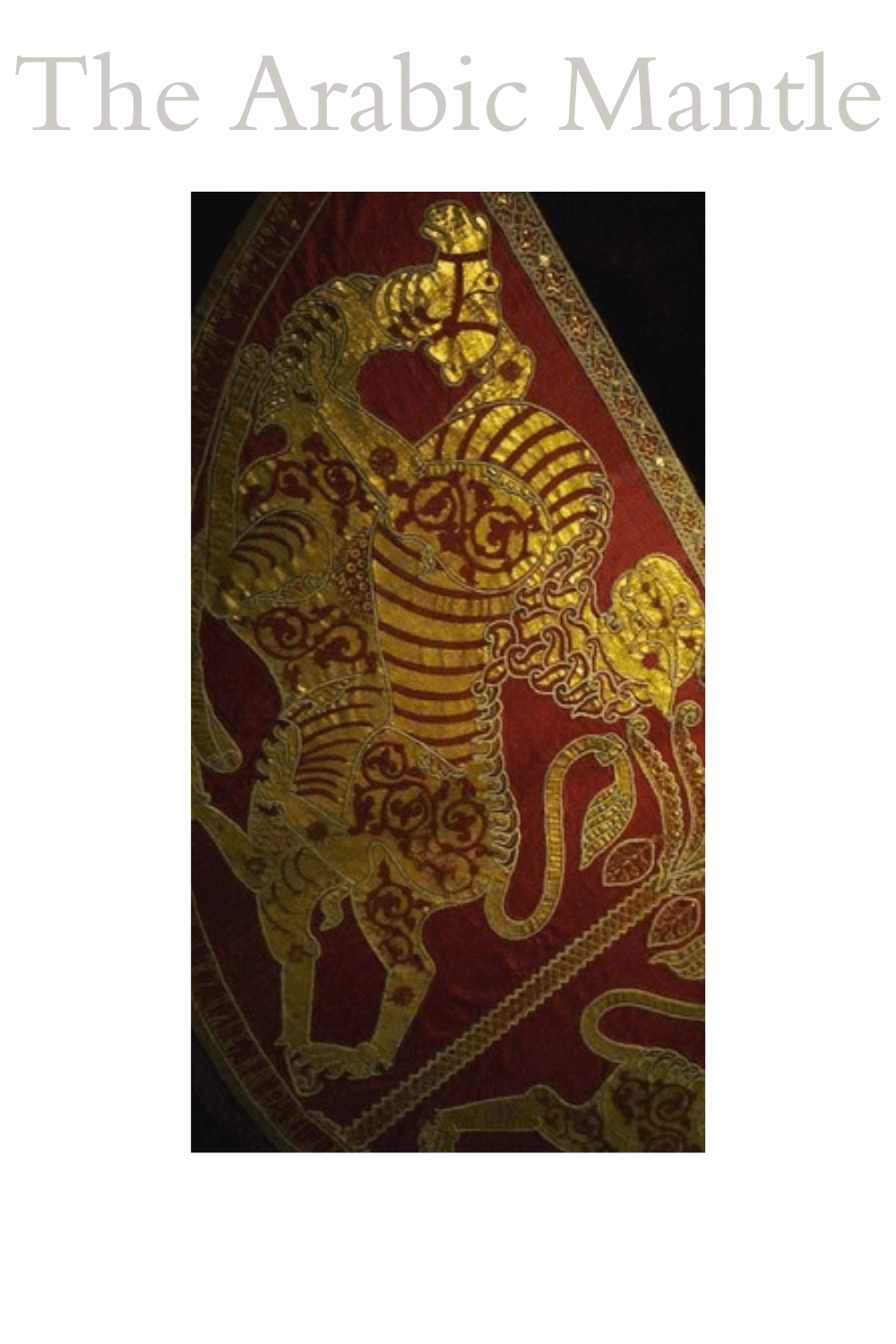
· The Coronation Mantle of Roger II : Arabic Luxury and the language of power