How one royal garment reveals Norman Sicily, Islamic prestige and the making of sovereignty
The Coronation Mantle of Roger II is a semicircular cloak of red silk, 146 × 345 cm, made in the royal workshop of Palermo in 528 AH — 1133–34 CE. Gold embroidery, thousands of pearls, enamel and gemstones. Along its lower edge runs an inscription in Arabic. It later became part of the coronation regalia of the Holy Roman Empire. It is held today in the Imperial Treasury in Vienna, part of the Kunsthistorisches Museum, inventory WS XIII/14.
In Vienna’s Imperial Treasury, one of the great objects of European royal history carries an inscription that is impossible to miss once you know where to look.
It is written in Arabic.
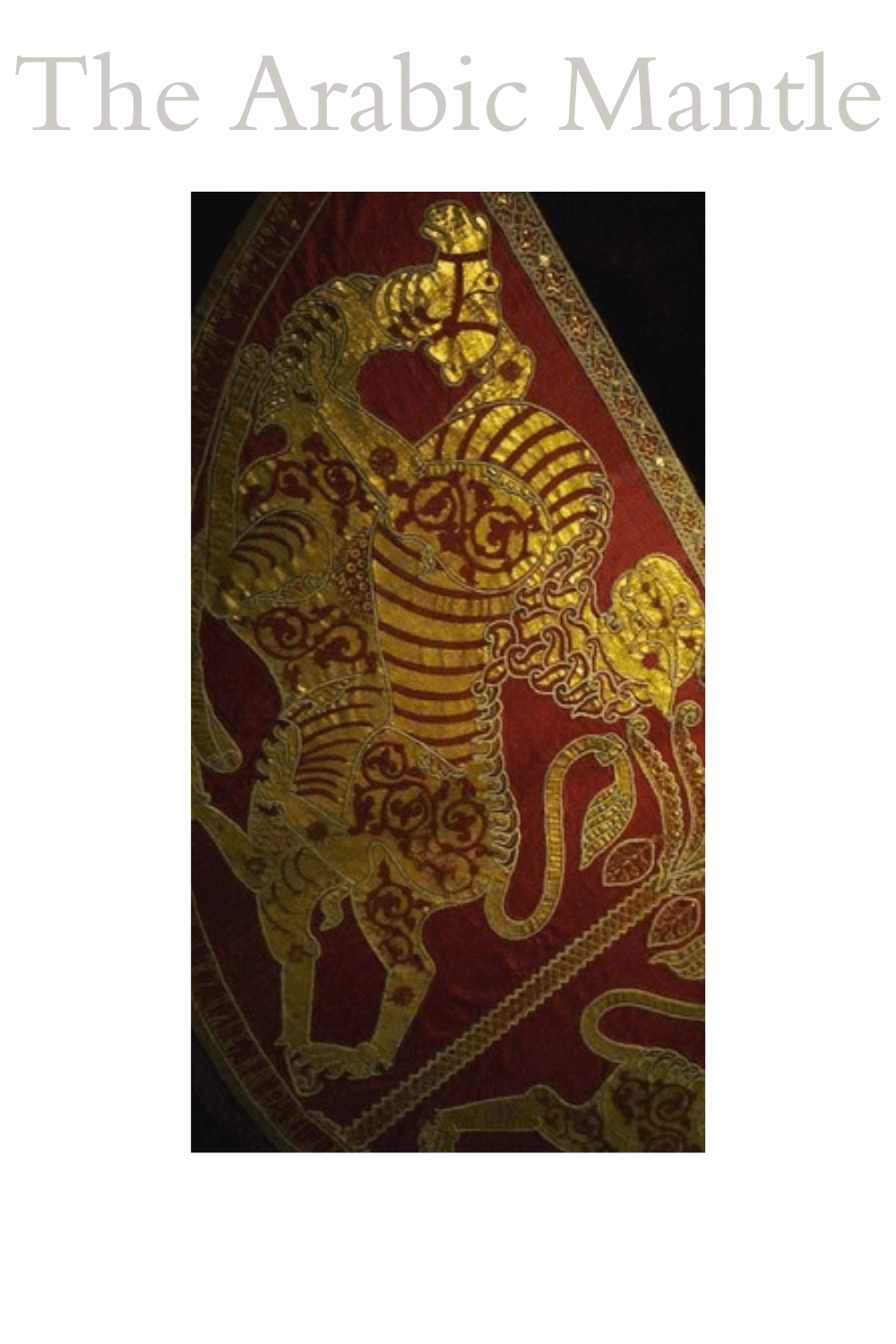
The Coronation Mantle of Roger II is an immense semicircle of deep red silk, almost three and a half metres wide, covered with gold embroidery, thousands of pearls, gemstones and enamel. Two monumental lions dominate two camels on either side of a stylised palm tree. Along the entire lower edge, Kufic calligraphy records that the garment was made in the royal workshop of Palermo in 528 AH — 1133–34 CE. Today it is preserved in the Imperial Treasury in Vienna, part of the Kunsthistorisches Museum.
It later became one of the ceremonial garments associated with the coronation of kings and emperors of the Holy Roman Empire.
A Christian monarchy. A royal garment covered in Arabic.
Artistic languages associated with the Islamic Mediterranean. And centuries of European imperial ritual. Four things that, in the categories through which we usually sort history, are not supposed to belong to the same object.
At first, the combination may appear surprising.
It becomes much less surprising once we understand the Sicily that produced it.
What Is the Coronation Mantle of Roger II?
Roger II became King of Sicily in 1130, crowned in Palermo on Christmas Day. The mantle was made three years later, which means that despite the name by which it is now famous, it was not created for his own coronation.
Its original function is not known with certainty. Scholars have proposed several possibilities, including royal ceremonies connected with dynastic succession, one recent study argues it may have been made for the investiture of the king’s sons in the mainland territories. What is clear is that the mantle was produced within Roger II’s royal environment and designed to materialise sovereign magnificence.
Its materials alone are extraordinary. Patterned silk dyed with kermes. Gold and silk embroidery. Thousands of pearls. Rubies, spinels, sapphires and garnets. Enamel and glass. The object measures approximately 146 by 345 centimetres, and every one of those materials had to travel.
Ariel Fein, writing for Smarthistory, sets out how far. The red samite that forms the base fabric likely came from the Byzantine Empire, possibly imported already woven. The gold threads are of exceptionally high purity significantly richer than other Sicilian textiles of the same period and the technique of wrapping thin metal strips around a silk core represents Byzantine expertise that Sicily did not yet possess.
But listing expensive materials tells us only part of the story.
The important question is: why these materials, these craftsmen, this language and this visual vocabulary? Why would a Latin Christian king choose to represent royal authority through an object so deeply connected to the artistic and courtly culture of the Arab-Islamic Mediterranean?
To understand the mantle, we first have to understand Palermo.
Norman Sicily Was Already a Crossroads
The Normans did not arrive on an empty cultural landscape.
Before the Norman conquest, Sicily had belonged for centuries to the Islamic Mediterranean. When Norman rulers established their kingdom, they governed an island containing a large Arabic-speaking Muslim population alongside Greek Christians, Latin Christians, Jews, Lombards and communities of French and Norman origin.
UNESCO, which inscribed Arab-Norman Palermo on the World Heritage List in 2015, describes the surviving architecture as the result of a socio-cultural syncretism between Western, Islamic and Byzantine cultures. These traditions did not simply exist beside one another. They generated new forms of architecture, decoration and political representation.
Roger II’s administration tells the same story. The historian Jeremy Johns, in Arabic Administration in Norman Sicily(Cambridge, 2002), has shown that Arabic did not simply survive accidentally from the island’s Muslim past. After Roger’s coronation, a sophisticated royal dīwān began producing Arabic and bilingual documents. Johns argues that Roger’s administration was deliberately restructured in relation to contemporary Fatimid Egypt, and that this Arabic dimension of government also contributed to the projection of royal authority.
Hubert Houben, in the biography he published the same year, gave Roger the subtitle that has stuck to him since: a ruler between East and West.
That distinction matters. Arabic culture was not merely tolerated as the remnant of a conquered population. Elements of the Islamic Mediterranean were actively incorporated into the language through which the Norman monarchy presented itself.
Roger II did not rule from the border between two perfectly separated worlds. He ruled in a place where several worlds were already meeting.
Why Is the Mantle Written in Arabic?
The inscription tells us that the mantle was produced in the royal workshop in Palermo, and it surrounds the ruler with a vocabulary of prosperity, honour, glory, beauty, protection, success and triumph.
Its form also belongs to a wider history of inscribed luxury textiles in Islamic court culture.
Across the Islamic world, textiles known as tirāz could be produced in royal workshops and used within systems of courtly distinction.
Their inscriptions might name a ruler, offer blessings, or identify the place and date of manufacture.
The Metropolitan Museum of Art notes that such textiles could serve as markers of royal authority and allegiance.
Roger II’s mantle is not a standard Islamic tirāz, and its inscription does not follow the normal formula of a caliphal textile. But it clearly draws on that political world. An Arabic inscription. A royal workshop. A luxury textile. A court ceremony.
Every one of those elements belongs to a system of sovereign representation that Palermo did not invent, and every one of them was recognisable to anyone who mattered across the twelfth-century Mediterranean.
This is a garment capable of communicating authority before its wearer has spoken.
And this is where the object becomes more intellectually interesting than the simple label “Islamic influence.” Influence does not explain why something was desirable. What did the Norman court recognise in these forms that made them worthy of royal power?
What Date Is Woven Into a Christian Coronation Robe?
There is a detail in that inscription that is easy to read past.
The mantle is not only written in Arabic. It is dated in Arabic and not by the Christian calendar. The year given is 528, counted from the Hijrah, the migration of the Prophet Muhammad ﷺ from Mecca to Madina in 622 CE. That year corresponds to 1133–34 in the Gregorian reckoning.
The garment worn at the coronations of Holy Roman Emperors carries, along its hem, a date from the Islamic calendar.
That detail also settles a question. Because 528 AH falls three years after Roger’s coronation in December 1130, the mantle cannot have been made for it. The object most firmly attached to the idea of a coronation was not present at the one it is named for. The Islamic calendar runs on lunar months, which is why an Islamic year and a Christian year never align for long and why the conversion has to be calculated rather than simply read.
Luxury as a Language of Power
Power has never existed through law and military force alone. It also constructs an image.
A palace changes the scale at which a ruler is encountered. A crown makes hierarchy visible. A procession turns authority into choreography. And luxury separates the sovereign from ordinary access.
Each of these is a technique, and each of them works on the eye before it works on the mind.
The mantle does all of these things through material.
The red silk does not simply look beautiful. The pearls do not simply decorate. The gold does not simply increase monetary value.
Together, they demonstrate the ability to command rare materials, specialist labour, international networks and extraordinary technical knowledge and to demonstrate it in a single glance.
And beauty itself matters. Political power has repeatedly sought to associate itself with what a society considers exceptional, refined and desirable. The ability to surround oneself with beauty, and to control access to its finest expressions, can itself become an attribute of status.
Luxury was not simply what power owned.
It was one of the languages through which power taught others how to see it.
This is what makes the Islamic dimension of the mantle so important. If the Norman monarchy selected artistic and ceremonial languages connected to Arabic-speaking and Islamic court culture for one of its most exceptional royal objects, then the question is not simply what the Normans borrowed.
The question is: what did they consider prestigious enough to borrow?
A rising monarchy does not need to invent every sign of sovereignty from nothing. It can observe other centres of power, recognise languages that already communicate magnificence, legitimacy and sophistication, and then translate them into its own political culture.
The result is not purely Islamic. It is not purely Byzantine. It is not purely Latin. It is Norman Sicily, a political culture assembled from what was available to it and what it judged worth having.
But the act of selection itself tells us something about the cultural prestige circulating through the twelfth-century Mediterranean.
Marcel Mauss and the Total Social Fact
This is where the work of the French anthropologist Marcel Mauss offers another way to look at the mantle.
Mauss, whose work also profoundly shaped sociology and who later taught at the Collège de France, developed the concept of the fait social total — the total social fact — most famously in his Essai sur le don of 1925, an analysis of gift exchange.
For Mauss, certain social phenomena cannot be understood by separating economics from law, religion from politics, prestige from obligation, or symbolism from social hierarchy. They operate together.
The mantle is not one of the exchanges Mauss studied, and it would be misleading to turn it mechanically into a Maussian gift. His method is useful for another reason: it teaches us to ask what happens when an object activates several dimensions of a society at the same time.
So what are we looking at when we look at Roger II’s mantle?
A textile.
A concentration of wealth.
A work of art.
A product of highly specialised labour.
Evidence of Mediterranean exchange.
A political instrument.
A representation of hierarchy.
A manifestation of taste.
A trace of Islamic court culture within a Christian monarchy.
A ceremonial object that would later enter another imperial system altogether.
Ten descriptions, all accurate, none of which can be removed without the object becoming smaller than it is.
All of these meanings exist together. More importantly, they give meaning to one another.
The pearls matter because very few people could command the resources necessary to gather and work them at this scale.
The craftsmen matter because access to exceptional knowledge is itself a form of power.
The Arabic matters because language can communicate belonging, authority and cultural orientation. The beauty matters because aesthetic distinction contributes to social distinction.
The royal workshop matters because production itself is connected to political institutions.
The garment becomes powerful not because one of these dimensions exists. It becomes powerful because they converge.
This is why the idea of the total social fact helps us see something larger in the mantle. It moves us away from asking only who made this object, toward another question: what kind of society made this object meaningful?
And one question further: what does a ruler reveal about his understanding of power through the cultures from which he chooses to construct its image?
What Do the Lions and Camels Mean?
At the centre of the mantle, two lions overpower two camels beside a stylised palm.
The composition is intensely symmetrical.
The lions dominate. The camels submit. The palm between them has often been read as a tree of life, a motif with a long history across the eastern Mediterranean.
The Kunsthistorisches Museum interprets the lions as symbols of the ruler triumphing over his enemies. Scholars have also discussed whether the imagery might evoke specific Norman victories over Muslim forces, although the exact meaning remains debated.
That uncertainty should remain.
The object does not need a single, definitive symbolic translation to communicate authority, and its visual hierarchy is already powerful without one.
The ruler does not merely wear the mantle. The mantle constructs an image around the ruler.
Again, material, beauty and politics become inseparable.
From Norman Sicily to European Imperial Power
The mantle’s history did not end with Roger II.
It passed out of Sicily by inheritance rather than conquest. Roger’s daughter Constance married Henry VI, son of Frederick Barbarossa, and the Norman royal treasure entered the Hohenstaufen dynasty with her. From there the mantle became part of the coronation regalia of the Holy Roman Empire, and it stayed there for centuries.
By the fourteenth century, another story had begun to attach itself to it. The mantle was associated with Charlemagne, and a legend developed that the emperor had taken it from the Moors.
The Kunsthistorisches Museum records this later tradition, a tradition that persisted while the Arabic inscription along the hem went on plainly identifying the object as a product of Palermo, made in 1133–34.
The object remained the same. Its biography changed around it.
This is not an isolated story.
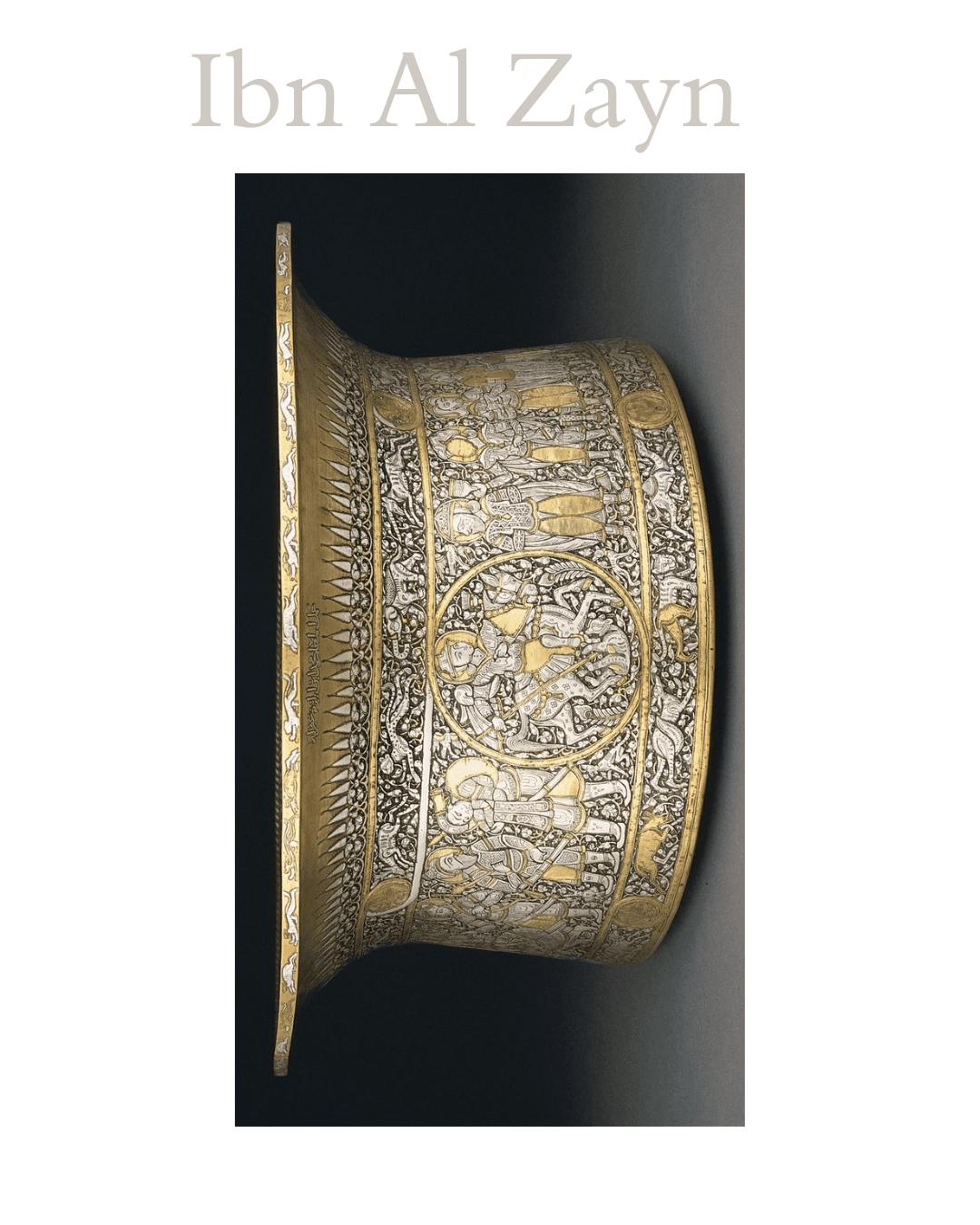
A few centuries later, a Mamluk metal basin made by Muhammad ibn al-Zayn would enter French royal ritual and acquire the name Baptistère de Saint Louis, even though it was created decades after Saint Louis died. The basin’s function changed. Its name changed. Its political meaning accumulated new layers. Its maker’s Arabic signature remained. Read: The Islamic Masterpiece That Baptized the Heirs of France
| Baptistère de Saint Louis | Coronation Mantle | |
|---|---|---|
| Made | Egypt or Syria, ca. 1325–1340 | Palermo, 528 AH / 1133–34 |
| Maker | Signed by Muhammad ibn al-Zayn | Royal workshop; craftsmen unnamed |
| Original purpose | A secular basin; use uncertain | Uncertain; possibly dynastic investiture |
| Entered Christian ritual | Through the French crown | Through inheritance, with Constance of Sicily |
| What changed | Its name and its function | Its wearer and its empire |
| What remained | The Arabic signature | The Arabic inscription |
The two objects followed very different journeys.
The Baptistère reveals how an object can be renamed and repurposed.
Roger II’s mantle reveals how a ruling power can adopt and transform another cultural language of prestige.
Both invite us to reconsider a habit of historical classification.
We often encounter Islamic history and European history in different galleries, different chapters and different academic categories.
Objects do not always respect those boundaries.
Eva Hoffman named this problem precisely in 2001, when she described the movement of such objects across the medieval Mediterranean as pathways of portability routes along which forms travelled faster than the categories built to contain them.
When the Object Says More Than the Category
Today the mantle hangs among some of the great objects of European imperial history.
It belongs to the history of Norman kingship.
To the Holy Roman Empire.
To the political rituals of Christian Europe.
All of that is true, and none of it is diminished by what follows.
And along its edge, Arabic remains.
That does not make its European history less European. It makes that history more complex.
Sometimes the Islamic presence in European history is not absent from the object. It is simply less visible in the categories through which the object is later remembered.
Roger II’s mantle allows us to ask a different kind of question.
Not: which civilization owns this object?
But: what does this object reveal about how civilizations actually build themselves?
Through inheritance.
Through exchange.
Through conquest.
Through admiration.
Through strategic selection.
Through the recognition that another culture may possess forms, knowledge or aesthetics worth integrating into one’s own language of power. Civilizations are built by all of these at once, and the mantle was made at a moment when all of them were operating in the same city.
The mantle became part of European imperial ceremony. Its political contexts changed. Its meanings changed. The societies around it changed.
But the Arabic inscription remained.
Power does not only govern. It constructs the image through which it wants to be seen. Roger II’s mantle allows us to see that image being constructed from more than one world.
And centuries later, the object still asks us to consider why.
Frequently Asked Questions
What is the Coronation Mantle of Roger II?
It is a semicircular cloak of red silk, 146 × 345 cm, made in the royal workshop of Palermo in 528 AH — 1133–34 CE — for Roger II, the first Norman king of Sicily. It is embroidered in gold with thousands of pearls, gemstones and enamel, and carries an Arabic inscription along its lower edge. It is held in the Imperial Treasury in Vienna, part of the Kunsthistorisches Museum.
Why is there Arabic on a Christian coronation robe?
Because it was made in Palermo, in a kingdom with a large Arabic-speaking population and a royal administration that produced documents in Arabic. Roger II’s monarchy actively drew on the artistic and ceremonial languages of the Islamic Mediterranean to represent its own authority. The Arabic was not a survival the Normans tolerated; it was a prestige language they chose.
Was the mantle used for Roger II’s coronation?
No. Roger II was crowned in Palermo on 25 December 1130, and the mantle’s inscription dates it to 528 AH, which corresponds to 1133–34. It was made about three years too late. Its original purpose is uncertain; one scholarly proposal connects it to ceremonies investing the king’s sons with mainland titles.
What does the Arabic inscription on the mantle say?
It records that the garment was made in the royal workshop in Palermo, gives the year 528 of the Islamic calendar, and surrounds the ruler with a vocabulary of prosperity, honour, glory, beauty, protection, success and triumph. It is written in a decorated Kufic script along the entire lower edge.
What is a tirāz?
A tirāz is an inscribed luxury textile produced in a royal or state workshop in the Islamic world. Its inscription might name a ruler, offer blessings, or record the place and date of manufacture. Such textiles functioned within systems of courtly distinction and could serve as markers of royal authority and allegiance.
What do the lions and camels on the mantle mean?
Two lions overpower two camels on either side of a stylised palm. The Kunsthistorisches Museum reads the lions as symbols of the ruler triumphing over his enemies. Some scholars have asked whether the imagery evokes specific Norman victories over Muslim forces, but the exact meaning remains debated and no single reading is settled.
How did a Sicilian robe become Holy Roman imperial regalia?
By inheritance. Constance, daughter of Roger II, married Henry VI, son of Frederick Barbarossa, and the Norman royal treasure passed to the Hohenstaufen dynasty. The mantle then entered the coronation regalia of the Holy Roman Empire, where it remained for centuries.
What was Arab-Norman Sicily?
The kingdom established by Norman rulers on an island that had belonged for centuries to the Islamic Mediterranean. Its population included Arabic-speaking Muslims, Greek and Latin Christians, Jews and Lombards. UNESCO inscribed Arab-Norman Palermo on the World Heritage List in 2015, describing its architecture as a socio-cultural syncretism of Western, Islamic and Byzantine traditions.
What is a “total social fact”?
A concept developed by the French anthropologist Marcel Mauss, most famously in his Essai sur le don of 1925. It describes phenomena that cannot be understood by separating economics from law, religion from politics, or prestige from obligation, because all of these operate at once and give meaning to one another.
Where can I see the Coronation Mantle of Roger II?
In the Imperial Treasury (Kaiserliche Schatzkammer) in Vienna, part of the Kunsthistorisches Museum, inventory number WS XIII/14.