Ramadan unfolds in stages.
The first days teach discipline.
The middle days deepen patience.
But the final ten nights carry a unique intensity.
It is during these nights that believers turn their hearts toward one of the most extraordinary moments described in the Qur’an: Laylat al-Qadr, the Night of Decree.
Allah ﷻ says:
(Qur’an 97:1-3)
“Indeed, We sent the Qur’an down during the Night of Decree. And what can make you know what the Night of Decree is? The Night of Decree is better than a thousand months.”
One night.
Better than a thousand months.
A lifetime of devotion could not equal the reward contained in a single night.
Earlier in this Ramadan series, during the first decade of the month, we explored the meaning of this extraordinary night and how believers can prepare themselves spiritually for it in our article
🔗 Laylat al-Qadr: The Night That Shapes the Year.
During those early days of Ramadan, the invitation was to prepare — to align the heart, refine intention, and become attentive to what might come.
Now, the final stage of Ramadan has arrived.
The nights that may hold Laylat al-Qadr are here.
When the Last Ten Nights Begin
In the Islamic calendar, the night precedes the day.
This means the final ten nights begin after the twentieth day of fasting, when the sun sets and the twenty-first night of Ramadan begins.
From that moment onward, believers enter the most spiritually intense period of the month.
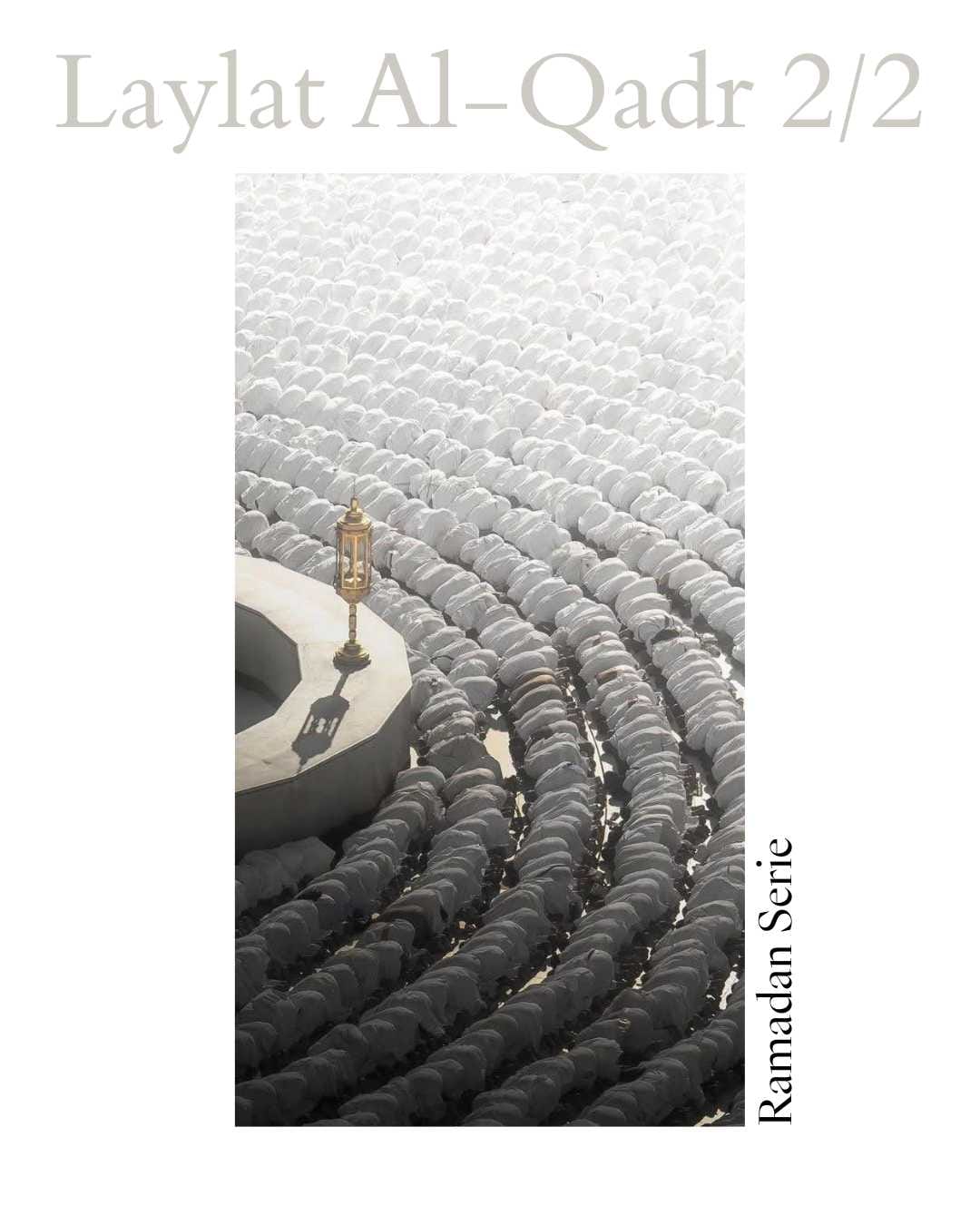
Mosques fill again after iftar.
The Qur’an is recited deep into the night.
Supplications multiply.
The rhythm of Ramadan shifts.
Sleep becomes lighter.
The nights become longer.
The heart becomes more attentive.
The Odd Nights
The Prophet Muhammad ﷺ said:
“Seek Laylat al-Qadr in the odd nights of the last ten nights of Ramadan.”
(Sahih al-Bukhari, Sahih Muslim)
For this reason, believers often give particular attention to the odd nights:
21
23
25
27
29
Yet the precise night of Laylat al-Qadr remains unknown.
This wisdom redirects the believer away from calculation and toward devotion.
Instead of trying to predict the night, the believer shows up — night after night — with sincerity, humility, and hope.
The believer chases one night.
But the search transforms many nights.
Why Every Night Matters
Another reason to dedicate oneself to all ten nights is the difference in moon sighting across the world.
This means the odd nights may fall on slightly different Gregorian dates depending on location.
Ramadan does not begin on the same day everywhere in the world. The start of the month depends on the sighting of the new moon, and different countries may confirm it on different evenings.
In 2026, for example, Saudi Arabia, Qatar and some mosques from Paris began Ramadan on the evening of February 18 following the confirmed sighting of the crescent moon.
For these communities, the odd nights correspond approximately to:
| Ramadan Night | Gregorian Night |
| 21st night | March 9 – March 10 |
| 23rd night | March 11 – March 12 |
| 25th night | March 13 – March 14 |
| 27th night | March 15 – March 16 |
| 29th night | March 17 – March 18 |
In other parts of the world, Ramadan began one day later due to local moon sighting.
Many other regions began the month one day later, on the evening of February 19. This included countries of the Maghreb such as Morocco, Algeria, and Tunisia, several countries in West Africa such as Senegal and Mali, as well as Egypt.
Muslim communities in many global cities including Paris, London, New York, Kuala Lumpur, and Jakarta — also began fasting on the evening of February 19 depending on the local mosques and religious authorities they follow.
Because of these differences in moon sighting, the odd nights of Ramadan may fall on slightly different Gregorian dates depending on location. This is one of the reasons scholars encourage believers to devote all of the final ten nights to worship rather than focusing on only one specific night. For these communities, the odd nights correspond approximately to:
| Ramadan Night | Gregorian Night |
| 21st night | March 10 – March 11 |
| 23rd night | March 12 – March 13 |
| 25th night | March 14 – March 15 |
| 27th night | March 16 – March 17 |
| 29th night | March 18 – March 19 |
This global variation is one of the reasons scholars encourage believers to devote all the final nights of Ramadan to worship.
Only Allah ﷻ knows with certainty which night is Laylat al-Qadr.
The Duʿāʾ for Laylat al-Qadr
ʿAisha (raḍiyallāhu ʿanhā) once asked the Prophet Muhammad ﷺ:
“O Messenger of Allah, if I know which night is Laylat al-Qadr, what should I say?”
He replied:
(Tirmidhi)
اللَّهُمَّ إِنَّكَ عَفُوٌّ تُحِبُّ الْعَفْوَ فَاعْفُ عَنِّي
Allahumma innaka ʿafuwwun tuḥibbu al-ʿafwa faʿfu ʿannī
O Allah, You are Most Forgiving and You love to forgive, so forgive me.
This supplication captures the essence of these nights: humility, hope, and the search for divine forgiveness.
Worship Takes Many Forms – A Note for Muslim Women
During these nights, believers increase prayer, remembrance, charity, and reflection.
For some, this means long hours standing in prayer.
For others, worship may take different forms.
A special note must be made for Muslim women who may be unable to perform the ritual prayer during these nights because of their cycle.
Of course, there can be a sense of sadness at not being able to stand in prayer during nights as precious as those of Laylat al-Qadr.
Yet this too is the decree of Allah ﷻ.
And worship in Islam is not limited to a single form.
Women can still engage deeply with these nights through remembrance (dhikr), supplication (duʿāʾ), reflection, listening to the Qur’an, charity, seeking forgiveness, and acts of kindness.
Doing what one can, with sincerity and presence of heart, remains an act of devotion.
Ramadan reminds us that closeness to Allah ﷻ is not restricted to one act of worship – it is found in sincerity, intention, and remembrance.
Al hamdulillah.
Ramadan Shapes the Nafs
Ramadan is not only a discipline of the body.
It is also a discipline of the nafs.
The search for Laylat al-Qadr carries a deeper wisdom.
The believer does not know exactly when this night will occur.
And that uncertainty is not a difficulty – it is a teaching.
It reminds us that knowledge belongs to Allah ﷻ, and that human beings only know what He allows them to know.
By searching for Laylat al-Qadr, night after night, the believer learns humility.
The nafs is softened.
Certainty gives way to hope.
Control gives way to trust.
Some believers concentrate their efforts on the odd nights.
Others choose to devote themselves to every night of the final ten nights.
Both approaches carry the same intention: to seek closeness to Allah ﷻ with sincerity.
This search becomes an act of spiritual discipline.
It teaches the heart patience.
It teaches the soul humility.
And it reminds us that the believer does not approach these nights with certainty, but with hope.
Hope that Allah ﷻ will allow us to be present.
Present with our hearts.
Present with our intention.
Present with our worship.
And present before Him with all that we have – our bodies, our hearts, our minds, our souls, our intentions, our sincerity, and our love for Him.
Because in the end, Laylat al-Qadr is not only about finding a night.
It is about standing before Allah ﷻ with sincerity and asking Him to accept us among those who sought it.
Seeking the Night
Laylat al-Qadr cannot be predicted with certainty.
It cannot be scheduled.
But it can be sought.
The believer does the means.
The believer shows up night after night.
The believer asks.
We hope.
We pray.
We ask Allah ﷻ to grant us the privilege of worshipping Him during a night that is better than a thousand months.
And perhaps the greatest wisdom of Laylat al-Qadr is this:
The believer searches for one night —
and in doing so, transforms many.
Summary
The last ten nights of Ramadan mark the most spiritually intense period of the month. During these nights, believers seek Laylat al-Qadr, the Night of Decree, which the Qur’an describes as better than a thousand months.
These nights begin after the twentieth day of fasting, when the twenty-first night of Ramadan enters at sunset. Muslims around the world increase acts of worship such as prayer, remembrance, supplication, charity, and reflection.
Special attention is often given to the odd nights of Ramadan — the 21st, 23rd, 25th, 27th, and 29th nights — because the Prophet Muhammad ﷺ encouraged believers to seek Laylat al-Qadr during these nights.
However, the exact night remains unknown. Because Ramadan may begin on different days depending on moon sighting, scholars encourage Muslims to devote themselves to all the final nights of Ramadan, seeking closeness to Allah ﷻ with sincerity and hope.
Laylat al-Qadr cannot be predicted, but it can be sought — through prayer, remembrance, and the sincere desire for forgiveness and guidance.
FAQ
What is Laylat al-Qadr?
What is Laylat al-Qadr?
Laylat al-Qadr, also known as the Night of Decree or Night of Power, is the night when the Qur’an was first revealed. The Qur’an describes it as better than a thousand months (Qur’an 97:3), meaning that acts of worship performed during this night carry immense spiritual reward.
When do the last ten nights of Ramadan begin?
When do the last ten nights of Ramadan begin?
The last ten nights of Ramadan begin after the twentieth day of fasting, when the sun sets and the twenty-first night of Ramadan begins. In the Islamic calendar, the night comes before the day.
Which night is Laylat al-Qadr?
Which night is Laylat al-Qadr?
The exact night of Laylat al-Qadr is not known. The Prophet Muhammad ﷺ encouraged believers to seek it during the odd nights of the last ten nights of Ramadan: the 21st, 23rd, 25th, 27th, and 29th nights.
Is the 27th night Laylat al-Qadr?
Is the 27th night Laylat al-Qadr?
Many Muslims give particular attention to the 27th night of Ramadan, and some scholars considered it likely to be Laylat al-Qadr. However, there is no definitive proof that it always occurs on that night, which is why believers are encouraged to worship throughout the final ten nights.
What are the signs of Laylat al-Qadr?
What are the signs of Laylat al-Qadr?
Some narrations mention signs associated with Laylat al-Qadr, such as a night that feels peaceful and calm, and a sunrise the following morning without harsh rays. However, these signs are not meant to determine the night in advance. The focus remains on sincere worship and devotion during the final nights of Ramadan.
What dua should be recited during Laylat al-Qadr?
What dua should be recited during Laylat al-Qadr?
The Prophet Muhammad ﷺ recommended the following supplication:
اللَّهُمَّ إِنَّكَ عَفُوٌّ تُحِبُّ الْعَفْوَ فَاعْفُ عَنِّي
Allahumma innaka ʿafuwwun tuḥibbu al-ʿafwa faʿfu ʿannī
O Allah, You are Most Forgiving and You love to forgive, so forgive me.
(Tirmidhi)
What should Muslims do during the last ten nights of Ramadan?
What should Muslims do during the last ten nights of Ramadan?
During the final ten nights of Ramadan, Muslims increase acts of worship such as night prayer (qiyam), recitation of the Qur’an, supplication, remembrance of Allah ﷻ, charity, and reflection. These nights are a time to seek forgiveness and draw closer to Allah.
Can Muslim women worship during Laylat al-Qadr if they are on their cycle?
Can Muslim women worship during Laylat al-Qadr if they are on their cycle?
Yes. Although women may not perform ritual prayer during their cycle, they can still engage in many forms of worship such as supplication (duʿāʾ), remembrance (dhikr), listening to the Qur’an, reflection, charity, and seeking forgiveness. Worship in Islam takes many forms, and sincerity of intention remains central.