Hilma af Klint, al-Ghayb and the Limits of Seeing
Al-ghayb (الغيب) is the Qur’anic term for the unseen: everything that is real but lies beyond human perception. Belief in al-ghayb in Islam is named among the first descriptions of the believer and in the same movement, knowledge of it is reserved to God alone.
Reality exceeds sight. Access to what exceeds sight is not granted on demand.
Between 6 May and 30 August 2026, the Grand Palais, in collaboration with the Centre Pompidou, presented Hilma af Klint: The Paintings for the Temple (1906–1915), the first major monographic exhibition devoted to the Swedish artist in France. It was curated by Pascal Rousseau, professor at the Université Paris 1 Panthéon-Sorbonne and a specialist of the early history of abstraction.
The Grand Palais introduced her significance with a remarkably direct sentence: her work upended the chronology of modern art.
That may be the best place to begin. It is not where this article ends.
Because the question Hilma af Klint raises is not simply when abstraction began. It is also what she believed abstraction could do and that second question belongs to a much older conversation about what human beings are able to know.
Who was Hilma af Klint?
Hilma af Klint was born on 26 October 1862 at Karlberg Castle in Solna, near Stockholm, and died on 21 October 1944 in Djursholm. She studied at the Royal Academy of Fine Arts in Stockholm from 1882 to 1887 and graduated with top marks, mastering the figurative language expected of an academically educated painter of her generation. She painted portraits, landscapes and botanical studies.
Then, from 1906, another body of work emerged.
Enormous surfaces. Spirals. Circles. Letters. Flowers. Geometric structures. Fields of yellow, blue, pink, violet and orange. Forms that sometimes resemble cells, seeds, shells, petals or diagrams, yet refuse to settle completely into anything recognizable.
Her monumental cycle The Paintings for the Temple, produced between 1906 and 1915, eventually comprised 193 works. Within it, the series known as The Ten Largest, painted in 1907, moves through four stages of human life on canvases more than three metres high. One of them — Group IV, No. 8, The Ten Largest, Adulthood (1907, tempera on paper mounted on canvas, 322 × 239 cm, inventory HAK109) is held by the Hilma af Klint Foundation in Stockholm.
The dates matter.
Af Klint was producing radically abstract compositions before the chronology through which European abstraction would later be conventionally narrated around artists such as Wassily Kandinsky, Kazimir Malevich and Piet Mondrian. This does not mean that art history should simply remove one name from the beginning of a timeline and replace it with another.
It means something more interesting.
Hilma af Klint makes the timeline itself less comfortable.
Her rediscovery reminds us that art history is not only the history of what was created. It is also the history of what was exhibited, circulated, collected, classified, preserved and eventually admitted into the story.
A Language of Her Own
Hilma af Klint did not simply stop painting recognizable objects and replace them with free forms. She constructed an entire visual ecosystem.
Colours, letters, flowers, circles, spirals and diagrams acquired meanings that developed across her different series. They were not always a rigid code, one sign could carry several associations but together they formed something closer to a symbolic grammar.
In parts of her work, blue and yellow became associated with feminine and masculine principles. Their encounter could be expressed through another colour. Spirals could suggest growth, development or evolution. Letters could distinguish concepts such as matter and spirit. Flowers and organic forms became part of a language through which she explored polarity, human development, unity and transformation.
In The Ten Largest, painted in 1907, she used monumental scale to move through childhood, youth, adulthood and old age. The series combines spiritual symbols with colours associated with these stages, and flowers, spirals and diagrams became elements in a language intended to represent what she understood as invisible realities.
This is important for understanding why her work continues to fascinate. The paintings were not conceived merely to be admired.
They were, at least in part, meant to be read.
One Painting, Two Systems of Reference
One work in The Ten Largest makes this question particularly vivid.
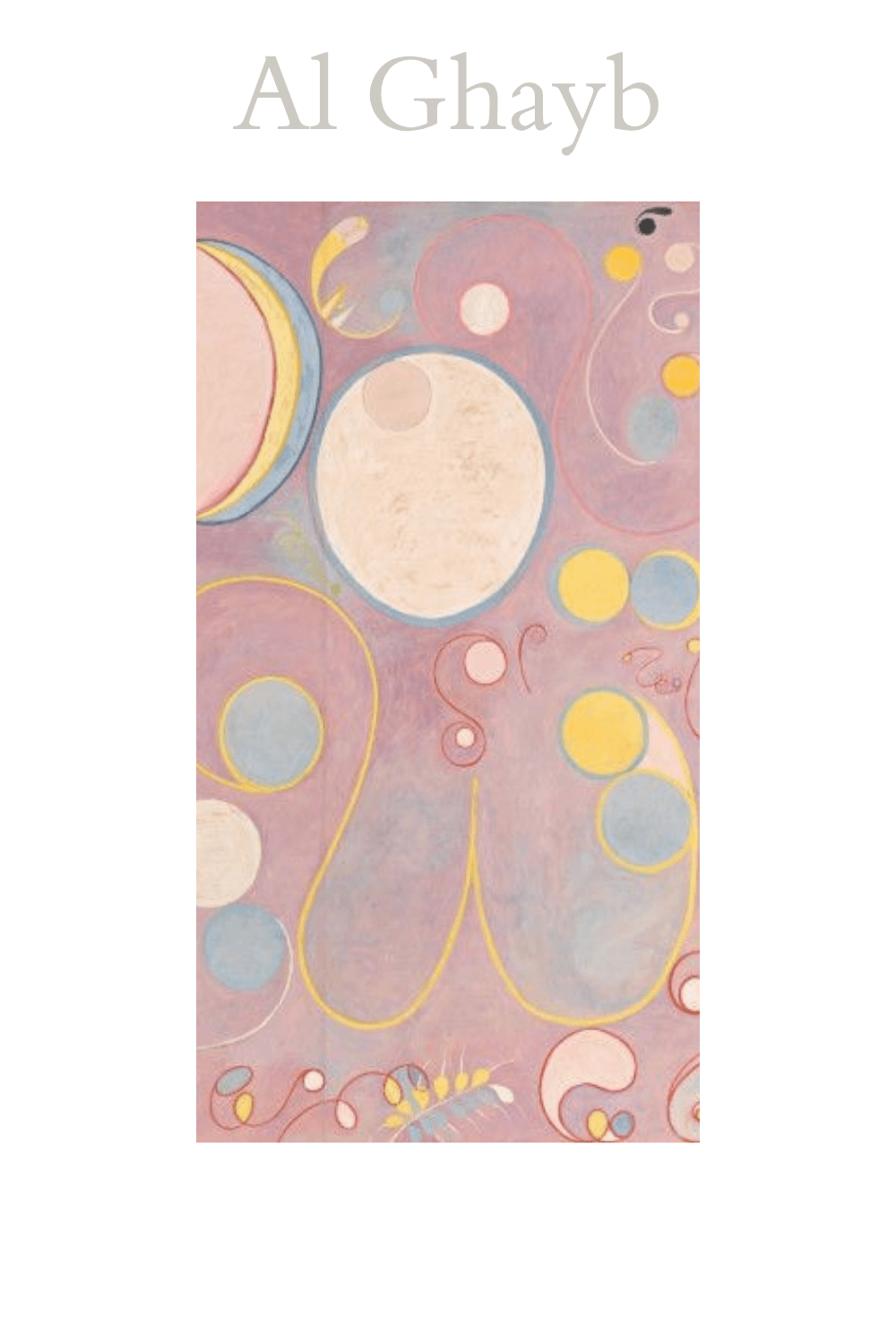
Group IV, No. 8, Adulthood, painted in 1907, is the fourth and final painting in the group devoted to adult life. The series as a whole follows four stages — childhood, youth, adulthood and old age — but the Moderna Museet cautions against reading these simply as biological ages. In Hilma af Klint’s work, the human life cycle is closely connected to mental and spiritual development, and the idea of evolution runs throughout the series. guide.modernamuseet.se
The museum’s interpretation of The Ten Largest also helps us understand what “development” meant within af Klint’s own symbolic world.
A recurring concern was what she called the Dual: apparently opposed principles seeking a form of reconciliation or wholeness. The Moderna Museet notes that the relationship between male and female principles runs through all four stages of life. This should not be understood simply as a romantic union between two people. In the symbolic framework recorded in her notebooks, they function as complementary qualities through which the divided human being moves toward completeness. guide.modernamuseet.se
In the four paintings devoted specifically to adulthood, this symbolic vocabulary develops from one image to the next. Letters, flowers and esoteric references appear across the group, but the museum stresses that there is no single decoding key: the same symbol or combination of letters can carry different meanings according to its context. guide.modernamuseet.se
And in No. 8 — the painting reproduced here — one relationship becomes particularly important.
According to the Moderna Museet, the interplay between blue and yellow is central to this final painting of adulthood. Within af Klint’s symbolic vocabulary, these colours correspond to the female and male principles. Across her wider work, their relationship belongs to a persistent exploration of polarity, development and the possibility of unity. guide.modernamuseet.se
This makes the painting more than an abstract arrangement of circles, loops and colours.
It belongs to an attempt to think visually about maturity: what happens as apparently different principles encounter one another, how development might lead toward greater integration, and how a human life might be understood as something more than physical ageing.
But there is another layer that interests me just as much.
An artwork is never encountered from nowhere.
Hilma af Klint brought one system of reference to these forms. Her notebooks, spiritual practices, Theosophy, ideas about evolution and her own symbolic vocabulary gave blue, yellow, circles, letters and organic forms particular meanings.
The person standing before the painting brings another.
Memory.
Culture.
Faith.
Education.
Images encountered elsewhere.
Ways of recognising form that the artist herself may never have shared.
Looking at No. 8 as a Muslim, I encounter something unexpectedly familiar.
There is something in these forms — and in a painting concerned precisely with maturity, development and the movement toward greater unity — that makes me smile.
I do not need to say what I see.
And, more importantly, I cannot claim that Hilma af Klint intended what my own eye recognises.
The recognition belongs to my gaze, not necessarily to the painting’s original vocabulary.
That distinction is essential.
To acknowledge what an image awakens in us is not the same as rewriting its history. A form can possess one documented meaning within the artist’s intellectual world and, centuries or cultures away, produce another resonance within the person looking at it.
This is why understanding a work of art requires two movements at once.
We can ask:
What did this mean within the world that produced it?
And then:
What happens when it enters mine?
The first question belongs to history.
The second belongs to encounter.
Confusing the two produces projection. Refusing the second altogether would pretend that viewers arrive before artworks without memory, belief or culture.
We do not.
My Muslim frame of reference accompanies me into the museum just as Hilma af Klint’s own frame of reference accompanied her into the studio.
What I recognise does not prove anything about what she intended.
Nor does it grant me access to the unseen.
But it reveals something important about perception itself: we do not only look at objects. We look through systems of meaning.
And sometimes, across radically different systems, a form can feel strangely close.
What that proximity ultimately means is another question.
Allah ﷻ knows best.
Paintings for a Future She Would Not See
There is another reason Hilma af Klint entered the history of art so unusually late. She herself restricted access to much of this work.
In 1932, at the age of seventy, she rewrote her will and stipulated that her paintings, notebooks and drawings should remain inaccessible until twenty years after her death. She died in 1944, leaving behind more than 26,000 pages of writing and some 1,300 paintings.
Twenty years passed, and nothing happened.
The art historian Julia Voss, whose Hilma af Klint: A Biography appeared in German in 2020 and in Anne Posten’s English translation in 2022, describes that decision as a deliberate act of postponement: af Klint sent her life’s work forward in time, out of reach of her contemporaries’ judgement. The reach turned out to be longer than she had planned. Writing in the London Review of Books in 2023, the art historian Jo Applin put the delay plainly:
“In the event, it took more than four decades for it to be seen in public.”
Jo Applin, London Review of Books, 2023.
The decisive moment came in 1986, when the Los Angeles County Museum of Art mounted The Spiritual in Art: Abstract Painting 1890–1985 and hung af Klint alongside Kandinsky, Malevich and Mondrian. Recognition accelerated from there. Between October 2018 and April 2019, the Solomon R. Guggenheim Museum in New York gave its entire rotunda to Hilma af Klint: Paintings for the Future. The art historian Griselda Pollock recorded the outcome: the exhibition broke the museum’s attendance record, drawing some 600,000 visitors and selling 30,000 catalogues.
Why did she want the work withheld? Af Klint appears to have believed that the paintings belonged to a future whose audience would be better prepared to understand them.
But here precision matters.
We know that she postponed access to the work. We know that she thought seriously about its future reception. We know that she understood much of its creation within a spiritual framework.
What we cannot infer from the later success of her paintings is that she somehow knew the future.
History can establish the instruction. It cannot establish supernatural foreknowledge.
That distinction becomes even more important when we look at the world of ideas from which the paintings emerged.
The Invisible World Hilma af Klint Sought
For readers unfamiliar with late nineteenth-century European esoteric movements, two terms need briefly to be explained: Spiritualism and Theosophy.
Spiritualism included the belief that communication with spirits or other non-material beings could occur through practices such as séances and mediumship.
Theosophy, developed around the Theosophical Society founded in 1875, sought a form of universal spiritual knowledge beneath established religions. It combined currents of Western esotericism with interpretations, often distinctly Western interpretations of ideas drawn from Hinduism, Buddhism and other religious traditions.
These movements existed within a period in which science itself was dramatically expanding the limits of human perception. X-rays revealed structures hidden inside the body. Electromagnetic phenomena demonstrated that forces could exist without being visible to the naked eye. Microscopes disclosed worlds contained within worlds.
The visible was becoming less synonymous with the real, and some artists and intellectuals began asking what else might exist beyond ordinary perception.
Hilma af Klint entered this environment deeply. In 1896, she and four other women formed De Fem — The Five. They participated in séances, automatic writing and drawing, and believed themselves to be communicating with spiritual beings they called the “High Masters.”
Af Klint later said that a being she called Amaliel had entrusted her with the task that became The Paintings for the Temple. She described some paintings as having passed through her without preliminary drawing.
One episode in this story is disputed, and the dispute is worth stating rather than smoothing over.
On 30 March 1908, Rudolf Steiner — then head of the German Section of the Theosophical Society, and from 1912 founder of the Anthroposophical Society — lectured in Stockholm. Hilma af Klint met him and showed him part of the Temple cycle. She then painted very little for roughly four years.
Popular accounts treat Steiner’s disapproval as the cause. Others resist that reading. Anne Weise, of the Rudolf Steiner Archive, has argued publicly that the simple sequence — meeting, discouragement, four-year silence — misrepresents a relationship that continued for two decades, and that af Klint was also caring for her mother, who had gone blind, during those same years. Af Klint returned to the cycle in 1912 and spent long periods at the Goetheanum in Dornach between 1921 and 1930.
The honest position is that the causation is contested. Both readings are held by serious people, and the sources do not settle it.
Once again, there are different levels of statement. We can document that Hilma af Klint believed this. Her notebooks survive. Her practices are historically documented. Her symbolic vocabulary can be studied. Her paintings are before us.
What we cannot prove historically is that the entities she described objectively existed, or that they were responsible for her work.
At that point, knowledge stops.
And this is precisely where, for me, the encounter becomes most interesting.
Looking at Western Art Through Muslim Eyes
I was born and raised in the West.
Western art history is therefore not a foreign civilization that I observe from outside. Its museums, paintings, architecture, philosophies and visual references belong to the cultural environment through which I learned to look.
But I am also Muslim.
And Islam gives me another framework through which to understand what can be known, what has been revealed and where the boundaries of human knowledge remain. This creates a position I find intellectually fertile.
I do not need to reject an artistic world because I do not share the belief system from which it emerged. Nor do I need to adopt that belief system in order to understand the art seriously.
I can admire Hilma af Klint’s scale. I can be fascinated by her colours and symbols. I can understand why her chronology disturbs an established history of abstraction. I can study the spiritual environment from which her paintings emerged.
And at the same time, my faith makes another question impossible to avoid:
Who has the authority to tell us what lies beyond the visible?
I encountered a similar kind of crossing between intellectual worlds while visiting Francis Kurkdjian’s Paris exhibition and thinking about perfume as an art that gives material expression to something we cannot see. The question was already there in another form: what happens when a Western contemporary artistic experience encounters a Muslim way of understanding perception, beauty and remembrance?
Hilma af Klint pushes that conversation further. Because now we are no longer speaking only about what cannot be seen. We are speaking about what cannot necessarily be known.
Al-Ghayb in Islam: Believing Without Possessing
Islam does not teach that reality ends where human perception ends.
One of the Qur’an’s earliest descriptions of the believers names it directly:
“…who believe in the unseen, establish prayer, and donate from what We have provided for them.”
Surah Al-Baqarah (2), verse 3 — The Clear Quran, Dr. Mustafa Khattab.
The Arabic word is al-ghayb — الغيب. The unseen. Reality, within an Islamic epistemology, therefore exceeds what can be touched, measured or perceived by the senses.
But the Qur’an places another statement beside this conviction:
“Say, ˹O Prophet,˺ ‘None in the heavens and the earth has knowledge of the unseen except Allah.’”
Surah An-Naml (27), verse 65 — The Clear Quran, Dr. Mustafa Khattab.
The two principles need each other. We believe that the unseen exists. That does not mean we possess it. We acknowledge realities beyond human perception. That does not grant unrestricted access to them.
A third verse completes the structure, and it is the one that carries the whole argument:
“˹He is the˺ Knower of the unseen, disclosing none of it to anyone, except messengers of His choice.”
Surah Al-Jinn (72), verses 26–27 — The Clear Quran, Dr. Mustafa Khattab.
That exception is the entire architecture. Some knowledge of al-ghayb does reach human beings, and it reaches them because God discloses it, through revelation, to those He has chosen. It does not reach them through technique, discipline, trance or intuition. The same logic governs how revelation first reached the Prophet in the cave of Hira: what was given was given, and not obtained.
Islam therefore avoids two very different reductions. It does not reduce reality to what can be empirically observed. But it does not allow every intuition, symbol, dream, vision or spiritual experience to become authoritative knowledge of what lies beyond observation either.
There are things we know. There are things Revelation has taught us. And there are things about which the most intellectually honest answer remains: we do not know.
Two Ways of Looking at a Flower
There is another dimension of Hilma af Klint’s work that makes this encounter particularly fascinating from within an Islamic visual culture: her persistent return to the botanical world.
Nature was not a passing interest. Af Klint had studied plants closely from a young age and produced botanical works before her abstract period. Flowers, seeds, spirals, shells and vegetal structures remained deeply present as her art changed.
But their function changed. The flower ceased to be only something to reproduce. It became something through which to think.
In her symbolic universe, flowers and organic forms could become expressions of life, evolution, polarity or spiritual transformation. She retained rhythms, structures and processes observed in nature and transformed them into another language. Her movement was increasingly from the visible plant toward what she believed existed behind or within its appearance.
Looking at that as a Muslim, I find both a proximity and a profound difference.
Botanical forms have travelled through Islamic visual culture for centuries. Leaves unfold across carved plaster and stone. Vines move through manuscripts. Flowers enter tiles, textiles, carpets and ceramics. Palmettes and scrolling vegetal forms are stylised until nature becomes rhythm. Gardens bring living plants into architecture itself.
Islamic civilizations inherited botanical vocabularies from earlier artistic cultures and continuously transformed them into new regional languages. Not every flower carried a hidden theological code. Not every arabesque was a metaphysical diagram. But nature became one of the great reservoirs from which Islamic artists learned to construct beauty.
In our article How to Read Islamic Architecture, we explored the same movement through geometry, light, gardens, water and the observation of natural order: not art as decoration added to meaning, but form as part of a civilization’s way of seeing.
And here the comparison becomes subtle.
Hilma af Klint could look at a flower and ask what hidden reality might be expressed through it. Islam offers another possible movement: the flower need not conceal a secret code in order to point beyond itself, because its visible existence is already astonishing.
Its growth. Its structure. Its dependence on water. Its symmetry and irregularity. Its colour. Its emergence from something as small as a seed.
The Qur’an continually returns human attention to precisely such visible realities. The created world can be contemplated as āyāt — signs. The thing points beyond itself without claiming to become a map of al-ghayb.
The same flower can therefore participate in two very different intellectual gestures: something to penetrate in search of a hidden reality, or something to contemplate because its visible existence is already a sign.
Colour, Symbol and What We Do Not Yet Know
None of this means colour, proportion, repetition or symbols are neutral.
Human cultures have always understood that colour carries force, association and memory. Scientific research continues to investigate the relationships between colour and human perception, cognition and emotion, and those relationships remain complex rather than reducible to universal formulas.
Islamic culture itself gives us reasons not to treat colour as meaningless. The Qur’an repeatedly includes green within its imagery of Paradise: garments of green silk, green cushions, gardens and flourishing vegetation (Sūrat al-Kahf 18:31; Sūrat al-Insān 76:21; Sūrat ar-Raḥmān 55:76). Over centuries, such imagery inevitably becomes part of a Muslim visual memory.
Hilma af Klint developed her own very different associations between colours, forms and principles. We can study those associations. We can study what colours and forms do perceptually where evidence exists.
What we should avoid is pretending that we already understand every mechanism by which visual forms may act upon human consciousness or, in the opposite direction, transforming what remains unexplained into proof of a hidden metaphysical system.
There is room between certainty and dismissal. That room is where inquiry belongs.
Two Approaches to What Cannot Be Seen
This brings us to what may be the deepest difference, and it is not a difference of form.
An esoteric approach can seek to penetrate what lies behind ordinary appearances and translate a hidden reality into symbols. The artist may understand herself as a mediator. Hilma af Klint’s own account of parts of her practice belongs to that territory.
Islam begins somewhere else. The unseen exists, but the human being does not need to gain private access to al-ghayb for the world to be filled with meaning because what is already visible can point.
Allah ﷻ says:
“Indeed, in the creation of the heavens and the earth and the alternation of the day and night there are signs for people of reason.”
Surah Āl ʿImrān (3), verse 190 — The Clear Quran, Dr. Mustafa Khattab.
Sky. Earth. Night. Day. Water. Growth. The human body. The Qur’an repeatedly asks us to look at what is already here, and calls it evidence enough.
That may appear at first to be a small difference. It is not. Set the two gestures side by side and the distinction becomes structural:
| To unveil | To point | |
|---|---|---|
| Where meaning is located | Behind appearances | In the appearance itself |
| Role of the artist | Mediator — receiving what is transmitted | Witness — attending to what is given |
| Status of the sign | A code to be deciphered | An āyah — a sign that directs attention |
| Claim about knowledge | Access has been obtained | Access has not been obtained |
| What the viewer is asked to do | Decipher | Look again |
Islamic Art and the Art of Pointing
Islamic art is far too vast to be reduced to geometry. Across Muslim civilizations we encounter calligraphy and architecture, figural manuscripts and metalwork, textiles and ceramics, gardens and carved wood, vegetal ornament and regional traditions developed across continents.
Yet many of these artistic forms demonstrate another possible relationship with transcendence.
Consider an Islamic garden. Water flows through stone. Trees create shade. Fruit grows. Fragrance enters the air. All of it belongs completely to this world.
And yet Revelation has already placed gardens, rivers, shade and fruit within the language through which Paradise is described. The earthly garden does not become Jannah. It does not claim to reproduce the unseen. It can become a living act of remembrance.
Consider calligraphy. The material is visible, ink, ceramic, stone, plaster yet matter can carry words of Revelation.
Consider geometry. A finite fragment of a pattern may suggest an order extending beyond the wall that contains it.
Consider light. It does not need a secret meaning to transform a space. It enters, moves, reveals, disappears and returns.
There is no need for the artist to say: I have accessed al-ghayb. The work can make another gesture. It says look. And perhaps more importantly: look again.
Revealing and Reminding Are Not the Same Thing
This may be the question Hilma af Klint ultimately leaves me with.
What is the difference between an image that claims access to the invisible and an image that reminds us that reality extends beyond what the eye can see?
They may sometimes look surprisingly similar. Both may use abstraction. Both may use geometry. Both may use flowers. Both may use colour and repetition. Both may produce an experience that exceeds ordinary representation.
The distinction is therefore not necessarily formal. It is epistemological.
One gesture asks: Can I cross the boundary and reveal what is hidden? Another asks: Can what I already see teach me to remember that my sight has limits?
One seeks to unveil. The other points.
This does not turn Hilma af Klint into a theological verdict. Nor does it make Islamic art the “correct” aesthetic response to hers. That would diminish both.
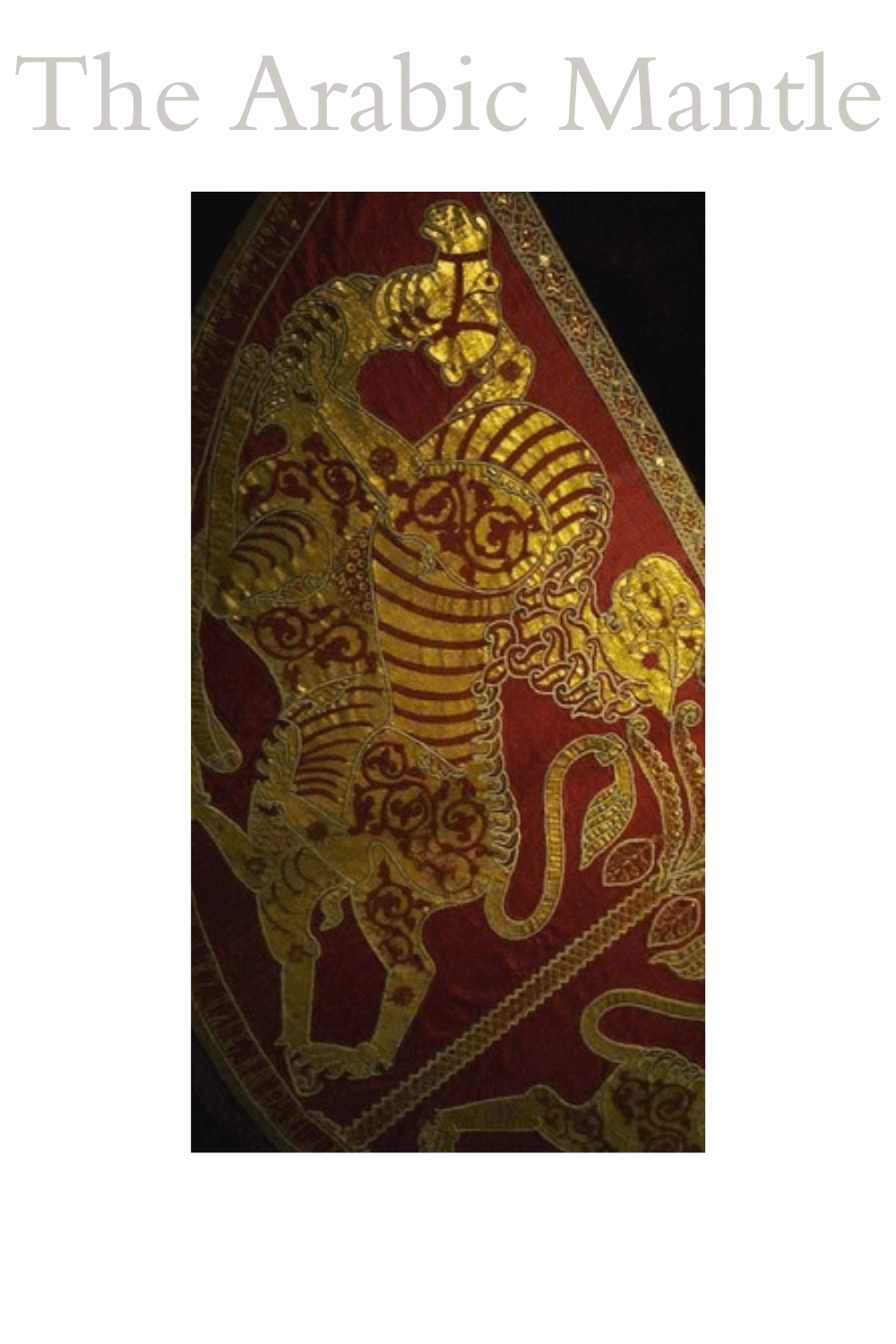
What her work offers instead is the possibility of encountering another worldview seriously enough to understand where it differs from our own. Objects do this too: a mantle embroidered in Palermo and worn at Christian coronations carries two worlds on the same surface without either one dissolving the other.
I can admire without confusing admiration with assent. I can study a symbolic language without accepting every claim behind it. I can inhabit a Western museum without leaving my Muslim epistemology at its door.
Perhaps that is what living between intellectual worlds can make possible, the same work of holding two frameworks at once that runs through living between two calendars.
With Better Eyes
When I leave Hilma af Klint’s work, I do not leave with an answer about the entities she believed guided her.
I do not know. Historical evidence cannot establish it. And Islam does not ask me to manufacture certainty where knowledge has not been given.
What remains is already extraordinary.
A woman who produced radically abstract work at a date that would later complicate the chronology of modernism. An artist who created an elaborate private vocabulary of colours, flowers, letters and geometries. A painter deeply attentive to nature who tried to make visible realities she believed could not ordinarily be seen. A woman who withheld much of that work from her contemporaries and imagined a future audience for it.
And, more than a century later, paintings created from a worldview very different from mine that nevertheless make me ask questions deeply connected to my own.
What can the eye know? What lies beyond it? What authority do we give to a symbol? Where does contemplation end and a claim to knowledge begin?
Perhaps the deepest distinction is not between figurative and abstract art. Nor between Western and Islamic art. It may be between art that seeks to unveil the unseen and art that teaches us how to look at the visible as a sign.
Hilma af Klint wanted painting to make invisible realities visible. Islam asks me to begin from another place. To know that the unseen exists. To recognise the limits of what I have been given to know.
And then to return to what is already before my eyes, the flower, the water, the colour, the sky, the pattern, the human being not as a world emptied of mystery but as one that may still have much to teach us about how to look.
Perhaps art does not always need to show us another world.
Sometimes it changes us simply by returning us to this one with better eyes.
All Qur’anic quotations in this article: The Clear Quran, Dr. Mustafa Khattab.