Ramadan, Appetite, and the Ethics of Restraint
Ramadan fasting is not designed to produce hunger as an end in itself. It is designed to cultivate measure.
In public discourse, Ramadan is often reduced to abstention: no food, no drink, no intimacy from dawn to sunset. Yet the Qur’an defines fasting differently:
“Fasting is prescribed for you as it was prescribed for those before you, so that you may attain Taqwa (God-consciousness).”
Qur’an, Surah Al-Baqara verse 183
The objective is not deprivation.
It is discipline.
Ramadan introduces not merely a change in diet, but a recalibration of proportion, a civilization of measure embedded in daily life.
The question is not what leaves the plate.
The question is what governs the self.
The One-Third Principle: Prophetic Architecture
The Prophet Muhammad ﷺ articulated a principle that remains both spiritually profound and physiologically intelligent:
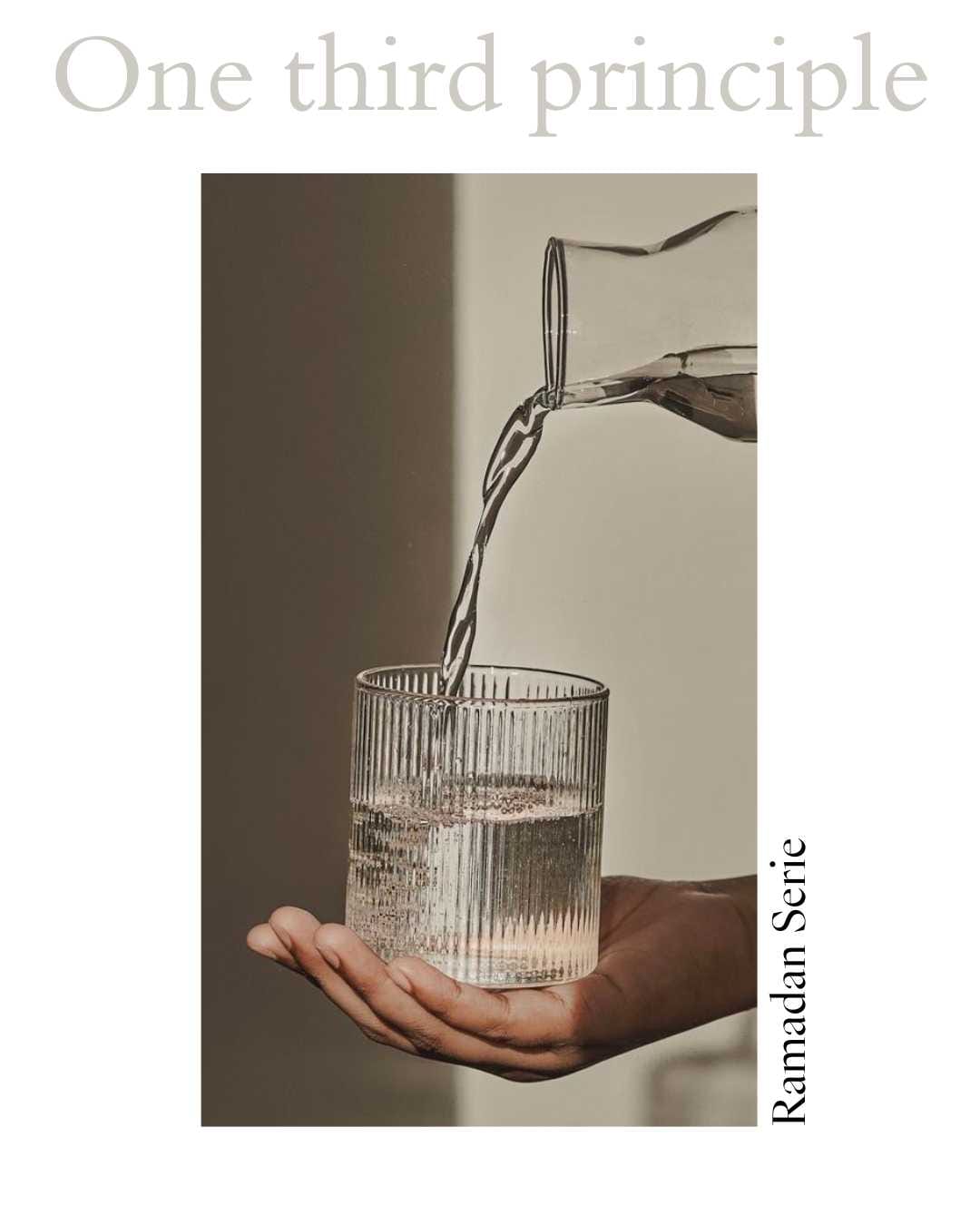
“The son of Adam fills no vessel worse than his stomach. It is sufficient for him to eat a few bites to keep his back straight. But if he must, then one third for food, one third for drink, and one third for breath.”
Tirmidhi
This hadith is not casual dietary advice. It is structural guidance.
The stomach is described as a vessel.
A vessel can be governed or it can govern.
One third for nourishment.
One third for hydration.
One third intentionally left empty.
Space remains.
Ramadan trains that space.
Space for prayer.
Space for clarity.
Space for restraint.
This is not asceticism.
It is proportion.
Ramadan and the Ethics of Appetite
Overeating in Ramadan reveals a paradox.
After hours of fasting, appetite intensifies. The senses awaken. The table shines. Desire expands.
But hunger and desire are not identical.
True hunger is simple.
It is satisfied quickly.
Desire compensates.
It seeks reward.
Often what feels like appetite is accumulated frustration — the impulse to reclaim what was withheld.
Ramadan exposes this difference.
The fast disciplines the body.
The evening tests the ego.
The one-third rule becomes most relevant at the moment of abundance.
Moderation is not denial.
It is governance.
Beauty, Abundance, and the Middle Path
Islam does not oppose beauty.
A generous iftar table.
Hospitality extended to neighbors.
Light in the home.
These are not contradictions of Ramadan.
They are expressions of gratitude, Al hamdoulillah.
Ramadan is a month of illumination. It is natural that homes reflect it.
But Islam is also the religion of the middle path (wasatiyyah).
The issue is not abundance.
It is excess.
Is the meal nourishing — or overwhelming?
Is it shared — or displayed?
Is it consumed — or wasted?
The Qur’an warns:
“Indeed, the wasteful are brothers of the devils.”
(Qur’an 17:27)Qur’an – Surah Al-Isra
Ramadan is the month of Zakat — redistribution and circulation of wealth. The discipline of the plate and the discipline of capital belong to the same moral structure.
A civilization of measure cannot tolerate waste.
The False Sparkle
The Qur’an repeatedly describes worldly life (dunya) as something that dazzles — immediate, attractive, compelling.
Its appeal is visible.
Its depth is limited.
The iftar table can mirror this dynamic.
After restraint, abundance glows. Without pause, one moves from discipline to indulgence in moments.
Ramadan introduces interruption.
What do I truly need?
What strengthens clarity?
What burdens worship?
The impulse that overfills the plate can overfill ambition, ego, schedule.
The discipline of appetite becomes rehearsal for the discipline of life.
Hunger as Clarity
Modern research increasingly recognizes the physiological benefits of controlled fasting — metabolic balance, cognitive sharpness, recalibration of insulin response.
But Islam prescribed fasting over fourteen centuries ago for a deeper reason.
Hunger reduces distraction.
When intake decreases, attention increases.
When distraction decreases, awareness sharpens.
A date tastes sufficient.
Water becomes deliberate.
Absence restores perception.
Ramadan is not anti-food.
It is anti-excess.
Resetting the Relationship with Food
Ramadan can function as recalibration.
Throughout the year, eating often becomes hurried, distracted, and unexamined. Processed food dominates. Sugar overstimulates. Convenience overrides reflection.
Fasting slows the rhythm.
When excess is reduced, taste changes. Just as reducing sugar increases sensitivity to sweetness, fasting increases sensitivity to simplicity.
Natural nourishment feels sufficient.
Moderation feels stable.
The body is an Amanah — a trust.
Health, energy, and clarity are gifts from Allah ﷻ. Ramadan invites stewardship.
Not obsession.
Not aesthetic minimalism.
But intention.
To eat what supports worship.
To avoid what burdens the heart.
To cultivate habits that endure beyond the month.
Ramadan is not starvation.
It is recalibration.
From the Plate to Civilization
The one-third principle is not merely about digestion.
It is about proportion in all domains.
Wealth without excess.
Speech without harm.
Consumption without waste.
Ambition without arrogance.
Ramadan embeds measure into daily life through repetition.
Every sunset becomes an ethical test.
Every plate becomes a mirror.
A civilization of measure begins with small acts repeated consistently.
Ramadan is not about hunger.
It is about proportion.
Food is the first layer.
Beyond it lies discipline.
Beyond discipline lies clarity.
Beyond clarity lies proximity to Allah ﷻ.
If fasting only empties the stomach, it remains incomplete.
If it refines appetite, recalibrates habit, disciplines desire, strengthens worship, and reduces waste — it fulfills its purpose.
The space left for breath is not emptiness.
It is intentional.
And from intention, civilizations are built.
Summary
The one-third principle in Islam, taught by the Prophet Muhammad ﷺ, establishes moderation as a foundational ethic. During Ramadan, fasting is not meant to glorify hunger but to cultivate proportion, discipline, and God-consciousness (Qur’an 2:183). Overeating contradicts the spirit of restraint, while food waste contradicts Qur’anic guidance (Qur’an 17:27). Ramadan functions as a reset — recalibrating appetite, reducing excess, and reinforcing ethical balance in personal and social life. The one-third rule reflects a broader civilizational framework of measure embedded in Islamic teaching.
FAQ
What is “the one third rule” in Islam ?
What is “the one third rule” in Islam ?
The Prophet ﷺ advised that if a person fills their stomach, it should be divided into one third for food, one third for drink, and one third left for breath (Tirmidhi). This teaches moderation and proportion.
Is overeating allowed after fasting in Ramadan?
Is overeating allowed after fasting in Ramadan?
Overeating is not prohibited, but it contradicts the spirit of restraint that fasting aims to cultivate. Ramadan trains moderation, not compensation.
What does Islam say about food waste?
What does Islam say about food waste?
The Qur’an condemns wastefulness explicitly (Qur’an 17:27). Ramadan emphasizes gratitude, moderation, and redistribution.
Can Ramadan improve our relationship with food?
Can Ramadan improve our relationship with food?
Yes. By reducing intake and increasing awareness, Ramadan can reset habits, increase sensitivity to natural nourishment, and encourage long-term moderation.
What is Laylatul Qadr ?
What is Laylatul Qadr ?
“The Night of Decree is better than a thousand months ” meaning that worship performed during this night surpasses the value of a lifetime of ordinary devotion.
On this night, the angels descend by permission of Our lord and its described as peace until the break of dawn..
Laylatul sadr occurs during the last ten nights of ramadan, most likely on one of the odd-numbered nights. it represents an intensification of sacred time at night when destiny, mercy and forgiveness are opened in extraordinary measure.
One night can transform a lifetime.