This object is not poetic by accident.
It is precise by necessity.
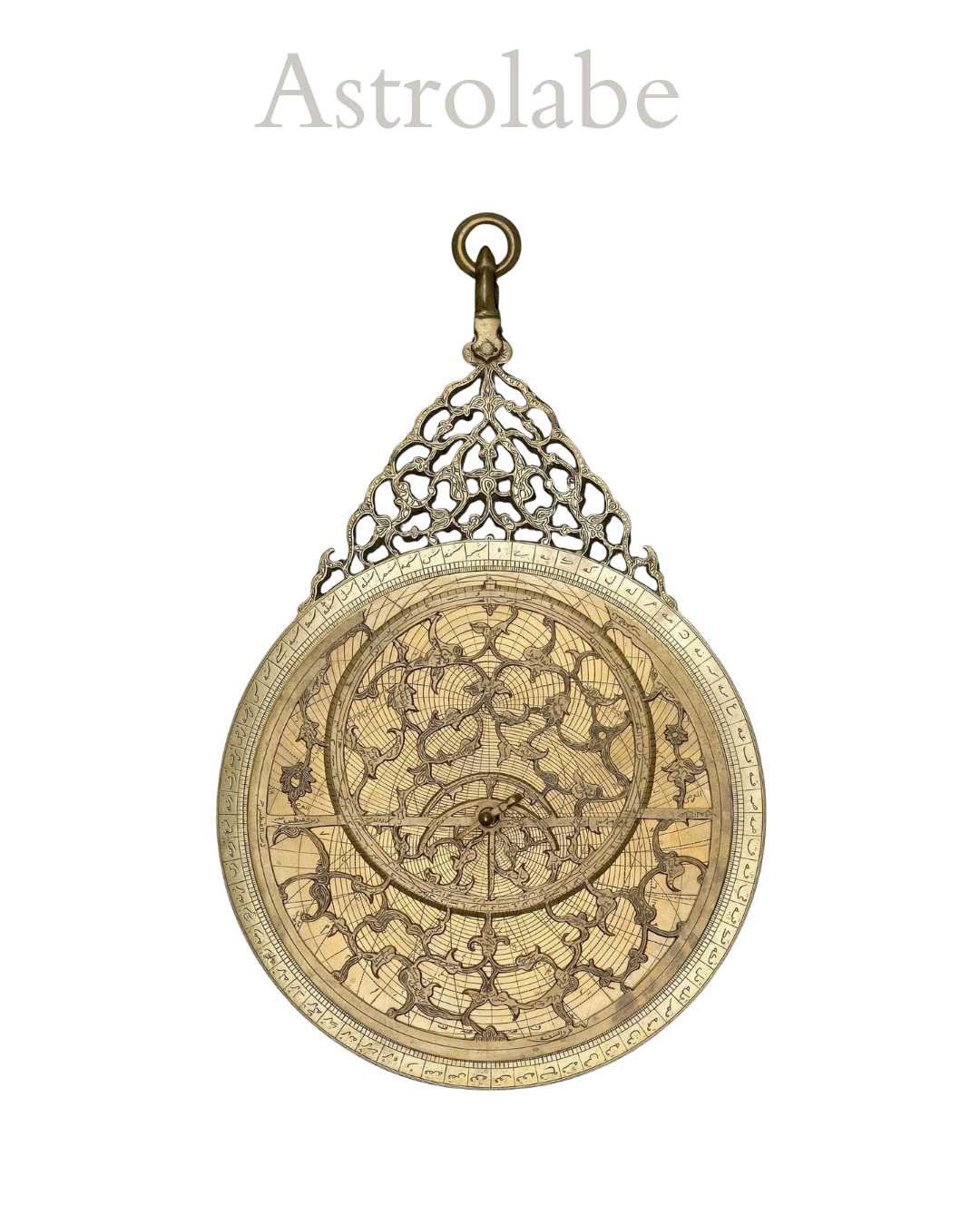
The astrolabe is a scientific instrument developed, refined, and transmitted in the Muslim world to model the heavens with accuracy. It was not conceived as an abstract object of curiosity, but as a functional interface between the sky, the earth, and human responsibility.
It was used to calculate time.
To determine prayer hours.
To locate the Qibla.
To measure the position of stars.
To navigate deserts and seas.
In other words, it answered a simple but demanding question:
How does one live rightly within an ordered universe?
To do so required advanced knowledge of mathematics, geometry, astronomy, and geography — not as isolated disciplines, but as a unified language. The sky was not observed for wonder alone. It was measured so that human action could remain aligned.
This was not anonymous knowledge.
It was built, transmitted, corrected, and improved over generations.
Names matter.
- Muhammad ibn Ibrahim al-Fazari
Among the first Muslim scholars to construct and describe the astrolabe, translating inherited knowledge into a working scientific instrument. - Al-Battani
Corrected astronomical data and refined calculations that would remain authoritative for centuries. - Abd al-Rahman al-Sufi
Produced the most accurate star catalogue of his time, directly informing astrolabe engravings and celestial mapping. - Al-Zarqali (Arzachel)
Invented the universal astrolabe, usable at any latitude — a major scientific breakthrough. - Al-Biruni
Unified astronomy, mathematics, geography, and religious practice into one coherent system.
These figures were not specialists in the modern sense.
They were physicians, jurists, mathematicians, astronomers, and theologians at once.
Specialisation did not fragment knowledge.
It disciplined it.
‘Ilm and the Desire to Understand
In Islam, ‘ilm is not detached from the heart.
The first revelation did not invite belief without understanding.
It invited attention.
To read.
To observe.
To reflect.
The Qur’an repeatedly calls the human being to look closely at creation,
at the movement of the stars,
the alternation of night and day,
the order placed in the heavens and the earth.
This call is not driven by idle curiosity.
It is driven by recognition.
To study the world is to encounter the signs of ALLAH ﷻ.
To understand creation is to deepen awareness of its Origin.
Curiosity, in this tradition, is not a distraction from faith.
It is one of its pathways.
The more precisely the heavens were measured,
the more carefully they were contemplated.
The more their order was understood,
the more their meaning unfolded.
Knowledge did not diminish wonder
it refined it.
Understanding deepened awareness of the One who is
—Al-Awwal and Al-Akhir —
who has always been and will always be, beyond time, which He created.
This is why Islamic science was never cold or detached.
It was attentive.
It was reverent.
To calculate was not to reduce mystery,
but to approach it with humility.
‘Ilm was pursued not to dominate the world,
but to stand correctly within it
with clarity,
with gratitude,
and with a deepening love for the One who placed order in all things.
What the Object Itself Reveals
At the centre of the astrolabe, the rete turns.
It represents the stars.
It moves.
The engraved sky beneath it remains fixed.
This is not decoration.
It reflects a civilisational principle.
Movement belongs to human experience.
Order belongs to the cosmos.
Knowledge, then, is not the power to reshape the universe,
but the ability to position oneself accurately within it.
To measure was not to control.
It was to align.
Precision was an ethical act.
Accuracy was a form of humility.
Why This Still Matters
The astrolabe demonstrates that Muslim civilisation
- produced advanced scientific instruments
- treated knowledge as a unified system, not fragmented disciplines
- connected science to daily life, worship, and responsibility
- understood measurement as orientation, not domination
This is not nostalgia.
It is historical fact.
And it is part of an intellectual legacy that deserves to be known, named, and reclaimed.
Not as pride.
Not as memory.
But as method.